Half-Money, Full Sustainability!
Ganga Prasad Rao
http://myprofile.cos.com/gangar
The media was full of news – of the wrong kind. Food colors and flavors poisoning the young yet growing their brains, muscles, and bones (Kidneys are disposable, aren’t they? Hey,…what are stem cells for!). Plastic bags choking every drain, nook and corner of our commons. Detergents with chemicals so toxic they put nuclear materials to shame. Untreated effluents and solid waste despoiling the rivers and our landscape. Industries, caught in the capitalist ‘more profit’ trap, shunning every social responsibility to fulfil the lifestyle expectations of investors abroad. There was no resolution to the problem despite much talk, reams of paper, twitters, blogs, even U-tube videos. Wasn’t anyone smart enough to find a common denominator across these seemingly disparate issues and design a strategy that addressed them together, simultaneously?
Perhaps the media does affect our sensibilities, for an idealist who swore by Justice and was as ‘blue’ as the median on a straight highway, took up the challenge. Much like the mythical Lord Ram, he stepped up to the ‘Bow Challenge’ after his illustrious competitors had failed at it. He realized he’d have to integrate the conflict between equity and efficiency in to his grand ‘externality’ resolution. He appreciated that the resolution must be built around logic, and further, that in-built incentives and dis-incentives were necessary to guarantee the stability of the system. Further, the involvement of the masses and even entrepreneurs would be necessary for his solution to gain any credibility.
Choosing to depart from the ordinary, the Just Idealist, as he would like to be known (Ego is no sin, or, is it?), declared open membership to, and participation in the ‘Alternate Economy’. He created 3 pots of money, which he christened ‘Equity Half-Money’, EqHM, ‘Efficiency Half-Money’, EfHM and, ExHM, Externality Half-Money. The EqHM pot was the repository of funds meant to stimulate ‘equity’ beyond capitalist consumption. The EfHM, the efficiency analogue of EqHM, served to hold funds meant for investments in firms that enhanced the efficiency of the larger economy. Funds for the EfHM were sourced from Closed-Cycle 2key Bakey, and LT Bonds; the latter being ‘No Diligence’ funds that needed to ensure a ‘Full key’ (a ‘demonstration’ of intentions to be ‘Inefficiency-, Externality- and Inequity Zero’) before entering the Equity markets. The ExHM pot held reserves for firms meant to provide services to correct environmental externalities. The ExHM Money pot was filled by a ‘Green 2key’ plus an ‘Infrastructure Gaskey’. Funds for EqHM were drawn from Gold markets, which were ‘required’ to offer ‘Inequity Utility Compensation’ (and sponsor a ‘Diamond key IPO’) in ‘Equal Opposite’ of those ‘Peace’ firms that had given up and stepped down in Gold Gaskey, short of achieving ‘Diamond’ status. Consistent with the Half-Money Pots, the Just Idealist provided for three types of firms: ‘Equity Services firms’, EqSF, ‘Efficiency Services firms’, EfSF, and ‘Externality Services firms’, ExSF.
Participants in the Alternate Economy, whether a group of individuals, an association, institution, or a firm, that engaged in a pre-approved and pre-announced set of environmentally- and socially-conscious positive acts were issued with uniquely identified ‘Money Points’, and the same was recorded to their credit (not unlike eMoney/MobileMoney). Firms earned Efficiency Points, EfPt and Externality Points, ExPt, in return for providing ‘Efficiency Services’ and ‘Externality Services’ - services not supplied in an Open capitalist economy for want of economic feasibility or regulatory incentives. EfSF firms earned EfPt by engaging in activities as diverse as R&D for more efficient, new technological processes, refining uneconomic non-recyclables, producing environmentally safer, higher quality products, and offering alternative bio-degradable formulations. ExSF firms provided environmental services such as effluent treatment and solid waste management services, for which they were paid in Environmental Points, ExPt. ExSF provided ‘Utility Compensation (UC)’ services and earned Equity Points, EqPt, in return for those services.
To ensure the EfSF and ExSF did not exploit the dedicated money pots, the Just Idealist arranged a ‘See-saw Triangular Balance’ between, on hand, the EqHM-EfHM fund pair and, on the other, the EqHM-ExHM fund pair - the former offering ‘Utility Compensation’, UC, to households to balance the support given to Closed Cycle failures in the equity markets, the burden of which they paid in their purchases. The latter sponsored UE to the masses at large in return for supporting those environmentally imprudent in the equity market. In Boom times, the ExHM sponsored UE to balance the environmental excesses of an overstretched industry even while the EfHM funded Closed-cycle R&D, and cost-cutting technological developments. In Bust, the ExHM funded environmental restoration while the EfHM underwrote UC to households at large. By supporting Closed-Cycle inefficiencies and tolerating environmental excesses in the Real Economy, but providing for compensatory enjoyment, even remedial action in the Alternate Economy, the Just Idealist was able to bring about a quasi-competitive system in which the wrongs of the present were ‘paid for’ as utility compensation in the short run, but corrected physically/economically over the long run.
Individuals or Households earned EqPt in various ways: recycling batteries, motor oil, collecting & depositing ‘un-economic’ plastic and other ‘non-recyclables, buying certified ‘bio-degradable’ goods and certified organic produce, even volunteering in specified citizen/social duties. These Equity points, transferable among members, would serve as the equivalent of free money or tickets, and further, be valid for transacting with participating EqSF businesses/events thru credit/debit cards as well as thru mobile phones. Romantic Getaways, Cruise ship vacations, Concerts, Trekking trips – activities preferred by the youth whose participation was deemed necessary for the success of the program - were offered by EqSF firms, constituted of EqHM debt capital, exclusively to Equity Point holders, in order of declining EqPt balance. However, and to retain or liven up interest and participation among the masses, EqSF firms were permitted to discount EqPt for their services to randomly chosen members using a probability-distribution-based sampling lottery.
With umpteen ways, both consumption-based and by volunteering, to collect EqPt, and as many ways to spend them, an informal price-system developed around them, guiding participants in to optimal consumption choices. In a similar way, the demand for, and supply of various efficiency enhancement and externality abatement services generated transactions that enabled the discovery of implicit shadow value of EfPt and ExPt. The overlap, on one hand, of certain Equity activities with Efficiency activities, and on the other, with Externality activities, permitted the discovery of implicit exchange values between EqPt, EfPt, and ExPt, which in turn enabled the Just Idealist to optimize utility compensation, resource allocation as well as investment and divestment decisions across the entire Alternate Economy.
The funding arrangement for firms constituted of EfHM or ExHM capital explicitly specified that the debt capital be ‘redeemed’ with ‘Whole Money’ – money obtained by pairing Half-moneys of equal value, whether ‘EqPt-EfPt’ or ‘EqPt-ExPt’. Thus paired, ‘Whole Money’ discharged an equal amount of debt on the capital account. He further envisaged that, firms, whether EqSF, EfSF, or ExSF, would have the option to exit the Alternate Economy (or choose to expand with additional debt capital) upon entirely redeeming the debt capital with ‘Whole Money’ capital. For every EfSF or ExSF firm that discharged its debt with Whole Money and graduated in to the Capitalist Economy through an IPO, an EqSF could claim to have paid off its obligations and turn debt-free. The ‘Whole Money’ strategy permitted the Just Idealist to claim that he had indeed brought about a ‘Full key’ resolution to what was ‘tainted money’ - one that would obtain a 3-way balance in the see-saw Alternate Economy, and even gain in the Capitalist Economy.
Enamoured by the prospect of participating in a ‘green’ movement that rewarded participants for their economically and environmentally-conscious choices, even out of turn, the public, particularly the youth, joined in large numbers, providing budding entrepreneurs the consumer base necessary to kickstart their operations. With the availability of easy debt toward the capital for EqSF, EfSF and ExSF, and the opportunity of exploiting a ready market in UC, many entrepreneurs came forward to service the Alternate Economy. The Capitalist Economy and the Alternate Economy served as foils to each other - the former invading upon the latter when environmentally unsustainable, or, less than diligent in its services; the latter encroaching upon the former if they turned monopolistic or inefficient, or tardy in capitalizing on capitalist market opportunities. Between the tug-of-war of the Capitalist-Alternate Economy, and the 3-way see-saw within the Alternate Economy, the markets turned competitive, the society equitable, and the environment sustainable.
As for the ‘Bow Challenge’, the Just Idealist left it to the votes from participants in the Alternate Economy !
Thursday, November 3, 2011
Tuesday, November 1, 2011
'Boursing' My Way to Utopia !
Boursing My Way to Utopia !
Ganga Prasad G. Rao
http://myprofile.cos.com/gangar
….And Alice woke up, all blurry-eyed, not remembering a word of what she had penned while in Wonderland. After staring and blinking a few seconds, she dozed off again in to another dream, this time just as exotic. Yes, something wasvery ‘grotesque’. The entire global financial system was in disarray. Panic ruled the markets.Buffeted between fears of currency crisis, global depression, and sovereign default, the entire financial community was looking for deliverance from their Messiah. But would the Messiah deliver on their pleas?
Call it the Big Lord’s design, Satan’s test of character, or cruel fate, but the Messiah was none other than a half-baked, unemployed albeit worldly-wise Economist, who, oblivious to the utter desperation in the financial community, fancied his hand at putting the world in order, and blog his resolution to the travails of the global markets. And, pray, what was his message? The Messiah accepted the fallacies of the past world, but stood resolute in his vision of the future - a world in which the sins, omissions and commissions of the industry were addressed in an overt, balanced, flexible and comprehensiveway. Rather than focus on any one externality to the exclusion of other significant externalities, the Messiah proposedclubbing them together in to an aggregate measure of firm-level externality. Firms as diverse as power plants burning brown coal, armaments industry overstocking mines, missiles and grenades to sustain employment, mining, refining and shipping, and the pesticide industries preferring environment-damaging inorganic pesticides to safer organic alternatives, could pay off their residual, un-mitigated externality, whether associated with inputs, outputs, transportation, consumption or disposal, in the capital market.
The Messiah’s disciple wondered what theory, principles, or tenets underlay the claim to measure aggregate non-pecuniary externality, and how he would go about extracting it. Perhaps it was telepathy, perhaps the Messiah was in the mood to sermonize; regardless, he chose to reveal his logic. Short of claiming the Garden of Eden as his vision of Sustainability, the Messiah advised that no matter how wrong the world was in the present, it should turn sustainable at some future point in time. And if the roots of the current unsustainability could be traced to the industry, the seeds of sustainability too lay in reforming the industry. Since the equity markets typically operated with limited foresight, the burden of sustainability fell upon the bond market. It was by issuing long bonds to correct wrongs of the past that the Government turned the future sustainable (and financed its budget in the present). Greater the wrong, the more long bonds issued to fund remedial action across years, even decades (Fukushima?, Why does it ring a bell?). Thus, the quantumof, and price variations in the long term bond market gave an indication of the extent of the ‘externality’ outstanding. The Messiah simply ensured a balance between theexternality damages by the industry and the value of outstanding long bonds. It was by perturbing the balance while simulating a firm as a monopoly that he comprehensively gauged the magnitude of its externalities. These externalities were distributed among shares and traded away in a ‘paired-complement’ strategy by creating two externality-differentiated share and bond classes.
Despite his misgivings of correcting externalities by monetary means in an inequitable world (which pre-supposed, among other things, an efficient capital market, in particular a comprehensive Sustainability Index feeding in to Long Bond pricing formula), the Messiah went about his mission methodically. He firstcreated some terminology: an economy was comprised of ‘War Firms’ and ‘Peace Firms’. Firms that truly believed in sustainable production and manufacturing, regardless of how polluting or non-polluting their process was, were assigned the ‘Peace’ label. Hawkish firms that would rather generate excess, short-term profits than go the extra mile for sustainability were deemed ‘War’ firms. To denote the extent of potential gains in various market sections, he coined ‘ungodly’ phrases: ‘2key’, signifying large and immediate, if not ‘excess returns’ (the all too familiar ‘alpha’) as appropriate to the asset class, and ‘gas key’, denoting nominal returns, if at all. In between these extremes, he recognized ‘Bakey’ (residual), ‘Complements’ and ‘Shares’ (and an ‘Ookey’ was short for ‘You should know better’!). These constituted the various fractions of every pot of money no matter which asset class – whether equity, commodity, bond, gold, or realty. The 2key portion rewarded firms for meeting objective measures of achievement; the ‘Gas key’ was essentially a ‘Capital Protection Fund’ that provided funds to alleviate ‘performance deficiencies’in stock market firms if by merely adding volatility to those market sections. (It protected the sponsors’ capital while leveraging the short-term gains of speculators to cause volatility in the equity market). Consistent with the theme of his mission, the Messiah distinguished between ‘Externality Outstanding’, EO equity shares and ‘Externality Internalized’, EI shares.
In the next step, he conceptualized an ‘Externality Quotient’, EQ, acomprehensive externality measure representing the discounted inter-temporal monetary negative,non-pecuniary externalities as normalized by the outstanding equity base of the firm or industry. A pre-market session was designed to elicit the EQ, first for the benchmark ‘EI Equal Frontrunner’ firm (a technological and environmental leader), and then for other firms in the industry/sub-aggregate. After noting the initial ‘equilibrium’ equity and bond prices, the ‘Frontrunner Benchmark’, the Messiah ordered the simulation of each firm by projecting it as a monopoly firm operating at competitive aggregate industry price and output against a designated bundle of long-term bonds of value equal the aggregate equity base of the sector to which the firm belonged. The simulation induced a change in Sustainability indices to the extent the firm’s externalities differed from the Frontrunner Benchmark.The change in the price of the long bond bundle, post simulation, from its benchmark value due changes in the underlying environmental and sustainability indices of the long-bond pricing formula were noted. The projected Gross EQ of the monopoly was simply the change in the value of bonds relative to the ‘Frontrunner Firm’ benchmark. To obtain the net firm EQ, the Gross EQ was re-computed and re-denominated to reflect the firm’s capacity/equity share in the aggregate. That externality estimate was distributed across the utility’s base of equity shares as ‘Sustainability Deficit’, SD. Each SD-tagged equity share now represented a share in the assets and profit stream of the firm, as well as a share in the uncompensated, non-pecuniary externality liability it generated across space and time.
To ensure changes in price of long ‘SD’ bonds indeed measured an externality impact in the pre-open session, the Messiah insisted that a ‘Sustainability Index’, a Divisia index of underlying indicators, factor into LT Bond prices the impact of firm operation on EHS measures in the short, medium and long run. The indicators were chosen to represent various potential and significant damage classes. The sustainability indicators included factors as diverse as air, water and land pollution measures, as well as population, health and social indicators such as maternal and infant mortality, longevity, even violence and terrorism. These measures and indicators were themselves the outputs of underlying scientific, socio-economic and statistical models – measures that had real societal values attached to them but were not priced in to the products and equity shares. The Divisia module, equivalent to a reduced form of an externality costing model, indicated the change in long bond prices for various values of underlying determinants.
The SD-tagged ‘Externality-Outstanding’ (EO) equity share‘entitled’ the firm to generate a certain amount of externality in the course of its business. Every EO-EI share transaction in the equity market released an SD to the bond market where it was bid up or down and priced in to a longbond transaction, again of the same value as the equity transaction. Only upon the cancellation of the Equity SD-ticket in the bond market was an EO equity share converted to ‘Externality-Internalised’ EI share. The Messiah requiredevery ‘EO-EI-SD-ticket’ transaction in the ‘War Zone’ be matched by a ‘Sustainability Complement’ transaction involving a ‘Peace firm’. Thus, 2 SD-tickets were generated simultaneously from the equity market and transferred to the bond market for price-discovery and to sanctify the conversion of Long SD Bonds to SB status.
Anticipating the impracticability of every firm negotiating the bidding of its SD-ticket in the bond market, a recognized haven of the Greens, the Messiah willed a ‘Blue Optimism’ fund and ‘Green Caution fund’. The two funds took opposing positions in the Bond market and competed with other interests in the race to garner as many SD-tickets as possible. The winner - the side which converted all its outstanding SD bonds to SB and prematurely retired the bonds - qualified for a Closed-Cycle IPO 2key; the loser sponsored a ‘De-listing Bakey’. Between them, the bond funds brought about a slow replacement of ‘low dividend yield’ funds with new Closed-cycle ‘growth’ funds that enlivened the market with Growth 2key.
To hasten the transition to an ‘Externality-Internalized’ industry, the Messiah suggested a ‘virtual bifurcation’ of the stock market between the two share classes- EO and EI, the intent being to restrict certain funds and money pots to appropriate share classes.Lest there be a stampede overnight, only the ‘strictly 2key’ money pots – Growth, Opportunity, and Foresight 2keys - were restricted to the EI-section of the market, while the EO section was satisficed with Bakey, Shares, Complements and Gas keys. The Messiah’s ‘bifurcation’ induced promoters and shareholders to churn their shares from EO to EI earlier than they would otherwise, and brought about an early and comprehensive internalization of externalities. This churning of EO shares in to EI shares continued until the entire equity share base turned ‘EI’, and all bonds ‘SB’. At this point, the Messiah deemed the stock market to have ‘soft-landed’ and hailed the birth of an operating, albeit rudimentary, financially closed-cycle economy.
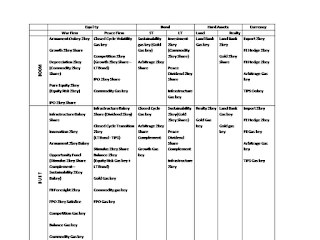
2key: Up to 95%; Share: 40-60%; Complement: 10-40%; Bakey: Residual, Gas key: 0-10% of ‘normal’ returns in asset class.
Now, the traders in the pit, the UPennFund managers on Wall Street,and Chicago Macro-economists pursuing their profession in the rarefied spaces of sky-high towers,alike,were in a tizzy as to how the system would adapt to the various stages of the macro-economic cycle. Once again, they approached the Messiah seeking his distilled essence. The Messiah obliged them, yet again. For each industry group, he used the pre-market session to obtain an estimate of the gross outstanding externality. He instructed the firms take sides – either ‘Peace’ or ‘War’ firms as appropriate to each. He then categorized investible funds in to ‘functional groups’: Growth, Risk Equity, Competition, Sustainable Development, Investment, Innovation, IPO, FPO– to name a few. Finally, lo and behold, the Messiah cranked up his ‘Mensa Economy'.
Boom time it was. Commodity prices spiralled up as the economy hummed and short-term interest rates firmed up. Equity prices, in particular those of ‘War’ and ‘Peace’ EO shares, gained traction. Shareholders in ‘War’ firms were beneficiaries of equity returns that were in consonance with the risk they had borne (Equity Risk 2Key). These firms also reaped rewards from a Commodity 2key Share - a return that supported Capital Retirement if in a Zero-sum with an Investment 2key in Long bonds.Peace firms, however, could only lay claim to a lesser return, a Growth 2key net of any inflation-induced bond impacts (a ‘paired fund’ return maximized by competition, hence Competition 2key). Both ‘War’ and ‘Peace’ firms shared in (own sector) IPO 2key in this phase of the economic cycle.
In the bond market, the Blue Optimism Fund exploited the low bond prices during the equity boom to buyback or exit SD-bonds while converting them to SB status by bidding away SD-tickets available at a discount from the equity market. The buyback enabled the Blue Optimism Fund to prematurely retire bonds, and facilitated the sponsoring of an IPO in the Equity market.
As the Economy peaked and entered the Bust cycle, shareholders in War firms enjoyed the Innovation 2key – a fund meant to support frontier, leading edge research. Both War and Peace firms enjoyed the Bakey returns of an Infrastructure investment fund whose primary gains went to LT Bonds. War firms were also favoured by an FII (Foresight) 2key, meant to pick winners for the early bird investor, andthe FPO 2key Satisfice, a strategic, thinly-disguised Monopoly fund, meant to expand market share by luring investors when most susceptible. These firms also benefited from a ‘paired Opportunity fund’ – a Stimulus 2key net of a Sustainability Bakey. Consistent with the Government’s view, the Opportunity fund ensured any gainaccruing to unsustainable War firms during the Bust period was ephemeral.
The story with ‘Peace Firms’ in Bust was quite different. Having accepted the vision of a sustainable industry, promoters and shareholders relied, on one hand,on the Infrastructure Bakey and a paired ‘Closed-cycle Transition 2key–TIPS’ fund, and on the other, on a paired ‘Balance2key’for equity gains. The Closed Cycle Transition ‘2key’ was essentially long bond returns net of inflation, a 2key maximized by a peaceful and cost-cutting, ‘Full Cost’ competitive economy. The Balance 2key, sourced from Equity Risk remnants (Gas key) and rising Long Bond returns, contributed to returns in this cycle, as did an Infrastructure Bakey camouflaged as Dividend 2key. In Bust, Long bonds attracted an Infrastructure 2key, a Sustainability 2key supported by excess Gold returns (Gold 2key), an Arbitrage 2key from equity and currency markets, and nominally, some Closed Cycle funds to enable aspiring firms to weather the ‘winter’. The Capital Protection Fund, CPF, (a Gold Gas key and a Commodity Gas key) preserved gains from Gold and Commodity markets among Peace firms while sowing the seed for a future 2key return. The Green Caution Fund exercised its option to bid up SD-tickets with the proceeds of its redemption from Long bonds from Peace firms even while investing in them on the equity side of the market.
In the ‘Hard Assets’ category – Land and Realty, the Messiahtrudged the simpler path.A Realty 2key supported Land prices during Bust period, while a Land Bank 2key and a Gold 2key Complement underwrote gains in Realty prices during Boom. A Land Bank gas key supported land assets in Boom, and realty assets in Bust. A Gold gas key added to Volatility in the Realty assets during Bust.
And as far as Currency markets were concerned, the Boom period was characterized by 2keys from Exports, Foreign Exchange Hedge, and FII Hedge pots. In the Bust cycle, currency markets moved with an Import 2key, and Foreign Exchange Hedge key, supplemented by FII gas key and Export gas key. A TIPS fund was distributed in 2key and gas key between the Boom and Bust cycles, albeit with a sting in the tail.
Having discussed threadbare the ideal operation of the stock market, the Messiah, sought to reinforce its utility by mentally simulating a policy goal to eliminate or minimize the Armament industry.He firmly believed that an industry as ‘bad’ and one as close to the government and its secrets as the Armament industry, would survive and proliferate, even if it meant the destruction of nations and their economies. The Messiah’s dilemma was how he would put an end to the scourge that robbed the global citizen of bread on his plate and returns in the market? How would he wind up an industry that had a long record of engendering technical innovations that bolstered the productivity and efficiency of industrially advanced nations, created business opportunities and sustained jobs – the very measures by which the Government and politicians were judged by the electorate? Could he not just give the industry the Christmas week and bull-doze the factories for bread lines come January 1? If the Messiah was no simpleton with child-like innocence camouflaging ignorance, thanks were in order to the Big Lord!
But seriously, the Messiah was aware, that behind the various wars and factional strife, was a coterie of advanced nations and industry barons heavily invested in mining and basic metal firms, in technology supporting those industries, as well as in commodity markets transacting the outputs of those industries. Fact of matter, the Messiah was so wise that he had a downright ‘unholy’suspicion: Could it be that the stakeholders and investors in those industries were forced to resort even to war to recover their investments that had been eroded by the umpteen stock market speculator-day traders? Perhaps Governments that had promised a 100% ‘Total return’ in the capital market to Hard Rock Mining and Basic Metal Industry, HRMBM firms, were obliged to consider novel ways - war and ‘peace-missions’ - to keep them, even if it meant the world was a last few steps away from a WW-III Armageddon?
Fearing the worst, the Messiah came up with a two-pronged ‘Carrot and Stick’ strategy. He decided he would, on one hand, offer the HRMBM industry a reasonable return for the risks they endured by sponsoring a ‘Stimulus 2key’ that stimulated economic demand and raised the standard of living of his followers, and on the other, simultaneously offer the armament industry an incentive to ‘downsize’, an opportunity to innovate in to a ‘non-military’ firm, and an opportunity to generate a ‘peace’ return on its investment while refraining from weapon production. To keep incentives straight, the Messiah exploited differences in intentions and outcomes between the two industries to promote a third party, Agriculture.
To facilitate the realization of the policy goal, the Messiah paired the Armament industry with the HRMBM industry, pitted them against ‘Peace Hawks’ (International Organizations) and Agriculture interests in the Bond market, and initiated equity trading in a ‘bifurcated’ stock market. In the boom-time economy, a Promoter of the Armament ‘War’ firm holding EO shares sought 2keys to realize capital gains, but was denied the same from lack of EI status. Unable to realize capital appreciation, his options were either to lobby and induce foreign policy mis-steps that enabled him to secure armament orders and exploit the Armament 2key, or fold in and submit his shares to the EO-EI conversion program. Sanity and good-will prevailed, and the Armament industry weighed its Externality Quotient in the pre-market session with intention to convert all EO shares to EI status, if eventually. As if walking a balance beam, the promoter sought to optimize, on one hand, the harvesting of 2key returns by releasing as many EO shares to the market as possible without compromising on share price, and on the other, minimize the loss of capital appreciation in the EI side of the Equity market from a delay in offering EO shares to the market. Avoiding the Armament 2key trap, he sold his EO shares to realize a ‘Depreciation2key’ with which to retire Armament production lines. The Buyer was an International Organization that monitored International military relations and managed a Peace Dividend fund. The transaction triggered an ‘SD Complement’ in the ‘Peace zone’ and an SD-ticket in the Bond market. An HRMBM ‘Peace’ firm pounced on the SD Complement and executed a similar trade to realize a ‘Competition 2key’.
Following the equity market transactions, the Bond market announced 2 SD tickets – one each from the Armament firm and the other from the HRMBM firm (both with a floor price supported by the UN/GEF/WWF). The SDs were bid up to different extents by bond market participants. The Armament SD, prized for the large risk to international peace that the industry had caused, was, again, bid away by the Peace Hawk whoapplied ‘Peace Dividend’ funds to buy in to the Bond market (which rose with infusion of the Peace Dividend 2key Share), thus ensuring a presence on both sides of the market. The HRMBM SD, comprised largely of damages to soil and ground water, was of particular interest to NABARD whose mission it was to support agriculture and which had issued agricultural bonds. It bid up the ‘exernality sin’ manifest in the SD tickets and won the right to retire the bonds prematurely when it had ‘redeemed’ sufficient number of SD tickets representing EO shares of value equal outstanding bonds in the market. The NABARD used the proceeds of the prematurely retired bonds to buy in to Land for agricultural use, thus offering a Land 2key to those invested in the asset.
In the Bust cycle, the Armament War firm had many takers for its EO shares. Shareholders had a choice between a Stimulus 2key, Innovation Funds, and Opportunity funds when offloading shares in the market. The Stimulus 2key supported Armament firms to the extent their output served non-military purposes. The Innovation 2key supported strategic research, albeit not necessarily peaceful or ‘Closed cycle’. Thus, the International Organization found it to its advantage to support the Armament firm with an Innovation 2key, and, simultaneously, buy out the SD ticket to consolidate in or exit the Bond Market. The Messiah also offered an Armament 2key, itself a Zero Sum with the Peace Dividend 2key, but only in Bakey, and only to holders of the Armament firm’s EI shares. The strategy restricted capital appreciation and ‘alpha’ to those Armament firms that had substantially converted their share base over to EI status and those that abjured the War route to profits.
The unconverted HRMBM Peace Firm EO shares, besides attracting Stimulus funds, found buyers in Closed Cycle proponents and Balance funds – the former seeking profits from lower cost consequent to enhancing the efficiency of material balances in the firm’s production process, and the latter seeking to profit from correcting the inefficient use of mining and refining capacity for production and stockpiling of arms.
In subsequent cycles, a dominant shareholder in the Armament industry, perhaps a Promoter, secured both the Armament 2key bakey for refraining from Armament production and stockpiling, and a Capital Depreciation/Retirement 2key for his ‘War EO’ shares (The Depreciation 2key was a Zero-Sum with an Investment 2key, both of which were sourced from returns generated in the Commodity market). The Capital Depreciation/Retirement2key was secured from a Peace Dividend Bond foreclosed by bidding away Armament SD-tickets in the bond market (which enabled the Promoter to claim EI status for his shares, a pre-requisite to de-commission an Armament production line or factory). The de-commissioning of Armament factory and/or the reduction in armament stockpile reduced the risk of war, which was an important factor in determining long bond prices. The consequent increase in bond prices was a reward to the Institution sponsoring the Peace Dividend Fund. The churning of the Armament EO to EI shares, induced a similar churn in the HRMBM shares, purchasing the SD-tickets from which enabled NABARD to retire its Agriculture bonds and channel them to purchase land for agricultural use – perhaps a harbinger of a nascent green revolution.
Armament factories outta business, sustained profits for metal and mining industry, a resurgent agriculture sector, an environmentally sustainable industry, and a financially-closed capital market? One would be excused for congratulating the Messiah for showing the path to sustainability, if not salvation. But the Messiah cared not to learn if his followers were ingrates. For, as he trudged his lonely path to the setting sun, he was wise to the nefarious, grand designs of those un-named bent on exploiting the opportunities and loopholes in his proposal and get the better of God in his own paradise (even if it meant a parallel, underground stock market and 8-figure signing bonuses for fresh Ivy League graduates !)
Ganga Prasad G. Rao
http://myprofile.cos.com/gangar
….And Alice woke up, all blurry-eyed, not remembering a word of what she had penned while in Wonderland. After staring and blinking a few seconds, she dozed off again in to another dream, this time just as exotic. Yes, something wasvery ‘grotesque’. The entire global financial system was in disarray. Panic ruled the markets.Buffeted between fears of currency crisis, global depression, and sovereign default, the entire financial community was looking for deliverance from their Messiah. But would the Messiah deliver on their pleas?
Call it the Big Lord’s design, Satan’s test of character, or cruel fate, but the Messiah was none other than a half-baked, unemployed albeit worldly-wise Economist, who, oblivious to the utter desperation in the financial community, fancied his hand at putting the world in order, and blog his resolution to the travails of the global markets. And, pray, what was his message? The Messiah accepted the fallacies of the past world, but stood resolute in his vision of the future - a world in which the sins, omissions and commissions of the industry were addressed in an overt, balanced, flexible and comprehensiveway. Rather than focus on any one externality to the exclusion of other significant externalities, the Messiah proposedclubbing them together in to an aggregate measure of firm-level externality. Firms as diverse as power plants burning brown coal, armaments industry overstocking mines, missiles and grenades to sustain employment, mining, refining and shipping, and the pesticide industries preferring environment-damaging inorganic pesticides to safer organic alternatives, could pay off their residual, un-mitigated externality, whether associated with inputs, outputs, transportation, consumption or disposal, in the capital market.
The Messiah’s disciple wondered what theory, principles, or tenets underlay the claim to measure aggregate non-pecuniary externality, and how he would go about extracting it. Perhaps it was telepathy, perhaps the Messiah was in the mood to sermonize; regardless, he chose to reveal his logic. Short of claiming the Garden of Eden as his vision of Sustainability, the Messiah advised that no matter how wrong the world was in the present, it should turn sustainable at some future point in time. And if the roots of the current unsustainability could be traced to the industry, the seeds of sustainability too lay in reforming the industry. Since the equity markets typically operated with limited foresight, the burden of sustainability fell upon the bond market. It was by issuing long bonds to correct wrongs of the past that the Government turned the future sustainable (and financed its budget in the present). Greater the wrong, the more long bonds issued to fund remedial action across years, even decades (Fukushima?, Why does it ring a bell?). Thus, the quantumof, and price variations in the long term bond market gave an indication of the extent of the ‘externality’ outstanding. The Messiah simply ensured a balance between theexternality damages by the industry and the value of outstanding long bonds. It was by perturbing the balance while simulating a firm as a monopoly that he comprehensively gauged the magnitude of its externalities. These externalities were distributed among shares and traded away in a ‘paired-complement’ strategy by creating two externality-differentiated share and bond classes.
Despite his misgivings of correcting externalities by monetary means in an inequitable world (which pre-supposed, among other things, an efficient capital market, in particular a comprehensive Sustainability Index feeding in to Long Bond pricing formula), the Messiah went about his mission methodically. He firstcreated some terminology: an economy was comprised of ‘War Firms’ and ‘Peace Firms’. Firms that truly believed in sustainable production and manufacturing, regardless of how polluting or non-polluting their process was, were assigned the ‘Peace’ label. Hawkish firms that would rather generate excess, short-term profits than go the extra mile for sustainability were deemed ‘War’ firms. To denote the extent of potential gains in various market sections, he coined ‘ungodly’ phrases: ‘2key’, signifying large and immediate, if not ‘excess returns’ (the all too familiar ‘alpha’) as appropriate to the asset class, and ‘gas key’, denoting nominal returns, if at all. In between these extremes, he recognized ‘Bakey’ (residual), ‘Complements’ and ‘Shares’ (and an ‘Ookey’ was short for ‘You should know better’!). These constituted the various fractions of every pot of money no matter which asset class – whether equity, commodity, bond, gold, or realty. The 2key portion rewarded firms for meeting objective measures of achievement; the ‘Gas key’ was essentially a ‘Capital Protection Fund’ that provided funds to alleviate ‘performance deficiencies’in stock market firms if by merely adding volatility to those market sections. (It protected the sponsors’ capital while leveraging the short-term gains of speculators to cause volatility in the equity market). Consistent with the theme of his mission, the Messiah distinguished between ‘Externality Outstanding’, EO equity shares and ‘Externality Internalized’, EI shares.
In the next step, he conceptualized an ‘Externality Quotient’, EQ, acomprehensive externality measure representing the discounted inter-temporal monetary negative,non-pecuniary externalities as normalized by the outstanding equity base of the firm or industry. A pre-market session was designed to elicit the EQ, first for the benchmark ‘EI Equal Frontrunner’ firm (a technological and environmental leader), and then for other firms in the industry/sub-aggregate. After noting the initial ‘equilibrium’ equity and bond prices, the ‘Frontrunner Benchmark’, the Messiah ordered the simulation of each firm by projecting it as a monopoly firm operating at competitive aggregate industry price and output against a designated bundle of long-term bonds of value equal the aggregate equity base of the sector to which the firm belonged. The simulation induced a change in Sustainability indices to the extent the firm’s externalities differed from the Frontrunner Benchmark.The change in the price of the long bond bundle, post simulation, from its benchmark value due changes in the underlying environmental and sustainability indices of the long-bond pricing formula were noted. The projected Gross EQ of the monopoly was simply the change in the value of bonds relative to the ‘Frontrunner Firm’ benchmark. To obtain the net firm EQ, the Gross EQ was re-computed and re-denominated to reflect the firm’s capacity/equity share in the aggregate. That externality estimate was distributed across the utility’s base of equity shares as ‘Sustainability Deficit’, SD. Each SD-tagged equity share now represented a share in the assets and profit stream of the firm, as well as a share in the uncompensated, non-pecuniary externality liability it generated across space and time.
To ensure changes in price of long ‘SD’ bonds indeed measured an externality impact in the pre-open session, the Messiah insisted that a ‘Sustainability Index’, a Divisia index of underlying indicators, factor into LT Bond prices the impact of firm operation on EHS measures in the short, medium and long run. The indicators were chosen to represent various potential and significant damage classes. The sustainability indicators included factors as diverse as air, water and land pollution measures, as well as population, health and social indicators such as maternal and infant mortality, longevity, even violence and terrorism. These measures and indicators were themselves the outputs of underlying scientific, socio-economic and statistical models – measures that had real societal values attached to them but were not priced in to the products and equity shares. The Divisia module, equivalent to a reduced form of an externality costing model, indicated the change in long bond prices for various values of underlying determinants.
The SD-tagged ‘Externality-Outstanding’ (EO) equity share‘entitled’ the firm to generate a certain amount of externality in the course of its business. Every EO-EI share transaction in the equity market released an SD to the bond market where it was bid up or down and priced in to a longbond transaction, again of the same value as the equity transaction. Only upon the cancellation of the Equity SD-ticket in the bond market was an EO equity share converted to ‘Externality-Internalised’ EI share. The Messiah requiredevery ‘EO-EI-SD-ticket’ transaction in the ‘War Zone’ be matched by a ‘Sustainability Complement’ transaction involving a ‘Peace firm’. Thus, 2 SD-tickets were generated simultaneously from the equity market and transferred to the bond market for price-discovery and to sanctify the conversion of Long SD Bonds to SB status.
Anticipating the impracticability of every firm negotiating the bidding of its SD-ticket in the bond market, a recognized haven of the Greens, the Messiah willed a ‘Blue Optimism’ fund and ‘Green Caution fund’. The two funds took opposing positions in the Bond market and competed with other interests in the race to garner as many SD-tickets as possible. The winner - the side which converted all its outstanding SD bonds to SB and prematurely retired the bonds - qualified for a Closed-Cycle IPO 2key; the loser sponsored a ‘De-listing Bakey’. Between them, the bond funds brought about a slow replacement of ‘low dividend yield’ funds with new Closed-cycle ‘growth’ funds that enlivened the market with Growth 2key.
To hasten the transition to an ‘Externality-Internalized’ industry, the Messiah suggested a ‘virtual bifurcation’ of the stock market between the two share classes- EO and EI, the intent being to restrict certain funds and money pots to appropriate share classes.Lest there be a stampede overnight, only the ‘strictly 2key’ money pots – Growth, Opportunity, and Foresight 2keys - were restricted to the EI-section of the market, while the EO section was satisficed with Bakey, Shares, Complements and Gas keys. The Messiah’s ‘bifurcation’ induced promoters and shareholders to churn their shares from EO to EI earlier than they would otherwise, and brought about an early and comprehensive internalization of externalities. This churning of EO shares in to EI shares continued until the entire equity share base turned ‘EI’, and all bonds ‘SB’. At this point, the Messiah deemed the stock market to have ‘soft-landed’ and hailed the birth of an operating, albeit rudimentary, financially closed-cycle economy.

2key: Up to 95%; Share: 40-60%; Complement: 10-40%; Bakey: Residual, Gas key: 0-10% of ‘normal’ returns in asset class.
Now, the traders in the pit, the UPennFund managers on Wall Street,and Chicago Macro-economists pursuing their profession in the rarefied spaces of sky-high towers,alike,were in a tizzy as to how the system would adapt to the various stages of the macro-economic cycle. Once again, they approached the Messiah seeking his distilled essence. The Messiah obliged them, yet again. For each industry group, he used the pre-market session to obtain an estimate of the gross outstanding externality. He instructed the firms take sides – either ‘Peace’ or ‘War’ firms as appropriate to each. He then categorized investible funds in to ‘functional groups’: Growth, Risk Equity, Competition, Sustainable Development, Investment, Innovation, IPO, FPO– to name a few. Finally, lo and behold, the Messiah cranked up his ‘Mensa Economy'.
Boom time it was. Commodity prices spiralled up as the economy hummed and short-term interest rates firmed up. Equity prices, in particular those of ‘War’ and ‘Peace’ EO shares, gained traction. Shareholders in ‘War’ firms were beneficiaries of equity returns that were in consonance with the risk they had borne (Equity Risk 2Key). These firms also reaped rewards from a Commodity 2key Share - a return that supported Capital Retirement if in a Zero-sum with an Investment 2key in Long bonds.Peace firms, however, could only lay claim to a lesser return, a Growth 2key net of any inflation-induced bond impacts (a ‘paired fund’ return maximized by competition, hence Competition 2key). Both ‘War’ and ‘Peace’ firms shared in (own sector) IPO 2key in this phase of the economic cycle.
In the bond market, the Blue Optimism Fund exploited the low bond prices during the equity boom to buyback or exit SD-bonds while converting them to SB status by bidding away SD-tickets available at a discount from the equity market. The buyback enabled the Blue Optimism Fund to prematurely retire bonds, and facilitated the sponsoring of an IPO in the Equity market.
As the Economy peaked and entered the Bust cycle, shareholders in War firms enjoyed the Innovation 2key – a fund meant to support frontier, leading edge research. Both War and Peace firms enjoyed the Bakey returns of an Infrastructure investment fund whose primary gains went to LT Bonds. War firms were also favoured by an FII (Foresight) 2key, meant to pick winners for the early bird investor, andthe FPO 2key Satisfice, a strategic, thinly-disguised Monopoly fund, meant to expand market share by luring investors when most susceptible. These firms also benefited from a ‘paired Opportunity fund’ – a Stimulus 2key net of a Sustainability Bakey. Consistent with the Government’s view, the Opportunity fund ensured any gainaccruing to unsustainable War firms during the Bust period was ephemeral.
The story with ‘Peace Firms’ in Bust was quite different. Having accepted the vision of a sustainable industry, promoters and shareholders relied, on one hand,on the Infrastructure Bakey and a paired ‘Closed-cycle Transition 2key–TIPS’ fund, and on the other, on a paired ‘Balance2key’for equity gains. The Closed Cycle Transition ‘2key’ was essentially long bond returns net of inflation, a 2key maximized by a peaceful and cost-cutting, ‘Full Cost’ competitive economy. The Balance 2key, sourced from Equity Risk remnants (Gas key) and rising Long Bond returns, contributed to returns in this cycle, as did an Infrastructure Bakey camouflaged as Dividend 2key. In Bust, Long bonds attracted an Infrastructure 2key, a Sustainability 2key supported by excess Gold returns (Gold 2key), an Arbitrage 2key from equity and currency markets, and nominally, some Closed Cycle funds to enable aspiring firms to weather the ‘winter’. The Capital Protection Fund, CPF, (a Gold Gas key and a Commodity Gas key) preserved gains from Gold and Commodity markets among Peace firms while sowing the seed for a future 2key return. The Green Caution Fund exercised its option to bid up SD-tickets with the proceeds of its redemption from Long bonds from Peace firms even while investing in them on the equity side of the market.
In the ‘Hard Assets’ category – Land and Realty, the Messiahtrudged the simpler path.A Realty 2key supported Land prices during Bust period, while a Land Bank 2key and a Gold 2key Complement underwrote gains in Realty prices during Boom. A Land Bank gas key supported land assets in Boom, and realty assets in Bust. A Gold gas key added to Volatility in the Realty assets during Bust.
And as far as Currency markets were concerned, the Boom period was characterized by 2keys from Exports, Foreign Exchange Hedge, and FII Hedge pots. In the Bust cycle, currency markets moved with an Import 2key, and Foreign Exchange Hedge key, supplemented by FII gas key and Export gas key. A TIPS fund was distributed in 2key and gas key between the Boom and Bust cycles, albeit with a sting in the tail.
Having discussed threadbare the ideal operation of the stock market, the Messiah, sought to reinforce its utility by mentally simulating a policy goal to eliminate or minimize the Armament industry.He firmly believed that an industry as ‘bad’ and one as close to the government and its secrets as the Armament industry, would survive and proliferate, even if it meant the destruction of nations and their economies. The Messiah’s dilemma was how he would put an end to the scourge that robbed the global citizen of bread on his plate and returns in the market? How would he wind up an industry that had a long record of engendering technical innovations that bolstered the productivity and efficiency of industrially advanced nations, created business opportunities and sustained jobs – the very measures by which the Government and politicians were judged by the electorate? Could he not just give the industry the Christmas week and bull-doze the factories for bread lines come January 1? If the Messiah was no simpleton with child-like innocence camouflaging ignorance, thanks were in order to the Big Lord!
But seriously, the Messiah was aware, that behind the various wars and factional strife, was a coterie of advanced nations and industry barons heavily invested in mining and basic metal firms, in technology supporting those industries, as well as in commodity markets transacting the outputs of those industries. Fact of matter, the Messiah was so wise that he had a downright ‘unholy’suspicion: Could it be that the stakeholders and investors in those industries were forced to resort even to war to recover their investments that had been eroded by the umpteen stock market speculator-day traders? Perhaps Governments that had promised a 100% ‘Total return’ in the capital market to Hard Rock Mining and Basic Metal Industry, HRMBM firms, were obliged to consider novel ways - war and ‘peace-missions’ - to keep them, even if it meant the world was a last few steps away from a WW-III Armageddon?
Fearing the worst, the Messiah came up with a two-pronged ‘Carrot and Stick’ strategy. He decided he would, on one hand, offer the HRMBM industry a reasonable return for the risks they endured by sponsoring a ‘Stimulus 2key’ that stimulated economic demand and raised the standard of living of his followers, and on the other, simultaneously offer the armament industry an incentive to ‘downsize’, an opportunity to innovate in to a ‘non-military’ firm, and an opportunity to generate a ‘peace’ return on its investment while refraining from weapon production. To keep incentives straight, the Messiah exploited differences in intentions and outcomes between the two industries to promote a third party, Agriculture.
To facilitate the realization of the policy goal, the Messiah paired the Armament industry with the HRMBM industry, pitted them against ‘Peace Hawks’ (International Organizations) and Agriculture interests in the Bond market, and initiated equity trading in a ‘bifurcated’ stock market. In the boom-time economy, a Promoter of the Armament ‘War’ firm holding EO shares sought 2keys to realize capital gains, but was denied the same from lack of EI status. Unable to realize capital appreciation, his options were either to lobby and induce foreign policy mis-steps that enabled him to secure armament orders and exploit the Armament 2key, or fold in and submit his shares to the EO-EI conversion program. Sanity and good-will prevailed, and the Armament industry weighed its Externality Quotient in the pre-market session with intention to convert all EO shares to EI status, if eventually. As if walking a balance beam, the promoter sought to optimize, on one hand, the harvesting of 2key returns by releasing as many EO shares to the market as possible without compromising on share price, and on the other, minimize the loss of capital appreciation in the EI side of the Equity market from a delay in offering EO shares to the market. Avoiding the Armament 2key trap, he sold his EO shares to realize a ‘Depreciation2key’ with which to retire Armament production lines. The Buyer was an International Organization that monitored International military relations and managed a Peace Dividend fund. The transaction triggered an ‘SD Complement’ in the ‘Peace zone’ and an SD-ticket in the Bond market. An HRMBM ‘Peace’ firm pounced on the SD Complement and executed a similar trade to realize a ‘Competition 2key’.
Following the equity market transactions, the Bond market announced 2 SD tickets – one each from the Armament firm and the other from the HRMBM firm (both with a floor price supported by the UN/GEF/WWF). The SDs were bid up to different extents by bond market participants. The Armament SD, prized for the large risk to international peace that the industry had caused, was, again, bid away by the Peace Hawk whoapplied ‘Peace Dividend’ funds to buy in to the Bond market (which rose with infusion of the Peace Dividend 2key Share), thus ensuring a presence on both sides of the market. The HRMBM SD, comprised largely of damages to soil and ground water, was of particular interest to NABARD whose mission it was to support agriculture and which had issued agricultural bonds. It bid up the ‘exernality sin’ manifest in the SD tickets and won the right to retire the bonds prematurely when it had ‘redeemed’ sufficient number of SD tickets representing EO shares of value equal outstanding bonds in the market. The NABARD used the proceeds of the prematurely retired bonds to buy in to Land for agricultural use, thus offering a Land 2key to those invested in the asset.
In the Bust cycle, the Armament War firm had many takers for its EO shares. Shareholders had a choice between a Stimulus 2key, Innovation Funds, and Opportunity funds when offloading shares in the market. The Stimulus 2key supported Armament firms to the extent their output served non-military purposes. The Innovation 2key supported strategic research, albeit not necessarily peaceful or ‘Closed cycle’. Thus, the International Organization found it to its advantage to support the Armament firm with an Innovation 2key, and, simultaneously, buy out the SD ticket to consolidate in or exit the Bond Market. The Messiah also offered an Armament 2key, itself a Zero Sum with the Peace Dividend 2key, but only in Bakey, and only to holders of the Armament firm’s EI shares. The strategy restricted capital appreciation and ‘alpha’ to those Armament firms that had substantially converted their share base over to EI status and those that abjured the War route to profits.
The unconverted HRMBM Peace Firm EO shares, besides attracting Stimulus funds, found buyers in Closed Cycle proponents and Balance funds – the former seeking profits from lower cost consequent to enhancing the efficiency of material balances in the firm’s production process, and the latter seeking to profit from correcting the inefficient use of mining and refining capacity for production and stockpiling of arms.
In subsequent cycles, a dominant shareholder in the Armament industry, perhaps a Promoter, secured both the Armament 2key bakey for refraining from Armament production and stockpiling, and a Capital Depreciation/Retirement 2key for his ‘War EO’ shares (The Depreciation 2key was a Zero-Sum with an Investment 2key, both of which were sourced from returns generated in the Commodity market). The Capital Depreciation/Retirement2key was secured from a Peace Dividend Bond foreclosed by bidding away Armament SD-tickets in the bond market (which enabled the Promoter to claim EI status for his shares, a pre-requisite to de-commission an Armament production line or factory). The de-commissioning of Armament factory and/or the reduction in armament stockpile reduced the risk of war, which was an important factor in determining long bond prices. The consequent increase in bond prices was a reward to the Institution sponsoring the Peace Dividend Fund. The churning of the Armament EO to EI shares, induced a similar churn in the HRMBM shares, purchasing the SD-tickets from which enabled NABARD to retire its Agriculture bonds and channel them to purchase land for agricultural use – perhaps a harbinger of a nascent green revolution.
Armament factories outta business, sustained profits for metal and mining industry, a resurgent agriculture sector, an environmentally sustainable industry, and a financially-closed capital market? One would be excused for congratulating the Messiah for showing the path to sustainability, if not salvation. But the Messiah cared not to learn if his followers were ingrates. For, as he trudged his lonely path to the setting sun, he was wise to the nefarious, grand designs of those un-named bent on exploiting the opportunities and loopholes in his proposal and get the better of God in his own paradise (even if it meant a parallel, underground stock market and 8-figure signing bonuses for fresh Ivy League graduates !)


Tuesday, October 25, 2011
Luck, Be a Lady Tonight !
Luck, Be a Lady Tonight !
Ganga Prasad G. Rao
http://myprofile.cos.com/gangar
‘Twas approaching midnight hour, Christmas eve. A lonely truck, probably carrying frozen turkeys from Thanksgiving, snaked its way through the mountain side. The road was tortuous, even dangerous. An entire mass of snow lay directly overhead the road. As he drove through the valley, the driver’s heartbeat quickened and his eyes turned wider from years of driving experience. He hoped the rattle of his pre-CAA era 6-wheeler would not disturb the peace of the snowflakes lying deep in the snow and ice-mass. He heaved a sigh of relief after negotiatingthe perilous section of the road. Avalanches were not unheard of in these parts. Unknown to him, a draft of relatively warm wind,swepta speck of soot from his exhaust pipe and carried it upslope. As it rose along the mountain side, it was engulfed by a larger mass of air, in fact one in the mood to …Snow! Ice crystals coalesced around the soot particle and it came down upon the bulging, almost heaving mass of snow on the steep sides of the mountain…..
…..A couple hundred feet below, Fred and Tom, automobile engineers by profession, but self-proclaimed environmental engineers in spare time, had just finished tightening the screws on a cylindrical, ceramic-lined contraption in their garage. From the looks of it, it was meant to be attached to the exhaust line of freight trucks. Apparently, the engineers, who happened to wear Santa Green caps, were nastily angry with freight vehicles farting cancerous diesel soot in to the lungs of their young ones. After much thought, and, ‘trial and error’, they came up with their yet-to-be patented ‘Golf Snowball Kart Apparatus’. The Golf Snowball Kart was meant to fit in to the exhaust system of diesel road freight vehicles. It was in essence a ceramic-lined cylinder containing innumerable pea-sized carbon-spherules that were continuously ‘wetted’ by a fine spray of a surface adhesive dissolved in a volatile organic fluid. The spray served to capture soot contained in the flow of exhaust gases through the cylinder on to the surface of the spherules. As the truck engine started,the cylinder rotated on its long axis, and the carbon spherules picked up soot from the exhaust flow and gained size while falling repeatedly over the sides of the rotating cylinder. When they turned the size of a golf-ball, a size-filter pushed these ‘heavy-weights’ up the duct in to a secured compartment for physical retrieval at truck stops. Fresh spherules entered the cylinder to maintain surface area requirements. The process was continuous and counter-current and automated, requiring no driver handling or supervision.
If there was a tinge of pride and ego in the engineers, it was all too pardonable. For they had, sophistication be damned, developed a reasonable means of achieving control of cancerous diesel soot from road freight vehicles. As they raised beer mugs to cherish their daughters’ health, talk meandered from how their ‘retrofit’ could bring about control of soot from freight vehicles worldwide and even be part of a global environmental strategy. The banter led, predictably and inexorably, to the ‘dyed-in-yellow, scum of the earth’ environmental economists, who for all their ‘expertise’, had permitted the Global warming conspiracy to escalate and spread its sooty tentacles to the Arctic and the Antarctic. Surely, Environmental Engineers could put one over their Economics cousins?
With that thought, and in to their fourth mug of the evening, Fred challenged Tom to try his hand at environmental policy. Not yet appreciating the potential of their invention, Tom casually suggested a ‘Give and take, 2-way Street’ deal. “A 2 way deal? Fill me in. Our Senator is sorta friend of my in-law; he could pull strings for us in the corridors of power” guffawed Fred. Tom was not known to be greedy, garrulous or, for that matter, romantically-inclined, but four mugs of beer can work magic. Besides, opportunity knocks but once.Luck, be a lady tonight!
A stranger sight was never beheld in Small Town, Frigida. Tom, his mug of beer in hand yet dirty with grease, invoked all the intelligence bequeath to him by his forefathers, and began lecturing with his pointer at the garage drawing board choc-a-bloc with engineering math and drawings of the ‘Golf-Kart Snowball’ apparatus. He expanded on how the Government would offer a ‘hand-sheikh’ deal to the OPEC Sheikhs – a deal in which the current EV mandate, requiring a phased introduction of EV automobiles, would extend to future years and even enlarge, but at an ‘endogenous’ pace – a pace determined by the Sheikh’s willingness to curb soot from diesel-fuelled freight trucks. Why, Tom even put up a simple relation that the Sheikh would have to contend with:
%EVSHAREt = αt -β*(PAHTONS/ARTM)t-1
where, at any time, t,%EVSHARE represented the mandatory fraction that EVs must constitute in new automobiles sales, PAHTONS the aggregate tons of PAH Golf Snow balls collected from Golf-Kart ‘bins’ ("$ Saaantaaa $"), and RTM, the Aggregate Road Ton-miles from all trucks - Golf-Kart, or otherwise.Not immediately anticipating the line of Tom’s argument - even beer is alcoholic after the fourth mug – Fred wondered what the incentives were, and who would fund the conversion of an entire fleet of dirty diesel trucks.
Tom explained the expression was merely a quantitative relation within a larger, if implicit ‘Zero-Sum’ strategy, between automobile gasoline demand and freight diesel fuel demand. Essentially, the Government would offer the Sheikhs some ‘rope’ in the form of slower EV penetration in return for the capture of diesel soot from freight trucks (Privately though, Tom wondered whether the EVs were re-charged on ‘dirty power’… and Fred feared that an American Consortium had won the right to creating and maintaining the Arctic Northern Shipping Passage!). The curtailment of diesel exhaust from retrofitted freight trucks would bring about a reduction in air pollution mortality and an increase in longevity of its citizens. To get the deal going, ‘Obama the Just’, would offer a ‘sweetener’ to the Sheikhs in the form of Lithium Commodity Fund Units, LCFUs, (lithium being the ‘heartbeat’ of EVs) which represented a convenient way of participating in the rise of EVs in the automobile space, as compensation for the unilateral incursion in to the Gasoline market. Anxious to arrest the CO2 trend before it melted the thick ice over the Antarctic rocks and exposed them to the mercy of Canadian Juniors, the UNEP too would pitch in with Certified Emissions Reductions, CERs, in amount equal to the tons CO2 avoided annually from the switch to EVs – a switch the pace of which the Sheikh would decide himself.
The Sheikh could remain invested, switch or redeem LCFUs and the CERs, the proceeds from which could be applied either to retrofit trucks with the ‘Snowball Golf Kart’ apparatus, and/or to exclusively discount diesel to retrofittedfreight trucks. In effect, the Sheikh, arguably the most powerful ‘supply persona’, was offered the opportunity to control fuel demand as well, albeit in a manner compatible with the goals of the Government and the UNEP. He could now influence incremental gasoline demand by determining the extent of EV penetration in to the auto market, while controlling freight fuel demand both by offering discounts on road diesel to ‘Golf-Kart’ equipped trucks,and by underwriting the retrofitting of ‘Golf Snowball -Kart’ equipment to freight trucks.
“Have the Sheikhs decide their own fate? Yup, Sounds interesting….and practical!.....“I am all ears”. Tom, ever so sensitive to exploitation, mumbled to himself “Luck, Be a lady tonight, …. Twice over”,before continuing with his exposition.
As Tom imagined, the Sheikh would optimize profits from both gasoline and diesel markets, depending on current and perceived direction of prices in those markets, the state of the economy, and the economics of freight haulage. He would also move dynamically between CER and LCFU units anticipating price movements due changes in stage of economic expansion, the fraction of automobile fleet constituted by EVs – both presently and prospectively, and the intensity of their use – a function of the price of power recharge. Aware the EVs would otherwise encroach deeper in to his traditional stronghold in automobile gasoline market, the Sheikh would perforce seek PAHTONS by applying theLCFU/CER redemption proceeds to a Golf Snowball Retrofit program while concomitantly offering a diesel discount to induce the preferential use of retrofitted trucks.
Tom was indeed making sense. Sensing Santa in the neighbourhood, Fred pushed another mug toward Tom. As he picked his fifth mug of beer, Tom thought wistfully….If only they came this easy….
Quickly back to his senses, Tom envisaged, that in bust times, the Sheikh would prefer the ‘benching’ the dirty truck fleet, and apply CER/LCFU proceeds to retrofit them with ‘Golf-Kart-Snowball’ apparatus. Diesel discounts, if any, would be largely limited to retrofitted freight trucks plying along the rail network (the discounts being necessary as much for the Sheikh to capture soot and restrain EV growth as it was for the truck haulers to compete with Rail freight priced to ensure full utilization of its physical network in poor economic times). In boom times, the Sheikh would cash out, first from the zooming Lithium market and next from the booming CER market. The proceeds would be applied to fund a fuel discount program for retrofitted trucks at the expense of the retrofitting program, thus obtaining large reductions in diesel soot necessary to limit EV penetration in the ensuing period.

2:22am! Hmm, Time to wind up the talk, but first a final gulp. Surprised at how good a policy it turned out to be, an animated Tom explained how the incentive, on one hand, to bench and retrofit dirty trucks, and, on the other, to ply them with discounted diesel in preference over dirty trucks served as instruments for the Sheikh to tweak the environmental performance of the road freight sector, and the means to manage the product mix from his refineries. He cautioned that the rate of EV penetration would vary period to period, and from Boom to Bust - sometimes up, sometimes down, but at all times minimizing the combined impact of GHG emissions and diesel soot – an outcome agreeable to the Government and the UNEP. And as the Sheikh danced the ‘dynamic equilibrium’ in the CER, LCFU, EV and Freight markets, the truck fleet turned cleaner, a lot cleaner….and citizens breathed fuller and healthier. And the Golf balls? Tom would rather the Environmental Administration arranged to collect and verify them for accuracy, and dispose the same in scrubber-equipped thermal power plants, if admixed with an oxygen-rich combustion enhancer.
Fred stared,still reeling from Tom’s genius,and wondered if it would all work the way he foresaw it. In that instant,he heard adistant rumble and the ground shook under them. The wind whistled and whooshed at their garage doors and windows. Fearing an avalanche, the two opened the door gingerly to take a peek. And just as they heaved a sigh of relief and were to close the door, a gust of snow billowed in and filled their empty mugs on the table!
Merry Christmas!
Ganga Prasad G. Rao
http://myprofile.cos.com/gangar
‘Twas approaching midnight hour, Christmas eve. A lonely truck, probably carrying frozen turkeys from Thanksgiving, snaked its way through the mountain side. The road was tortuous, even dangerous. An entire mass of snow lay directly overhead the road. As he drove through the valley, the driver’s heartbeat quickened and his eyes turned wider from years of driving experience. He hoped the rattle of his pre-CAA era 6-wheeler would not disturb the peace of the snowflakes lying deep in the snow and ice-mass. He heaved a sigh of relief after negotiatingthe perilous section of the road. Avalanches were not unheard of in these parts. Unknown to him, a draft of relatively warm wind,swepta speck of soot from his exhaust pipe and carried it upslope. As it rose along the mountain side, it was engulfed by a larger mass of air, in fact one in the mood to …Snow! Ice crystals coalesced around the soot particle and it came down upon the bulging, almost heaving mass of snow on the steep sides of the mountain…..
…..A couple hundred feet below, Fred and Tom, automobile engineers by profession, but self-proclaimed environmental engineers in spare time, had just finished tightening the screws on a cylindrical, ceramic-lined contraption in their garage. From the looks of it, it was meant to be attached to the exhaust line of freight trucks. Apparently, the engineers, who happened to wear Santa Green caps, were nastily angry with freight vehicles farting cancerous diesel soot in to the lungs of their young ones. After much thought, and, ‘trial and error’, they came up with their yet-to-be patented ‘Golf Snowball Kart Apparatus’. The Golf Snowball Kart was meant to fit in to the exhaust system of diesel road freight vehicles. It was in essence a ceramic-lined cylinder containing innumerable pea-sized carbon-spherules that were continuously ‘wetted’ by a fine spray of a surface adhesive dissolved in a volatile organic fluid. The spray served to capture soot contained in the flow of exhaust gases through the cylinder on to the surface of the spherules. As the truck engine started,the cylinder rotated on its long axis, and the carbon spherules picked up soot from the exhaust flow and gained size while falling repeatedly over the sides of the rotating cylinder. When they turned the size of a golf-ball, a size-filter pushed these ‘heavy-weights’ up the duct in to a secured compartment for physical retrieval at truck stops. Fresh spherules entered the cylinder to maintain surface area requirements. The process was continuous and counter-current and automated, requiring no driver handling or supervision.
If there was a tinge of pride and ego in the engineers, it was all too pardonable. For they had, sophistication be damned, developed a reasonable means of achieving control of cancerous diesel soot from road freight vehicles. As they raised beer mugs to cherish their daughters’ health, talk meandered from how their ‘retrofit’ could bring about control of soot from freight vehicles worldwide and even be part of a global environmental strategy. The banter led, predictably and inexorably, to the ‘dyed-in-yellow, scum of the earth’ environmental economists, who for all their ‘expertise’, had permitted the Global warming conspiracy to escalate and spread its sooty tentacles to the Arctic and the Antarctic. Surely, Environmental Engineers could put one over their Economics cousins?
With that thought, and in to their fourth mug of the evening, Fred challenged Tom to try his hand at environmental policy. Not yet appreciating the potential of their invention, Tom casually suggested a ‘Give and take, 2-way Street’ deal. “A 2 way deal? Fill me in. Our Senator is sorta friend of my in-law; he could pull strings for us in the corridors of power” guffawed Fred. Tom was not known to be greedy, garrulous or, for that matter, romantically-inclined, but four mugs of beer can work magic. Besides, opportunity knocks but once.Luck, be a lady tonight!
A stranger sight was never beheld in Small Town, Frigida. Tom, his mug of beer in hand yet dirty with grease, invoked all the intelligence bequeath to him by his forefathers, and began lecturing with his pointer at the garage drawing board choc-a-bloc with engineering math and drawings of the ‘Golf-Kart Snowball’ apparatus. He expanded on how the Government would offer a ‘hand-sheikh’ deal to the OPEC Sheikhs – a deal in which the current EV mandate, requiring a phased introduction of EV automobiles, would extend to future years and even enlarge, but at an ‘endogenous’ pace – a pace determined by the Sheikh’s willingness to curb soot from diesel-fuelled freight trucks. Why, Tom even put up a simple relation that the Sheikh would have to contend with:
%EVSHAREt = αt -β*(PAHTONS/ARTM)t-1
where, at any time, t,%EVSHARE represented the mandatory fraction that EVs must constitute in new automobiles sales, PAHTONS the aggregate tons of PAH Golf Snow balls collected from Golf-Kart ‘bins’ ("$ Saaantaaa $"), and RTM, the Aggregate Road Ton-miles from all trucks - Golf-Kart, or otherwise.Not immediately anticipating the line of Tom’s argument - even beer is alcoholic after the fourth mug – Fred wondered what the incentives were, and who would fund the conversion of an entire fleet of dirty diesel trucks.
Tom explained the expression was merely a quantitative relation within a larger, if implicit ‘Zero-Sum’ strategy, between automobile gasoline demand and freight diesel fuel demand. Essentially, the Government would offer the Sheikhs some ‘rope’ in the form of slower EV penetration in return for the capture of diesel soot from freight trucks (Privately though, Tom wondered whether the EVs were re-charged on ‘dirty power’… and Fred feared that an American Consortium had won the right to creating and maintaining the Arctic Northern Shipping Passage!). The curtailment of diesel exhaust from retrofitted freight trucks would bring about a reduction in air pollution mortality and an increase in longevity of its citizens. To get the deal going, ‘Obama the Just’, would offer a ‘sweetener’ to the Sheikhs in the form of Lithium Commodity Fund Units, LCFUs, (lithium being the ‘heartbeat’ of EVs) which represented a convenient way of participating in the rise of EVs in the automobile space, as compensation for the unilateral incursion in to the Gasoline market. Anxious to arrest the CO2 trend before it melted the thick ice over the Antarctic rocks and exposed them to the mercy of Canadian Juniors, the UNEP too would pitch in with Certified Emissions Reductions, CERs, in amount equal to the tons CO2 avoided annually from the switch to EVs – a switch the pace of which the Sheikh would decide himself.
The Sheikh could remain invested, switch or redeem LCFUs and the CERs, the proceeds from which could be applied either to retrofit trucks with the ‘Snowball Golf Kart’ apparatus, and/or to exclusively discount diesel to retrofittedfreight trucks. In effect, the Sheikh, arguably the most powerful ‘supply persona’, was offered the opportunity to control fuel demand as well, albeit in a manner compatible with the goals of the Government and the UNEP. He could now influence incremental gasoline demand by determining the extent of EV penetration in to the auto market, while controlling freight fuel demand both by offering discounts on road diesel to ‘Golf-Kart’ equipped trucks,and by underwriting the retrofitting of ‘Golf Snowball -Kart’ equipment to freight trucks.
“Have the Sheikhs decide their own fate? Yup, Sounds interesting….and practical!.....“I am all ears”. Tom, ever so sensitive to exploitation, mumbled to himself “Luck, Be a lady tonight, …. Twice over”,before continuing with his exposition.
As Tom imagined, the Sheikh would optimize profits from both gasoline and diesel markets, depending on current and perceived direction of prices in those markets, the state of the economy, and the economics of freight haulage. He would also move dynamically between CER and LCFU units anticipating price movements due changes in stage of economic expansion, the fraction of automobile fleet constituted by EVs – both presently and prospectively, and the intensity of their use – a function of the price of power recharge. Aware the EVs would otherwise encroach deeper in to his traditional stronghold in automobile gasoline market, the Sheikh would perforce seek PAHTONS by applying theLCFU/CER redemption proceeds to a Golf Snowball Retrofit program while concomitantly offering a diesel discount to induce the preferential use of retrofitted trucks.
Tom was indeed making sense. Sensing Santa in the neighbourhood, Fred pushed another mug toward Tom. As he picked his fifth mug of beer, Tom thought wistfully….If only they came this easy….
Quickly back to his senses, Tom envisaged, that in bust times, the Sheikh would prefer the ‘benching’ the dirty truck fleet, and apply CER/LCFU proceeds to retrofit them with ‘Golf-Kart-Snowball’ apparatus. Diesel discounts, if any, would be largely limited to retrofitted freight trucks plying along the rail network (the discounts being necessary as much for the Sheikh to capture soot and restrain EV growth as it was for the truck haulers to compete with Rail freight priced to ensure full utilization of its physical network in poor economic times). In boom times, the Sheikh would cash out, first from the zooming Lithium market and next from the booming CER market. The proceeds would be applied to fund a fuel discount program for retrofitted trucks at the expense of the retrofitting program, thus obtaining large reductions in diesel soot necessary to limit EV penetration in the ensuing period.

2:22am! Hmm, Time to wind up the talk, but first a final gulp. Surprised at how good a policy it turned out to be, an animated Tom explained how the incentive, on one hand, to bench and retrofit dirty trucks, and, on the other, to ply them with discounted diesel in preference over dirty trucks served as instruments for the Sheikh to tweak the environmental performance of the road freight sector, and the means to manage the product mix from his refineries. He cautioned that the rate of EV penetration would vary period to period, and from Boom to Bust - sometimes up, sometimes down, but at all times minimizing the combined impact of GHG emissions and diesel soot – an outcome agreeable to the Government and the UNEP. And as the Sheikh danced the ‘dynamic equilibrium’ in the CER, LCFU, EV and Freight markets, the truck fleet turned cleaner, a lot cleaner….and citizens breathed fuller and healthier. And the Golf balls? Tom would rather the Environmental Administration arranged to collect and verify them for accuracy, and dispose the same in scrubber-equipped thermal power plants, if admixed with an oxygen-rich combustion enhancer.
Fred stared,still reeling from Tom’s genius,and wondered if it would all work the way he foresaw it. In that instant,he heard adistant rumble and the ground shook under them. The wind whistled and whooshed at their garage doors and windows. Fearing an avalanche, the two opened the door gingerly to take a peek. And just as they heaved a sigh of relief and were to close the door, a gust of snow billowed in and filled their empty mugs on the table!
Merry Christmas!
Monday, September 19, 2011
Pull a punch, Will Ya? Not This Round !
Pull a punch, Will Ya? Not This Round !
Ganga Prasad G. Rao
http://myprofile.cos.com/gangar
These days, even the guy on the street is familiar with global warming, climate change, emissions taxes and emissions credits. After decades of wrangling, it is perhaps safe now to openly support (without triggering ‘RTI hits and FOIA misses’!) the claim that fossil fuel use has induced and accelerated climate change. Economists, ever so prescient, have proposed various schemes – from per capita emission limits to tradable, bankable emissions credits. Why, and notwithstanding the currency crisis, there is even a European Carbon Credit Trading market (that is when you trade Gouda cheese and thermal power emissions for Swiss cheese and home heating emissions!). But seriously, or more aptly, to tickle your cranial nerves, here’s one that you haven’t come across yet (unless someone smoked it outta me as I showered, and posted it before I trudged my last mile to the public computer center). So, what do I have to gain, and you to lose with a blog/column on the subject? Nothin’ much, no matter which side of the debate you stand on. And, what do I call this piece? Not my comatose day-dreaming and delirious rantings as I snake my way thru ‘Alice in Wonderland’ !
The Problem
In the beginning there were two Sultanates headed by, respectively, the ‘Blue IEA Sultan’ and the ‘Green GEF Sultan’ answerable only to the ‘World Bank Monarch’. The IEA Sultan sought the exploitation of all fossil fuel reserves and discoveries. The GEF Sultan wouldn’t hear of it until his adversary ‘diligently’ pronounced ‘Environmental Sustainability’. This impasse continued until the Big One, as the Monarch would imagine himself to be, asked them to hammer out a middle road between their polar positions. To cut the story short, and much as they hated each other, the two Sultans sat on opposite corners of the palatial hall and shouted across as to how much energy the global economy should consume and how much the earth could warm. With the world stock markets awaiting their word ever so impatiently, they decided to go with the advice of the Monarch’s scientific and economic advisors. The advisors put up charts indicating the causality and relationship between global economic output, energy intensity, carbon intensity of fuels, carbon emissions, CO2 concentration, and the Steady State Long-run global mean temperature, SS-LR-GMT, (the chosen measure for global warming) consistent with those emissions/CO2 concentration. To the relief of bond managers managing trillion dollar portfolios, the advisors also estimated the ‘Optimal Steady State Long run Global Mean Temperature’, T*, one that ostensibly maximized intergenerational global welfare while minimizing economic, environmental and social damages. The Sultans sagaciously accepted the advisors’ recommendations.

The Answer?
Required to dovetail their policies and realize the optimal SS-LR-GMT target, T*, or risk losing their Sultanate to the Monarch, the Sultans scratched their heads to come up with a solution to achieve it as early as possible without giving up either the natural resources at hand, or the profits churned up by the global economy. Wisely, they turned to their trusted Chair of Environmental Economics for answers. The academic, wizened by decades of wrangling for funds, the punches, barbs and stings from sponsors, stakeholders and critics in the academe and beyond for every paper he published in his illustrious career, chose to play a simple, yet effective ball game. He decided to pit the two Sultans in a head-to-head, multi-round boxing match!
All zealously profit-minded firms, were asked to line up behind the IEA Sultan. Those other firms that gave more than mere lip-service to ‘Corporate Social and Environmental Responsibility’ were suggested to accept patronage of the Green GEF Sultan. The Academic asked the two Sultans to administer the group of firms under them. The IEA Sultan was asked to maximize in each period, the aggregate accounting profits, Ht, of ‘n’ Blue firms under him:

The GEF Sultan was suggested he maximize a static ‘Net Resource Rent’ function, Dt,

where ‘OilRev’ stood for the total proceeds from Monopoly Oil sales to the IEA Sultan, ‘RF Outgo’, the cost of Carbon-Zero Renewable Fuel, CZRF, purchased from the IEA Sultan, P^ERt, the price of an emission right modified by the amount of change in SS-LR-GMT that it induced (the dollar price for a 1 degree temperature change in SS-LR-GMT), TProj, the current period projected SS-LR-GMT as determined by actual past period GMT, Tt-1, ERt, the emissions in the current period, and T*, the global welfare-maximizing GMT.
Now, the Blue IEA Sultan was eager to lead the Resource bandwagon, and anxious to fulfill all energy needs of the world. But, as ordained by the Divine Lord himself (The Monarch favored the Green Sultan who shared the Big One’s vision of the Earth being a Garden of Eden), the GEF Sultan cornered all rights to fossil energy production and supply. Entrusted with securing the Green Orb for the future, the GEF Sultan further sought and obtained the right to administer the Emission Rights (ER) Bank in which firms could deposit, hold and redeem their ERs.
Paradoxically, thankfully, and perhaps even appropriately, the IEA Sultan, now forced to buy Monopoly Oil from the GEF Sultan for firms under him, won both the right to control supply of ‘carbon-zero’ renewable fuels, CZRF, and the power to issue Emission Rights, ERs. Upstaged by the Green Sultan in resource rights, and green with jealousy, the IEA Sultan wrought his vengeance, first by monopolizing the production and supply of CZRF, and then, by allotting ERs free to Blue firms in amounts equal to the number of Oil barrels they purchased from him in auction each period. Blue firms could either apply the ERs toward oil consumption, bank them in an ER Bank, exchange them for CZRF barrels, or, trade them over to the Greens in ‘Blue’ ER Auctions.
His stature in the fossil energy market notwithstanding, the GEF Sultan was forced to buy CZRF from the IEA Sultan at monopoly prices and auction them to his Greens. Post the CZRF auction, the GEF Sultan also offered ‘gratis’ to Green firms those oil barrels not purchased by the IEA Sultan, on condition every barrel be consumed with an ER. Sharing their Sultan’s vision, the Greens bought ERs from the Blue firms in competitive, market-based, secret auctions. Green firms could apply the ERs to Oil consumption, exchange them for CZRF barrels, bank them in the ER Bank, and/or turn them in to their Sultan for ER credits, ERCs.
The Pay-Off
His brain sharpened by the decades of ‘walk the tightrope’, the academic tied the Sultans in to a further obligation. Fully cognizant of the conflict of interest, he specified a ‘Pay-off function’ for both Sultans - a function that determined their ‘take’ at the conclusion of each ‘boxing round’ which they themselves administered – a test of their morals and ethics. The IEA Sultan’s Pay-off function was, simply:
IEA Sultan Pay-off, POBt = ‘Blue’ Oil Auction Revenuest – Monopoly Oil Purchase Costt
The GEF Sultan’s Pay-off function was similar:
GEF Sultan Pay-off, POGt = ‘Green’ CZRF Auction Revenuest – Monopoly CZRF Costt + Aggregate Blue ER Auction Profitst
Rich Pickings? or Lean Meat!
At the conclusion of each round, the Monarch called upon the Sultans and satisfied himself that the economies were turning incrementally efficient and environmentally sustainable, even equitable. He further ensured the Sultans computed their Pay-offs only after reconciling Oil transactions in his office. In a strategy that revealed the Chair’s genius, revenues from monopoly oil sales to the IEA Sultan were distributed each round among Green firms in proportion to their ERC balance in the complement of the percentage ER profits that the Blue firms turned in to the ‘Blue ER Profit Bank’. The rest of the Monopoly Oil sale revenue (equal the % ER profit turned in by Blue firms in to the ER Profit Bank) went in to the Monarch’s Granary (Yes, the ‘Royal Resource Sink’ Bank!) until such time TPr exceed T*.
As further required by the Chair, the GEF Sultan, bound to his ‘Garden of Eden’ charter, turned in any excess from his Pay-off (POG-POB) over his counterpart’s, to an Environmental Remediation Fun, ERF. And in those periods, when the IEA Sultan’s pay-off exceeded the GEF Sultan’s, he turned the excess over to the Equal Opportunity Compensation Fund, EOC – a dole for firms at the bottom of the Blue Ladder meant to ensure their survival while yet new and small. The Green, recipients of residual oil barrels post the Blue auction, did not mind the EOC diversion.

After a re-computation of ER balances, and a re-jig of firms on the Blue and Green Ladder, respectively by cumulative profits and ERCs, the IEA Sultan, just as soon turned his attention to the next round, gauged the input and output prices, as well as the position of banked emission rights before deciding how much Oil to bid from the GEF Sultan. Not to be outdone, the GEF Sultan took stock of how much the past period GMT and emissions impacted upon TProj(‘Impact Function’), how that deduction impacted upon his Objective Function, and made anticipatory, compensatory adjustments to the amount (and implicitly, the price) of Oil he offered to the IEA Sultan next period. In that matter too, the GEF Sultan followed the advice of the Chair who guided him with a ‘Response Curve’ to quantify his decisions. The ‘Response Curve’ indicated how the GEF Sultan ought to alter the quantity of Oil offered to the IEA Sultan from period to period for various projections deviations from T*.
And as the bell rang for the next round, the Blue firms and the Green firms – the boxers – began to pull punches all over again. The Blue firms maximized profits while the Green firms were intent on generating income to purchase ERs and turn them in to ERCs, the measure by which Monopoly Oil revenues were distributed among them (and in fact, their ticket to ‘Nirvana’). Together, the Greens and the Blues, bid up or down the price of Oil, ERs and RF in a manner that signaled to the Sultans appropriate remedial policy measures to jointly maximize their take and yet conform to the Monarch’s objectives.
Signals and Incentives
The Monarch’s advisors examined the many stocks, flows and ratios in this ‘proxy boxing match’, but in particular, a) the number of banked ERs, and b) the ratio of the price of ER to the price of the marginal oil barrel. A positive change in the magnitude of banked ERs indicated an expectation of increasing economic activity, resource scarcity, and/or environmental sensitivity in future periods. Similarly, an increase in the ratio of the price of ER to the price of Oil suggested a lower pay-off for Oil exploration. The same were considered as macro-economic ‘signaling instruments’ to influence economic, environmental and resource policies.
Nirvana
At the Tea, a closing ceremony sponsored by the Monarch following a round, the two Sultans took stock of their ilk. The IEA Sheikh re-arranged Blue firms on the basis of cumulative accounting profit criterion; firms that had churned the largest cumulative profit holding the top rungs of the ladder. Rankings on the Green Ladder were decided by cumulative ERCs. Firms were then permitted to cross the road albeit on a case by case basis. Lured by the prospect of sharing the Oil auction rents, many firms sought to cross over the ‘Laxman Rekha’, and jump on to the Green Ladder. In other periods, some Green firms decided they had a better chance of climbing the ladder by churning out profits on the Blue side. Unmindful of the treachery, the two Sultans permitted firms to change sides, albeit on a case by case basis (the Blue Sultan wouldn’t as much give audience to the RF supplying firms). Moving firms could carry their ‘banked assets’ across the road but would need to conform to the rules and criterion on that side of the road.
As an incentive to compete and excel, the Monarch, in consultation with the Sultans, chose following each round a Blue firm and a Green firm at the head of the two ladders, for ‘Nirvana’, an exalted state signifying ‘principled success’. The Monarch bought out the Chosen Green of the round, while the corresponding Blue firm was rewarded with a ‘share buyback’ from the ‘Blue ER Profit Bank’ (In both cases, the shareholders had a little something to cherish). The Owners/promoters of the ‘Nirvana-Blue’ firm joined the Blue Sultan as ‘Slave Drivers’ (albeit ‘Administrators’) and took charge of managing the ‘Blue Line’, in particular the administration of the Oil auctions, the distribution of ‘EO Compensation’ monies to Blue tailgaters, as well as decision-making involving the various economic parameters necessary for the IEA Sultan to optimize aggregate profits. Owners/Promoters of the Green firm achieving Nirvana were privileged to serve as Environmental Judges on behalf the Monarch and entrusted with the administration of the Environmental Remediation Fund. To limit collusion, and self-audit the system, the Sultans occasionally winked at an exchange of administrators.
Death, ‘Punarjanma’, and the Birth of the Closed Cycle
To permit business failure concomitant with the graduation of ‘Nirvana firms’, and leverage it for the better of the Earth for a future economic cycle, the Monarch bought out one ‘failing’ firm each round from between the Greens and the Blues and re-structured it in to an entirely new Closed Cycle entity at the bottom of the ladder – alternating between Green and Blue ladders each round. The new entity was permitted to expand and move up the ladder only if it could conform to the guidelines of a closed-cycle economy.
Epilogue? Or a What If?
As it turned out, nations of the world were confronted with a horned-dilemma between choosing global economic depression and engendering irreversible global environmental damage. On the one hand, the Emissions Trading System, ETS, of the Developed world was distorted by the monetary greed of currency funds, hedging strategies of commodity funds, and geopolitical strong-arming of sovereign funds; on the other, developing nations, held back by per-capita policy-based subsidized economies, shied away from participating in the ETS, and turning it largely ineffective at controlling global GHG emissions. The proxy Moulin Slugfest between the Sultans’ Loyals was not an inappropriate strategy, perhaps even a middle road to an economic and environmental resolution between die-hard opponents and enemies.
This ‘Technology-Resource – Efficiency-Equity’ tussle between the Developing World and the Developed World continued while firms in ‘Moses Pariah’ nations played a Zero-Sum within their economies (as opposed to a ZS among firms across nations in the ETS) until they turned a lot more efficient, even a shade greener, and moved up in to the ‘Club of the Empowered’ (the G20). Both groups found the challenge of duopolic sparring rounds, the allurement of resource rents, and the dream of ‘Nirvana’ while achieving T*, ‘the grand utopia’, an economic-environmental alternative worth considering.
And as Moses herded his sheep across the River Jordan, the incentives to cross the Blue-Green divide diminished eventually, until it didn’t matter whether a firm or nation chose one or the other side of the road to the Garden of Eden!
ps: As for the Green and Blue Administrators, they had just enough coins, pennies and dimes left over to order an elaborately designed carpet for the boxing rink (and, matter of fact, did not mind a few loose ends!).
Ganga Prasad G. Rao
http://myprofile.cos.com/gangar
These days, even the guy on the street is familiar with global warming, climate change, emissions taxes and emissions credits. After decades of wrangling, it is perhaps safe now to openly support (without triggering ‘RTI hits and FOIA misses’!) the claim that fossil fuel use has induced and accelerated climate change. Economists, ever so prescient, have proposed various schemes – from per capita emission limits to tradable, bankable emissions credits. Why, and notwithstanding the currency crisis, there is even a European Carbon Credit Trading market (that is when you trade Gouda cheese and thermal power emissions for Swiss cheese and home heating emissions!). But seriously, or more aptly, to tickle your cranial nerves, here’s one that you haven’t come across yet (unless someone smoked it outta me as I showered, and posted it before I trudged my last mile to the public computer center). So, what do I have to gain, and you to lose with a blog/column on the subject? Nothin’ much, no matter which side of the debate you stand on. And, what do I call this piece? Not my comatose day-dreaming and delirious rantings as I snake my way thru ‘Alice in Wonderland’ !
The Problem
In the beginning there were two Sultanates headed by, respectively, the ‘Blue IEA Sultan’ and the ‘Green GEF Sultan’ answerable only to the ‘World Bank Monarch’. The IEA Sultan sought the exploitation of all fossil fuel reserves and discoveries. The GEF Sultan wouldn’t hear of it until his adversary ‘diligently’ pronounced ‘Environmental Sustainability’. This impasse continued until the Big One, as the Monarch would imagine himself to be, asked them to hammer out a middle road between their polar positions. To cut the story short, and much as they hated each other, the two Sultans sat on opposite corners of the palatial hall and shouted across as to how much energy the global economy should consume and how much the earth could warm. With the world stock markets awaiting their word ever so impatiently, they decided to go with the advice of the Monarch’s scientific and economic advisors. The advisors put up charts indicating the causality and relationship between global economic output, energy intensity, carbon intensity of fuels, carbon emissions, CO2 concentration, and the Steady State Long-run global mean temperature, SS-LR-GMT, (the chosen measure for global warming) consistent with those emissions/CO2 concentration. To the relief of bond managers managing trillion dollar portfolios, the advisors also estimated the ‘Optimal Steady State Long run Global Mean Temperature’, T*, one that ostensibly maximized intergenerational global welfare while minimizing economic, environmental and social damages. The Sultans sagaciously accepted the advisors’ recommendations.

The Answer?
Required to dovetail their policies and realize the optimal SS-LR-GMT target, T*, or risk losing their Sultanate to the Monarch, the Sultans scratched their heads to come up with a solution to achieve it as early as possible without giving up either the natural resources at hand, or the profits churned up by the global economy. Wisely, they turned to their trusted Chair of Environmental Economics for answers. The academic, wizened by decades of wrangling for funds, the punches, barbs and stings from sponsors, stakeholders and critics in the academe and beyond for every paper he published in his illustrious career, chose to play a simple, yet effective ball game. He decided to pit the two Sultans in a head-to-head, multi-round boxing match!
All zealously profit-minded firms, were asked to line up behind the IEA Sultan. Those other firms that gave more than mere lip-service to ‘Corporate Social and Environmental Responsibility’ were suggested to accept patronage of the Green GEF Sultan. The Academic asked the two Sultans to administer the group of firms under them. The IEA Sultan was asked to maximize in each period, the aggregate accounting profits, Ht, of ‘n’ Blue firms under him:

The GEF Sultan was suggested he maximize a static ‘Net Resource Rent’ function, Dt,

where ‘OilRev’ stood for the total proceeds from Monopoly Oil sales to the IEA Sultan, ‘RF Outgo’, the cost of Carbon-Zero Renewable Fuel, CZRF, purchased from the IEA Sultan, P^ERt, the price of an emission right modified by the amount of change in SS-LR-GMT that it induced (the dollar price for a 1 degree temperature change in SS-LR-GMT), TProj, the current period projected SS-LR-GMT as determined by actual past period GMT, Tt-1, ERt, the emissions in the current period, and T*, the global welfare-maximizing GMT.
Now, the Blue IEA Sultan was eager to lead the Resource bandwagon, and anxious to fulfill all energy needs of the world. But, as ordained by the Divine Lord himself (The Monarch favored the Green Sultan who shared the Big One’s vision of the Earth being a Garden of Eden), the GEF Sultan cornered all rights to fossil energy production and supply. Entrusted with securing the Green Orb for the future, the GEF Sultan further sought and obtained the right to administer the Emission Rights (ER) Bank in which firms could deposit, hold and redeem their ERs.
Paradoxically, thankfully, and perhaps even appropriately, the IEA Sultan, now forced to buy Monopoly Oil from the GEF Sultan for firms under him, won both the right to control supply of ‘carbon-zero’ renewable fuels, CZRF, and the power to issue Emission Rights, ERs. Upstaged by the Green Sultan in resource rights, and green with jealousy, the IEA Sultan wrought his vengeance, first by monopolizing the production and supply of CZRF, and then, by allotting ERs free to Blue firms in amounts equal to the number of Oil barrels they purchased from him in auction each period. Blue firms could either apply the ERs toward oil consumption, bank them in an ER Bank, exchange them for CZRF barrels, or, trade them over to the Greens in ‘Blue’ ER Auctions.
His stature in the fossil energy market notwithstanding, the GEF Sultan was forced to buy CZRF from the IEA Sultan at monopoly prices and auction them to his Greens. Post the CZRF auction, the GEF Sultan also offered ‘gratis’ to Green firms those oil barrels not purchased by the IEA Sultan, on condition every barrel be consumed with an ER. Sharing their Sultan’s vision, the Greens bought ERs from the Blue firms in competitive, market-based, secret auctions. Green firms could apply the ERs to Oil consumption, exchange them for CZRF barrels, bank them in the ER Bank, and/or turn them in to their Sultan for ER credits, ERCs.
The Pay-Off
His brain sharpened by the decades of ‘walk the tightrope’, the academic tied the Sultans in to a further obligation. Fully cognizant of the conflict of interest, he specified a ‘Pay-off function’ for both Sultans - a function that determined their ‘take’ at the conclusion of each ‘boxing round’ which they themselves administered – a test of their morals and ethics. The IEA Sultan’s Pay-off function was, simply:
IEA Sultan Pay-off, POBt = ‘Blue’ Oil Auction Revenuest – Monopoly Oil Purchase Costt
The GEF Sultan’s Pay-off function was similar:
GEF Sultan Pay-off, POGt = ‘Green’ CZRF Auction Revenuest – Monopoly CZRF Costt + Aggregate Blue ER Auction Profitst
Rich Pickings? or Lean Meat!
At the conclusion of each round, the Monarch called upon the Sultans and satisfied himself that the economies were turning incrementally efficient and environmentally sustainable, even equitable. He further ensured the Sultans computed their Pay-offs only after reconciling Oil transactions in his office. In a strategy that revealed the Chair’s genius, revenues from monopoly oil sales to the IEA Sultan were distributed each round among Green firms in proportion to their ERC balance in the complement of the percentage ER profits that the Blue firms turned in to the ‘Blue ER Profit Bank’. The rest of the Monopoly Oil sale revenue (equal the % ER profit turned in by Blue firms in to the ER Profit Bank) went in to the Monarch’s Granary (Yes, the ‘Royal Resource Sink’ Bank!) until such time TPr exceed T*.
As further required by the Chair, the GEF Sultan, bound to his ‘Garden of Eden’ charter, turned in any excess from his Pay-off (POG-POB) over his counterpart’s, to an Environmental Remediation Fun, ERF. And in those periods, when the IEA Sultan’s pay-off exceeded the GEF Sultan’s, he turned the excess over to the Equal Opportunity Compensation Fund, EOC – a dole for firms at the bottom of the Blue Ladder meant to ensure their survival while yet new and small. The Green, recipients of residual oil barrels post the Blue auction, did not mind the EOC diversion.

After a re-computation of ER balances, and a re-jig of firms on the Blue and Green Ladder, respectively by cumulative profits and ERCs, the IEA Sultan, just as soon turned his attention to the next round, gauged the input and output prices, as well as the position of banked emission rights before deciding how much Oil to bid from the GEF Sultan. Not to be outdone, the GEF Sultan took stock of how much the past period GMT and emissions impacted upon TProj(‘Impact Function’), how that deduction impacted upon his Objective Function, and made anticipatory, compensatory adjustments to the amount (and implicitly, the price) of Oil he offered to the IEA Sultan next period. In that matter too, the GEF Sultan followed the advice of the Chair who guided him with a ‘Response Curve’ to quantify his decisions. The ‘Response Curve’ indicated how the GEF Sultan ought to alter the quantity of Oil offered to the IEA Sultan from period to period for various projections deviations from T*.
And as the bell rang for the next round, the Blue firms and the Green firms – the boxers – began to pull punches all over again. The Blue firms maximized profits while the Green firms were intent on generating income to purchase ERs and turn them in to ERCs, the measure by which Monopoly Oil revenues were distributed among them (and in fact, their ticket to ‘Nirvana’). Together, the Greens and the Blues, bid up or down the price of Oil, ERs and RF in a manner that signaled to the Sultans appropriate remedial policy measures to jointly maximize their take and yet conform to the Monarch’s objectives.
Signals and Incentives
The Monarch’s advisors examined the many stocks, flows and ratios in this ‘proxy boxing match’, but in particular, a) the number of banked ERs, and b) the ratio of the price of ER to the price of the marginal oil barrel. A positive change in the magnitude of banked ERs indicated an expectation of increasing economic activity, resource scarcity, and/or environmental sensitivity in future periods. Similarly, an increase in the ratio of the price of ER to the price of Oil suggested a lower pay-off for Oil exploration. The same were considered as macro-economic ‘signaling instruments’ to influence economic, environmental and resource policies.
Nirvana
At the Tea, a closing ceremony sponsored by the Monarch following a round, the two Sultans took stock of their ilk. The IEA Sheikh re-arranged Blue firms on the basis of cumulative accounting profit criterion; firms that had churned the largest cumulative profit holding the top rungs of the ladder. Rankings on the Green Ladder were decided by cumulative ERCs. Firms were then permitted to cross the road albeit on a case by case basis. Lured by the prospect of sharing the Oil auction rents, many firms sought to cross over the ‘Laxman Rekha’, and jump on to the Green Ladder. In other periods, some Green firms decided they had a better chance of climbing the ladder by churning out profits on the Blue side. Unmindful of the treachery, the two Sultans permitted firms to change sides, albeit on a case by case basis (the Blue Sultan wouldn’t as much give audience to the RF supplying firms). Moving firms could carry their ‘banked assets’ across the road but would need to conform to the rules and criterion on that side of the road.
As an incentive to compete and excel, the Monarch, in consultation with the Sultans, chose following each round a Blue firm and a Green firm at the head of the two ladders, for ‘Nirvana’, an exalted state signifying ‘principled success’. The Monarch bought out the Chosen Green of the round, while the corresponding Blue firm was rewarded with a ‘share buyback’ from the ‘Blue ER Profit Bank’ (In both cases, the shareholders had a little something to cherish). The Owners/promoters of the ‘Nirvana-Blue’ firm joined the Blue Sultan as ‘Slave Drivers’ (albeit ‘Administrators’) and took charge of managing the ‘Blue Line’, in particular the administration of the Oil auctions, the distribution of ‘EO Compensation’ monies to Blue tailgaters, as well as decision-making involving the various economic parameters necessary for the IEA Sultan to optimize aggregate profits. Owners/Promoters of the Green firm achieving Nirvana were privileged to serve as Environmental Judges on behalf the Monarch and entrusted with the administration of the Environmental Remediation Fund. To limit collusion, and self-audit the system, the Sultans occasionally winked at an exchange of administrators.
Death, ‘Punarjanma’, and the Birth of the Closed Cycle
To permit business failure concomitant with the graduation of ‘Nirvana firms’, and leverage it for the better of the Earth for a future economic cycle, the Monarch bought out one ‘failing’ firm each round from between the Greens and the Blues and re-structured it in to an entirely new Closed Cycle entity at the bottom of the ladder – alternating between Green and Blue ladders each round. The new entity was permitted to expand and move up the ladder only if it could conform to the guidelines of a closed-cycle economy.
Epilogue? Or a What If?
As it turned out, nations of the world were confronted with a horned-dilemma between choosing global economic depression and engendering irreversible global environmental damage. On the one hand, the Emissions Trading System, ETS, of the Developed world was distorted by the monetary greed of currency funds, hedging strategies of commodity funds, and geopolitical strong-arming of sovereign funds; on the other, developing nations, held back by per-capita policy-based subsidized economies, shied away from participating in the ETS, and turning it largely ineffective at controlling global GHG emissions. The proxy Moulin Slugfest between the Sultans’ Loyals was not an inappropriate strategy, perhaps even a middle road to an economic and environmental resolution between die-hard opponents and enemies.
This ‘Technology-Resource – Efficiency-Equity’ tussle between the Developing World and the Developed World continued while firms in ‘Moses Pariah’ nations played a Zero-Sum within their economies (as opposed to a ZS among firms across nations in the ETS) until they turned a lot more efficient, even a shade greener, and moved up in to the ‘Club of the Empowered’ (the G20). Both groups found the challenge of duopolic sparring rounds, the allurement of resource rents, and the dream of ‘Nirvana’ while achieving T*, ‘the grand utopia’, an economic-environmental alternative worth considering.
And as Moses herded his sheep across the River Jordan, the incentives to cross the Blue-Green divide diminished eventually, until it didn’t matter whether a firm or nation chose one or the other side of the road to the Garden of Eden!
ps: As for the Green and Blue Administrators, they had just enough coins, pennies and dimes left over to order an elaborately designed carpet for the boxing rink (and, matter of fact, did not mind a few loose ends!).
Monday, August 29, 2011
Public Funding of the Election Dance – Try the ‘Rao Twist’ !
Public Funding of the Election Dance? Try the ‘Rao Twist’ !
Ganga Prasad G. Rao
http://myprofile.cos.com/gangar
We may be between elections, but corruption is a perennial river - a river with many sources, one dirtier than the other, each seeking the rainbow, and, both the setting sun on the horizon and the rising moon as the serpentine merges in to the confluence of the sky and the sea. Elections, doubtless, are one of the largest of these corruption sources; the reason being that a change in government brings about changes in policy that affect large domestic business houses, VHNIs, and foreign industries, beyond impacting, in a fundamental way, the multitudes invested in stock markets and fixed assets. The consequent large shadow values attached to electoral results is the motivation behind many-a-backroom pre-election moves. Practically, every one of these moves is an underhand deal with payoffs arranged in one of the many discrete and not-so-discrete ways. So, what can we, as Anna Hazare faithfuls, do, to correct this corruption curse, a monstrosity that visits upon us every few years (and sometimes is the reason for the premature change in government?) Yes, we could adopt PR at the ballot box, but that does not get to corruption. Are we then to turn, either meek witnesses to the rape of our constitution and the loot of public wealth, or, God forbid, storm the Parliament, to impose our will? Thankfully, No.
Let us, instead, consider an ‘overground system’ for the funding of elections. Political parties are aware of and exploit voting blocs among the masses – Employees-HomeOwners-Investors, Businesses-Producers-Capitalists, Voters-Subsidy Recipients-Consumers, Retirees-Pensioners, Farmers, Environmentalists, Religious Groups (if constitutionally permitted), to name a few. Presume that a mechanism can be created to channel a small percent, say 0.1 %, from the financial transactions of each citizen/business entity/organization in to one or more of the public Voting Bloc funds. These Voting Bloc Funds would be overseen by the CEC (perhaps a triumvirate of officers for each voting bloc deputed by the CVC to the CEC). Upon the announcement of elections, these Voting Blocs announce auction-based funding rounds. Funds are offered on a per-contested-seat basis, albeit with a lien. The lien is removed post election results when a certain fraction (‘take back’) is held back depending on the party’s electoral performance. This ‘take back’ fraction is bidded upon in online auctions in successive funding rounds across all voting blocs. Thus, a 90% take-back round is announced for all voting blocs simultaneously, and parties willing to ‘give back’ 90% for every loss may approach one or more of the voting blocs for funds. This is followed by a 80% take-back round, then 70%, and so on, until the officers declare the funding rounds closed. The CEC would, at the conclusion of the elections, publish consolidated accounts that reconcile liens and ‘take backs’ from each party. This mechanism ensures, on one hand, that only the politically viable parties approach the voting blocs first, and on the other, guarantees propriety in party electoral expenses, which otherwise would tend to inflate with freely available public funds in a competitive election arena involving parties that must outspend each other to catch the voter’s attention.
Voters, who previously had little clout, now have an organized, legal, even a public channel to pursue their agenda. Each voter would have indicated, online, his choice of voting bloc for the channeling of his contributions. Conceivably, each voter could opt to channel his contributions, cumulated and apportioned annually, to one or more of the (overlapping) voting blocs (a consumer is also a ‘green’, an investor and a retiree). At the ballot box, voters evaluate each party’s manifesto, its funding sources, and the compatibility of their manifesto with that of funding sources, and with one’s own preferences and opinions on various issues of national importance, and societal/personal interest.
Parties, which previously resorted to large scale corruption to fund their campaign, or that approached large business houses and those unnamed foreign sources for electoral funding, now turn to public funding sources. They cast their manifesto and choose candidates to maximize some joint function of electoral success and (retained/net) electoral funding from public sources. Clearly, the availability of legal and public source of electoral funding reduces the incentive to seek out ‘high-risk’ and illegal electoral funding sources whose patrons exact their pound of flesh upon the nation, its citizens, and its future. The overt nature of funding and transparency of the electoral process also contributes to a less-corrupt electoral process, and in turn, to a more upright Parliament and Government.
Bottom line, a less-corrupt, more efficient, and a more equitable society. Not a bad way to fight corruption, huh?
Wanna vote on my proposal?
(Comments and Suggestions? Direct them to the CEC and the CVC !)
Ganga Prasad G. Rao
http://myprofile.cos.com/gangar
We may be between elections, but corruption is a perennial river - a river with many sources, one dirtier than the other, each seeking the rainbow, and, both the setting sun on the horizon and the rising moon as the serpentine merges in to the confluence of the sky and the sea. Elections, doubtless, are one of the largest of these corruption sources; the reason being that a change in government brings about changes in policy that affect large domestic business houses, VHNIs, and foreign industries, beyond impacting, in a fundamental way, the multitudes invested in stock markets and fixed assets. The consequent large shadow values attached to electoral results is the motivation behind many-a-backroom pre-election moves. Practically, every one of these moves is an underhand deal with payoffs arranged in one of the many discrete and not-so-discrete ways. So, what can we, as Anna Hazare faithfuls, do, to correct this corruption curse, a monstrosity that visits upon us every few years (and sometimes is the reason for the premature change in government?) Yes, we could adopt PR at the ballot box, but that does not get to corruption. Are we then to turn, either meek witnesses to the rape of our constitution and the loot of public wealth, or, God forbid, storm the Parliament, to impose our will? Thankfully, No.
Let us, instead, consider an ‘overground system’ for the funding of elections. Political parties are aware of and exploit voting blocs among the masses – Employees-HomeOwners-Investors, Businesses-Producers-Capitalists, Voters-Subsidy Recipients-Consumers, Retirees-Pensioners, Farmers, Environmentalists, Religious Groups (if constitutionally permitted), to name a few. Presume that a mechanism can be created to channel a small percent, say 0.1 %, from the financial transactions of each citizen/business entity/organization in to one or more of the public Voting Bloc funds. These Voting Bloc Funds would be overseen by the CEC (perhaps a triumvirate of officers for each voting bloc deputed by the CVC to the CEC). Upon the announcement of elections, these Voting Blocs announce auction-based funding rounds. Funds are offered on a per-contested-seat basis, albeit with a lien. The lien is removed post election results when a certain fraction (‘take back’) is held back depending on the party’s electoral performance. This ‘take back’ fraction is bidded upon in online auctions in successive funding rounds across all voting blocs. Thus, a 90% take-back round is announced for all voting blocs simultaneously, and parties willing to ‘give back’ 90% for every loss may approach one or more of the voting blocs for funds. This is followed by a 80% take-back round, then 70%, and so on, until the officers declare the funding rounds closed. The CEC would, at the conclusion of the elections, publish consolidated accounts that reconcile liens and ‘take backs’ from each party. This mechanism ensures, on one hand, that only the politically viable parties approach the voting blocs first, and on the other, guarantees propriety in party electoral expenses, which otherwise would tend to inflate with freely available public funds in a competitive election arena involving parties that must outspend each other to catch the voter’s attention.
Voters, who previously had little clout, now have an organized, legal, even a public channel to pursue their agenda. Each voter would have indicated, online, his choice of voting bloc for the channeling of his contributions. Conceivably, each voter could opt to channel his contributions, cumulated and apportioned annually, to one or more of the (overlapping) voting blocs (a consumer is also a ‘green’, an investor and a retiree). At the ballot box, voters evaluate each party’s manifesto, its funding sources, and the compatibility of their manifesto with that of funding sources, and with one’s own preferences and opinions on various issues of national importance, and societal/personal interest.
Parties, which previously resorted to large scale corruption to fund their campaign, or that approached large business houses and those unnamed foreign sources for electoral funding, now turn to public funding sources. They cast their manifesto and choose candidates to maximize some joint function of electoral success and (retained/net) electoral funding from public sources. Clearly, the availability of legal and public source of electoral funding reduces the incentive to seek out ‘high-risk’ and illegal electoral funding sources whose patrons exact their pound of flesh upon the nation, its citizens, and its future. The overt nature of funding and transparency of the electoral process also contributes to a less-corrupt electoral process, and in turn, to a more upright Parliament and Government.
Bottom line, a less-corrupt, more efficient, and a more equitable society. Not a bad way to fight corruption, huh?
Wanna vote on my proposal?
(Comments and Suggestions? Direct them to the CEC and the CVC !)
Wednesday, August 17, 2011
A 2-Part Vehicle Insurance Proposal that Enhances Road Safety and Saves You a Buck (or two)!
A 2-Part Vehicle Insurance Proposal that Enhances Road Safety and saves you a Buck (or two)!
Ganga Prasad G. Rao
http://myprofile.cos.com/gangar
Man (or, was it the ape?) invented the wheel eons ago. 4-wheeled powered transport is all of 2 centuries old. Road networks came in to existence a hundred years ago. Car insurance some 50 years back, GPS and interactive maps yesterday…..and yet, accidents continue to recur on our roads at a frequency that would shame those who conceived transport as a panacea - a means to foster equity across a large, spread out population. Every nation, whether advanced or developing, loses a not insignificant fraction of its well-heeled, even well-educated population in accidents; in fact, accidents have claimed some of our better known social personalities. No one seeks an accident so why does it happen? True, the improvement in automobile safety features and better road infrastructure have tended to cut down on fatalities if not on accident frequency, but the many-fold increase in average and peak speed has increased the severity of accidents. The increase in traffic density and lack of traffic discipline has tended to exacerbate both the frequency and severity of accidents. Human error, both immediate and in planning trips has always been an overwhelming influence.
Talking of human error, the question to ponder about is: Could we not force drivers to plan their trip, anticipate risks and reduce the risk of accidents to self and other drivers on road? What would aid such planning? Isn’t there a market mechanism to induce safe behavior on road, and dissuade the less-than-prudent drivers to stay off road? If not, why, and what can we do about it? Unlike planes and trains where your fate is decided by the operator (or the drunken bus driver who claimed his right to cross what seemed like a horizontal ladder on the road ! The passengers did not live to verify the truth), automobile safety is largely in the hands of the driver/owner. Human error then manifests from lack of planning and anticipation, either from carelessness or from lack of priority relative to other ‘pressing engagements’. Insufficient information about static (section of poor road) and dynamic road risks (trucks riding the fast lane in tandem or buses competing to get to the next town for passengers) is an important contributing factor behind road accidents. In the days of yore, there wasn’t much that one could do about it. But with advances in information technology and automobile sophistication, one now has potential access to information critical to ensure superior safety on roads.
Human nature being what it is, any action that attenuates a risk or the damage from risk results immediately in further ‘use’ of the risky activity. Insurance is a well known moral hazard. The fact that motor insurance is collected largely invariant to the extent of driving is an important source of excessive vehicular use. So are transactions cost, free ridership and the ‘commons externality’. If it were not for damage to self and one’s own or rented vehicle, a driver would carry minimal if at all any insurance regardless of the fact that his vehicle and his driving contributes to the background, or sometimes the incremental risk of on-road vehicular accident. This lack of regard for the safety of fellow drivers on road is an important cause of accidents, especially those accidents in which human error is indicated. The bottom line is a lack of willingness to pay for public risk-alleviation and risk-alleviating strategies. This lack of willingness to pay for enhancing group safety results in lower than optimal investment in safety – whether safety features in vehicles, training in defensive driving, pre-emptive automobile maintenance and repair, or, as proposed here, a commercially feasible trip-planning-cum-insurance service. Consequently, technologies and services that would have provided services that enhanced road safety are pre-empted from existence. After all, who would invest sizable resources to inform the millions of car drivers of risks on a real-time basis? And that, fellow citizens, is the crux of the matter. There must be an incentive for the dissemination and use of safety information.
To an economist, the message is simple. Drivers must be induced to perceive a monetary gain or loss related to their safety performance on road. And entrepreneurs must perceive sufficient profits to set shop and disseminate trip planning and safety information that enhance safety while on road. The first condition only obtains when motor insurance is tied to (incremental) accident risk, which derives from commuting/travel distance, driving performance and other on-road risks not explicitly considered in a traditional insurance policy. To realize the first condition, one could, in a guarded way, suggest motor insurance quotes be separated in to a ‘fixed annual’ part provided by traditional insurance firms covering for daily commute within a certain radius around one’s primary residence, and a ‘variable part’ that covers for discretionary long distance trips including business and pleasure trips. Commuting and local driving constitutes the 'inelastic' part of driving. Such driving is relatively less-risky, largely invariant to income and weather fluctuations and even anticipated. Inter-city driving, on the other hand, is less-frequent, subject to vagaries of weather if not income, is less-well anticipated, and hence carries a larger risk - thus motivating and justifying a separate insurance cover. Partitioning motor insurance thus could reduce premiums substantially, especially for local driving. If a large fraction of that driving is employment-related, it could even be subsidized by the employer or prevalent/amended tax laws.
Let us focus on road safety in discretionary driving. To maximize on-road safety performance, it is necessary to relate insurance premium to driving diligence in a perceptible and immediate manner. The trip planner’s insurance has a significant role to play in establishing such an incentive. The variable insurance assessed by the trip planning services is offered as a ‘Deposit Refund’ quote – a strategy in which drivers pay for each business/pleasure trip an amount quoted by the trip planning service, a part of which is returned based on the post-journey driving assessment as provided by the on-vehicle driver evaluation software.
The second condition, that of innovation-driven feasibility of business, is realized when the cost of providing real time road safety information falls sufficiently, in real terms, to provide it competitively (sufficient insurance savings for vehicle owners to flock in and buy in to the service) and make a profit. Witness 3G, 4G and 5G bandwidth for sale! Heck, if Piramal can buy in to Vodafone to offer medical services over the airwaves (or, so I presume), so can I to save the lives and accidents on road! True, it might require sponsoring an ISRO satellite launch, but the gains are tangible and long-term, if not immediate. A dedicated ‘ISRO-TRANSAT’ would lower costs and enable the provision of real-time, online, raod-trip advisory services. The online service, aware of the driver’s credentials, his/her driving record, driving plans, vehicle age and condition, would evaluate risk and be in a position to offer individually tailored insurance quotes for each trip. With ‘IT-enabled’ vehicle, an owner registered with an online trip planning service would login, provide necessary information, answer a list of ‘diligence’ questions and obtain a quote. A ‘trip ticket’ would be generated after paying the quoted amount which would double both as trip insurance premium and a ‘diligence fee/deposit’. The fee/premium would entitle the driver to real-time Road Information System (RIS) while on road. Information on road condition, weather and other impending risks – even processions and protests - would be communicated wirelessly to the subscriber on his vehicle console. Even moving transient hazards, such as unsafe drivers and vehicles could be anticipated and informed with 'just-before-time' precision. If, as alluded above, the vehicle were fitted with a ‘driver rating software’, the trip-planning service would, at the conclusion of the journey, pull up the insured's driving evaluation for the trip and return the diligence deposit to the extent his driving passes the safety benchmarks. Easy money for safe driving! Howzzat?
Such a system would be a boon to drivers who are careful with their vehicle and their driving. In fact, it induces drivers to drive extra safe for larger refunds, and incentivizes this group with lower insurance premiums. Conversely, the system would require higher premiums from the less-informed, less-diligent, and less-trustworthy on the road, and perhaps even induce them to seek alternative means of transport. By providing divergent incentives to drivers at opposite ends of the safety spectrum, the proposed insurance system enhances road safety. On one hand, it increases the proportion of safe drivers and safe vehicles on inter-city roads, and reduces the number of unsafe drivers from undertaking long and risky journeys on the other. The 2-part insurance would, beside furthering competition, provide an opportunity for insurance firms to self-select their risk niche, and perhaps even contribute to lower insurance costs for those urban dwellers who limit their vehicle use to commuting to work, dropping off their children at school and weekend shopping. Discretionary driving is anticipated and priced for each instance, thus enabling the trip planning-cum-insurance firm to tailor its quote specifically for every driver, vehicle and trip.
Now, you wouldn’t mind paying a small incremental ‘surcharge’ toward abating global warming with your discretionary driving quotes, would you?
Welcome to Shangri La!
Ganga Prasad G. Rao
http://myprofile.cos.com/gangar
Man (or, was it the ape?) invented the wheel eons ago. 4-wheeled powered transport is all of 2 centuries old. Road networks came in to existence a hundred years ago. Car insurance some 50 years back, GPS and interactive maps yesterday…..and yet, accidents continue to recur on our roads at a frequency that would shame those who conceived transport as a panacea - a means to foster equity across a large, spread out population. Every nation, whether advanced or developing, loses a not insignificant fraction of its well-heeled, even well-educated population in accidents; in fact, accidents have claimed some of our better known social personalities. No one seeks an accident so why does it happen? True, the improvement in automobile safety features and better road infrastructure have tended to cut down on fatalities if not on accident frequency, but the many-fold increase in average and peak speed has increased the severity of accidents. The increase in traffic density and lack of traffic discipline has tended to exacerbate both the frequency and severity of accidents. Human error, both immediate and in planning trips has always been an overwhelming influence.
Talking of human error, the question to ponder about is: Could we not force drivers to plan their trip, anticipate risks and reduce the risk of accidents to self and other drivers on road? What would aid such planning? Isn’t there a market mechanism to induce safe behavior on road, and dissuade the less-than-prudent drivers to stay off road? If not, why, and what can we do about it? Unlike planes and trains where your fate is decided by the operator (or the drunken bus driver who claimed his right to cross what seemed like a horizontal ladder on the road ! The passengers did not live to verify the truth), automobile safety is largely in the hands of the driver/owner. Human error then manifests from lack of planning and anticipation, either from carelessness or from lack of priority relative to other ‘pressing engagements’. Insufficient information about static (section of poor road) and dynamic road risks (trucks riding the fast lane in tandem or buses competing to get to the next town for passengers) is an important contributing factor behind road accidents. In the days of yore, there wasn’t much that one could do about it. But with advances in information technology and automobile sophistication, one now has potential access to information critical to ensure superior safety on roads.
Human nature being what it is, any action that attenuates a risk or the damage from risk results immediately in further ‘use’ of the risky activity. Insurance is a well known moral hazard. The fact that motor insurance is collected largely invariant to the extent of driving is an important source of excessive vehicular use. So are transactions cost, free ridership and the ‘commons externality’. If it were not for damage to self and one’s own or rented vehicle, a driver would carry minimal if at all any insurance regardless of the fact that his vehicle and his driving contributes to the background, or sometimes the incremental risk of on-road vehicular accident. This lack of regard for the safety of fellow drivers on road is an important cause of accidents, especially those accidents in which human error is indicated. The bottom line is a lack of willingness to pay for public risk-alleviation and risk-alleviating strategies. This lack of willingness to pay for enhancing group safety results in lower than optimal investment in safety – whether safety features in vehicles, training in defensive driving, pre-emptive automobile maintenance and repair, or, as proposed here, a commercially feasible trip-planning-cum-insurance service. Consequently, technologies and services that would have provided services that enhanced road safety are pre-empted from existence. After all, who would invest sizable resources to inform the millions of car drivers of risks on a real-time basis? And that, fellow citizens, is the crux of the matter. There must be an incentive for the dissemination and use of safety information.
To an economist, the message is simple. Drivers must be induced to perceive a monetary gain or loss related to their safety performance on road. And entrepreneurs must perceive sufficient profits to set shop and disseminate trip planning and safety information that enhance safety while on road. The first condition only obtains when motor insurance is tied to (incremental) accident risk, which derives from commuting/travel distance, driving performance and other on-road risks not explicitly considered in a traditional insurance policy. To realize the first condition, one could, in a guarded way, suggest motor insurance quotes be separated in to a ‘fixed annual’ part provided by traditional insurance firms covering for daily commute within a certain radius around one’s primary residence, and a ‘variable part’ that covers for discretionary long distance trips including business and pleasure trips. Commuting and local driving constitutes the 'inelastic' part of driving. Such driving is relatively less-risky, largely invariant to income and weather fluctuations and even anticipated. Inter-city driving, on the other hand, is less-frequent, subject to vagaries of weather if not income, is less-well anticipated, and hence carries a larger risk - thus motivating and justifying a separate insurance cover. Partitioning motor insurance thus could reduce premiums substantially, especially for local driving. If a large fraction of that driving is employment-related, it could even be subsidized by the employer or prevalent/amended tax laws.
Let us focus on road safety in discretionary driving. To maximize on-road safety performance, it is necessary to relate insurance premium to driving diligence in a perceptible and immediate manner. The trip planner’s insurance has a significant role to play in establishing such an incentive. The variable insurance assessed by the trip planning services is offered as a ‘Deposit Refund’ quote – a strategy in which drivers pay for each business/pleasure trip an amount quoted by the trip planning service, a part of which is returned based on the post-journey driving assessment as provided by the on-vehicle driver evaluation software.
The second condition, that of innovation-driven feasibility of business, is realized when the cost of providing real time road safety information falls sufficiently, in real terms, to provide it competitively (sufficient insurance savings for vehicle owners to flock in and buy in to the service) and make a profit. Witness 3G, 4G and 5G bandwidth for sale! Heck, if Piramal can buy in to Vodafone to offer medical services over the airwaves (or, so I presume), so can I to save the lives and accidents on road! True, it might require sponsoring an ISRO satellite launch, but the gains are tangible and long-term, if not immediate. A dedicated ‘ISRO-TRANSAT’ would lower costs and enable the provision of real-time, online, raod-trip advisory services. The online service, aware of the driver’s credentials, his/her driving record, driving plans, vehicle age and condition, would evaluate risk and be in a position to offer individually tailored insurance quotes for each trip. With ‘IT-enabled’ vehicle, an owner registered with an online trip planning service would login, provide necessary information, answer a list of ‘diligence’ questions and obtain a quote. A ‘trip ticket’ would be generated after paying the quoted amount which would double both as trip insurance premium and a ‘diligence fee/deposit’. The fee/premium would entitle the driver to real-time Road Information System (RIS) while on road. Information on road condition, weather and other impending risks – even processions and protests - would be communicated wirelessly to the subscriber on his vehicle console. Even moving transient hazards, such as unsafe drivers and vehicles could be anticipated and informed with 'just-before-time' precision. If, as alluded above, the vehicle were fitted with a ‘driver rating software’, the trip-planning service would, at the conclusion of the journey, pull up the insured's driving evaluation for the trip and return the diligence deposit to the extent his driving passes the safety benchmarks. Easy money for safe driving! Howzzat?
Such a system would be a boon to drivers who are careful with their vehicle and their driving. In fact, it induces drivers to drive extra safe for larger refunds, and incentivizes this group with lower insurance premiums. Conversely, the system would require higher premiums from the less-informed, less-diligent, and less-trustworthy on the road, and perhaps even induce them to seek alternative means of transport. By providing divergent incentives to drivers at opposite ends of the safety spectrum, the proposed insurance system enhances road safety. On one hand, it increases the proportion of safe drivers and safe vehicles on inter-city roads, and reduces the number of unsafe drivers from undertaking long and risky journeys on the other. The 2-part insurance would, beside furthering competition, provide an opportunity for insurance firms to self-select their risk niche, and perhaps even contribute to lower insurance costs for those urban dwellers who limit their vehicle use to commuting to work, dropping off their children at school and weekend shopping. Discretionary driving is anticipated and priced for each instance, thus enabling the trip planning-cum-insurance firm to tailor its quote specifically for every driver, vehicle and trip.
Now, you wouldn’t mind paying a small incremental ‘surcharge’ toward abating global warming with your discretionary driving quotes, would you?
Welcome to Shangri La!
Monday, July 18, 2011
A Deposit-Refund Population Control Policy - Private or Public?
A Deposit-Refund Population Control Policy - Private or Public?
Ganga Prasad Rao
http://myprofile.cos.com/gangar
It has turned in to a quaint political ritual of its own. Procrastinate on those environmental issues for weeks, even months at a time, but back down just a bit and just in time for the World Environment Day. Yes, it is politically astute to recognize that ‘green’ too is part of the ‘VIBGYOR’ we seek! Now, population isn’t exactly ‘environment’; it is a bigger, all-encompassing issue that straddles the environment, the economy, and all future generations – in fact the future of the nation. It is a lesson in history and socio-economics that almost every populous nation continues, to this day, to be a ‘developing’ third-world nation. Population growth is ‘numero-uno’ of the various problems that bedevil social scientists.
So, when it is World Population Day, our democratically-elected leaders give pause and faithfully mouth policy statements meant to assuage the voting public that their leaders are indeed conscious of the magnitude of the problem and even acting on it. Perhaps the truth is dark and sinister, and in fact just the opposite of official policy statements? Truth be revealed, Western capitalists and Indian industrialists have turned in to strange bedfellows who abet the unholy agenda of those elected to power on the back of populist vote-gathering policies. Together, they conspired to delay population control and create a subsidy-funded growth economy fed by, and in turn dependent on population growth. In fact, population growth has, perversely, served the interests of capitalists who have the mass-producing automation necessary to feed and profit off the starving millions in a per-capita subsidy economy. For the government to stand, the industry and the stock market must flourish. For the industry to flourish, there must be demand growth... and that implies population growth! Now, who would kill the goose that lays the golden egg in the stock market? And who will bell the cat….. Our elected politicians and their bankrollers/sponsors?
I hardly need list the policy initiatives that successive governments have taken on the population front – from Sanjay Gandhi’s forced ‘castration’ to the famous ‘Father-Mother-Child Triangle’ ‘emblem’ with the ‘hum do hamara ek’ message that has since shrunk to ‘naangu erundu namathu onnu’ (Me ain’t no native tamil, but you get the message nonetheless). Free condom-dispensing machines and pills notwithstanding, our population continues to surge, and by official estimates is set to cross China’s within a decade. Wow! What an achievement for a country only 65 years old! Care to peep in to our 200th Republic Day?
Too crowded to even stick your neck out, heh? Exactly. So what do we do about it – short of awaiting the infamous Surat plague or an AIDS epidemic contracted from hip-swinging gals and guys on the local news channel?! A policy that preserves our personal freedom to choose the timing of the holy knot and the number and spacing of children; a policy that is discriminating of income (and child gender) differences and its impacts on family formation, and yet cognizant of the population externality that each additional birth brings about, indeed a policy that is both equitable and quasi-efficient? I motivate my proposal (while laying no claim to originality) in the policies of the recently elected TN government. While the world talks of population control and sustainability, the TN government has proposed, wait a minute, a ‘marriage bonus’ – a lumpsum reward on marriage day! It could be that the government values public morality among the NextGen more than environmental disaster, or that the ‘home-builder’s-cum-home loan provider’ lobby has, for mysterious reasons, special access to the CM’s office. But it sure sets a poor precedent and a wrong message to international organizations that have a stake in our economy and stock markets. Shouldn’t we be taxing married couples if not for the population externalities engendered by early marriages and unwanted pregnancies, but as a test of their ‘conjugal’ commitment and their financial sustainability given the distractions of the modern day?
A marriage registration tax is already in place in every state in India. It takes but trivial effort to upgrade the tax in to an effective population control policy. The policy, at the core, is rather simple – a deposit-refund system. Every couple at the altar pays in a substantial sum as marriage registration fee (the 'Deposit'). The fee varies by female age and the income tax slab of the couple. It earns interest and accumulates over a 20 year period. The birth of a child, whether 1st or 2nd, draws it down – a quarter of the original amount in the case of the first, and a third or half for the second. The amount accrued at maturity (the 'Refund') is returned with a 100% bonus if the couple chooses to stop with two children; the couple forfeits all monies if it chooses a third live birth. (The government could seek the participation of the employer or even the PF Authority in doubling the payoff at maturity.) A marriage tax deposit-refund system implicitly doubles as a 'birth tax' and flexibly induces delayed marriage, delayed first birth and spacing of second birth. A 'Double or Lose it all' strategy sharpens the incentives, thus ensuring against proliferation of family size. These incentives at the personal level are expressed in the population as delayed marriages (less number of marriages in any given period), and a sharply lower birth rate, particularly for the second birth – an outcome (not even measured and perhaps) not obtained as fast by other voluntary population control instruments. A lower birth rate, ceteris paribus, implies a slower rate of population growth, an early stabilization or even a reversal of population growth.

In the figure, a female/couple 1 in a higher tax bracket faces a ‘Marriage Registration Deposit’ schedule denoted by MRD2. Paying a much higher deposit, k, to start with, the couple receives 2B by limiting themselves to one child. A second child causes a deeper loss, reducing their payoff at maturity to 2F. The same couple would have paid a much smaller MRD of ‘m’ had they married a few years later to start with. A poorer couple, 2, that paid ‘l’ as MRD would stand to gain 2E with one child, but only 2G with the second.
There is an option to fine tune the interest rate before and after the birth of the first child. A reduction in interest rate following the birth of the first child matters less to the rich and more to the poor. Therefore the rich will not defer their second as much as the poor. Thus the ‘interest rate stepdown option’ has the potential to induce differential spacing of the second birth across couples in different income slabs.
There is much to commend this system of 'private incentives'. It discriminates by age of the bride and income slab. By increasing the marriage registration fee for younger brides, the policy discourages too early a marriage; yet does not forbid it for those who well-off, those successful at an early age, or those strongly desirous of early marriage. By income discrimination, it ensures the tax is neither too harsh upon the poor nor too frivolous on the rich. It does not mandate the number or spacing of births. To the contrary, it forces couples to consider the long-term cost of their family planning decisions and thus internalizes the externality they cause to the nation with unplanned, too early, or two many births. Correctly benchmarked, the policy has the potential to induce each couple to plan the timing of marriage, and the number and spacing of infants optimally – both privately and for the national good.
Much the same outcome of the 'Private' approach can be obtained with a 'public' government program that credits to each couple at the altar a lumpsum toward a 'Family Provident Fund', a variable sum that vests with the couple after 20 years subject to drawdowns after the first (and the second) birth. Apart from the source of the initial lumpsum, the proposal is much the same. If tailored appropriately, this program could achieve results similar to that in the 'private' approach. This option is particularly attractive to the oil-rich muslim nations grappling with a population crisis.
With the mechanics of the proposal laid bare, the focus moves to ‘who will foot the initial bill’?. Will the proposal reduce to worsen the burden on the bride’s family. Will it substitute and therefore lessen the scourge of dowry? Wouldn’t it increase abortions? .... But the couple does not plan its size on marriage day.... What about the 'income' and the 'price' effect? Shouldn’t the maturity bonus vary with income slab? How do you measure ‘income’ among those already subsidized with ‘roti, kapda, and makaan’? What about….?
And if you ask our politicians, they just might just encourage you to mail in your proposals and fund each one of those questions with a research grant.
Care to apply?
Ganga Prasad Rao
http://myprofile.cos.com/gangar
It has turned in to a quaint political ritual of its own. Procrastinate on those environmental issues for weeks, even months at a time, but back down just a bit and just in time for the World Environment Day. Yes, it is politically astute to recognize that ‘green’ too is part of the ‘VIBGYOR’ we seek! Now, population isn’t exactly ‘environment’; it is a bigger, all-encompassing issue that straddles the environment, the economy, and all future generations – in fact the future of the nation. It is a lesson in history and socio-economics that almost every populous nation continues, to this day, to be a ‘developing’ third-world nation. Population growth is ‘numero-uno’ of the various problems that bedevil social scientists.
So, when it is World Population Day, our democratically-elected leaders give pause and faithfully mouth policy statements meant to assuage the voting public that their leaders are indeed conscious of the magnitude of the problem and even acting on it. Perhaps the truth is dark and sinister, and in fact just the opposite of official policy statements? Truth be revealed, Western capitalists and Indian industrialists have turned in to strange bedfellows who abet the unholy agenda of those elected to power on the back of populist vote-gathering policies. Together, they conspired to delay population control and create a subsidy-funded growth economy fed by, and in turn dependent on population growth. In fact, population growth has, perversely, served the interests of capitalists who have the mass-producing automation necessary to feed and profit off the starving millions in a per-capita subsidy economy. For the government to stand, the industry and the stock market must flourish. For the industry to flourish, there must be demand growth... and that implies population growth! Now, who would kill the goose that lays the golden egg in the stock market? And who will bell the cat….. Our elected politicians and their bankrollers/sponsors?
I hardly need list the policy initiatives that successive governments have taken on the population front – from Sanjay Gandhi’s forced ‘castration’ to the famous ‘Father-Mother-Child Triangle’ ‘emblem’ with the ‘hum do hamara ek’ message that has since shrunk to ‘naangu erundu namathu onnu’ (Me ain’t no native tamil, but you get the message nonetheless). Free condom-dispensing machines and pills notwithstanding, our population continues to surge, and by official estimates is set to cross China’s within a decade. Wow! What an achievement for a country only 65 years old! Care to peep in to our 200th Republic Day?
Too crowded to even stick your neck out, heh? Exactly. So what do we do about it – short of awaiting the infamous Surat plague or an AIDS epidemic contracted from hip-swinging gals and guys on the local news channel?! A policy that preserves our personal freedom to choose the timing of the holy knot and the number and spacing of children; a policy that is discriminating of income (and child gender) differences and its impacts on family formation, and yet cognizant of the population externality that each additional birth brings about, indeed a policy that is both equitable and quasi-efficient? I motivate my proposal (while laying no claim to originality) in the policies of the recently elected TN government. While the world talks of population control and sustainability, the TN government has proposed, wait a minute, a ‘marriage bonus’ – a lumpsum reward on marriage day! It could be that the government values public morality among the NextGen more than environmental disaster, or that the ‘home-builder’s-cum-home loan provider’ lobby has, for mysterious reasons, special access to the CM’s office. But it sure sets a poor precedent and a wrong message to international organizations that have a stake in our economy and stock markets. Shouldn’t we be taxing married couples if not for the population externalities engendered by early marriages and unwanted pregnancies, but as a test of their ‘conjugal’ commitment and their financial sustainability given the distractions of the modern day?
A marriage registration tax is already in place in every state in India. It takes but trivial effort to upgrade the tax in to an effective population control policy. The policy, at the core, is rather simple – a deposit-refund system. Every couple at the altar pays in a substantial sum as marriage registration fee (the 'Deposit'). The fee varies by female age and the income tax slab of the couple. It earns interest and accumulates over a 20 year period. The birth of a child, whether 1st or 2nd, draws it down – a quarter of the original amount in the case of the first, and a third or half for the second. The amount accrued at maturity (the 'Refund') is returned with a 100% bonus if the couple chooses to stop with two children; the couple forfeits all monies if it chooses a third live birth. (The government could seek the participation of the employer or even the PF Authority in doubling the payoff at maturity.) A marriage tax deposit-refund system implicitly doubles as a 'birth tax' and flexibly induces delayed marriage, delayed first birth and spacing of second birth. A 'Double or Lose it all' strategy sharpens the incentives, thus ensuring against proliferation of family size. These incentives at the personal level are expressed in the population as delayed marriages (less number of marriages in any given period), and a sharply lower birth rate, particularly for the second birth – an outcome (not even measured and perhaps) not obtained as fast by other voluntary population control instruments. A lower birth rate, ceteris paribus, implies a slower rate of population growth, an early stabilization or even a reversal of population growth.

In the figure, a female/couple 1 in a higher tax bracket faces a ‘Marriage Registration Deposit’ schedule denoted by MRD2. Paying a much higher deposit, k, to start with, the couple receives 2B by limiting themselves to one child. A second child causes a deeper loss, reducing their payoff at maturity to 2F. The same couple would have paid a much smaller MRD of ‘m’ had they married a few years later to start with. A poorer couple, 2, that paid ‘l’ as MRD would stand to gain 2E with one child, but only 2G with the second.
There is an option to fine tune the interest rate before and after the birth of the first child. A reduction in interest rate following the birth of the first child matters less to the rich and more to the poor. Therefore the rich will not defer their second as much as the poor. Thus the ‘interest rate stepdown option’ has the potential to induce differential spacing of the second birth across couples in different income slabs.
There is much to commend this system of 'private incentives'. It discriminates by age of the bride and income slab. By increasing the marriage registration fee for younger brides, the policy discourages too early a marriage; yet does not forbid it for those who well-off, those successful at an early age, or those strongly desirous of early marriage. By income discrimination, it ensures the tax is neither too harsh upon the poor nor too frivolous on the rich. It does not mandate the number or spacing of births. To the contrary, it forces couples to consider the long-term cost of their family planning decisions and thus internalizes the externality they cause to the nation with unplanned, too early, or two many births. Correctly benchmarked, the policy has the potential to induce each couple to plan the timing of marriage, and the number and spacing of infants optimally – both privately and for the national good.
Much the same outcome of the 'Private' approach can be obtained with a 'public' government program that credits to each couple at the altar a lumpsum toward a 'Family Provident Fund', a variable sum that vests with the couple after 20 years subject to drawdowns after the first (and the second) birth. Apart from the source of the initial lumpsum, the proposal is much the same. If tailored appropriately, this program could achieve results similar to that in the 'private' approach. This option is particularly attractive to the oil-rich muslim nations grappling with a population crisis.
With the mechanics of the proposal laid bare, the focus moves to ‘who will foot the initial bill’?. Will the proposal reduce to worsen the burden on the bride’s family. Will it substitute and therefore lessen the scourge of dowry? Wouldn’t it increase abortions? .... But the couple does not plan its size on marriage day.... What about the 'income' and the 'price' effect? Shouldn’t the maturity bonus vary with income slab? How do you measure ‘income’ among those already subsidized with ‘roti, kapda, and makaan’? What about….?
And if you ask our politicians, they just might just encourage you to mail in your proposals and fund each one of those questions with a research grant.
Care to apply?
Thursday, May 19, 2011
Do You Have an Idling Timer?
Do You Have an Idling Timer?
Ganga Prasad Rao
http://myprofile.cos.com/gangar
I have been awaiting the UID enumerator to show up at my door if for nothing else but to wail my angst at the system that seems to have targeted, engulfed and victimized the ‘green-class’ in our society. But wait as I might, the enumerator gives the slip daily leaving me fuming from breathing diesel soot and benzene from vehicles passing by our dusty potholed street. Must I choke to death with ‘PAHcancer’ and turn a ‘statistic’ before I find a place in the Gobarnment database of Sheikh-subsidized citizens?
Talking of Sheikh subsidies, the other day, my hired autorickshaw lined up at the gas station behind a SUV. And while we waited, I wondered at the incongruity of the SUV revving up and leaving us in a pall of subsidized diesel soot. Vehicles that gas the immediate neighbourhood with soot or the green orb with ‘excess’CO2 for the same mile on road in fact pay less than those other clean and efficient vehicles. Call it a child’s ‘beat up the bad guy’ urge, the environmentalist’s lava of rage at the profligate, or just plain old yellow slime of the ‘have-nuts’, but why should the rich pay less to pollute more when their poorer brethren pay more despite polluting less? More to the point, what do we do about it knowing vehicles that exploit lower cost fuel will invariably cost more and therefore find favour with the rich and among ‘intensive’ users? Shouldn’t we favour a policy of environmental pricing of fuels that differentiates between ‘rich profligates’ driving gas guzzlers and ‘intensive’ users - the former being wilful exploiters of vehicle pricing and the fuel subsidy policy, the latter rather price-sensitive?
In truth, there is a built-in incentive to choose fuel-efficient vehicles to the extent fuel costs factor in the buyers’ buying and driving decisions. While that incentive is environmentally compatible, it manifests more among the less-affluent and intensive users (the incentive is 'sorta' proportional to the fuel-expenditure share in income). Affluent users stress other vehicular and driving attributes, notably safety, terrain handling, looks and upholstery, interior space, air-conditioning, to name a few, in making their purchase and driving decisions. Those attributes, found in gasoline-fuelled luxury vehicles and in upscale diesel SUVs, are likely to imply or to be associated with lower vehicle fuel economy. However, strangely and perversely, that lack of environmental incentive among the affluent is either ignored (as in the case of gasoline), or, reinforced at the pump with (diesel) fuel subsidies.
The Sheikh-sponsored government and fuel-policies notwithstanding, there must be a way to address this incongruity. Where there is a will there is a way, and where there is vile injustice, there is a wave, if not a ‘brine wave’! Could we tackle the issue of environmental mis-pricing of fuels with a VID? A Vehicle Identification Database Administration that enumerated every vehicle on the road and issued a vehicle-specific VID card. A VID card that doubles exclusively as a fuel credit/debit card and provides instantaneous access to all vehicle and owner/driver details – technical, traffic-related and socio-economic – at the gas station. Flash the VID-cum-debit card and, lo and behold, your card is debited for gas/diesel at a price appropriate for your vehicle and user characteristics.(Yes, it’d register multiple drivers for a vehicle)
With the means to identify the vehicle and user characteristics of every vehicle owner/driver no matter where or when, the challenge turns to ‘vehicle/driver-attuned’ environmental pricing of fuels. What if the price of fuel at the pump reflected not merely the 25% mark-up on the government-endorsed collusive ‘average cost’ of the month (You mean it is not transmitted every week by the Sheikhs thru CIA to Deora?!), but also the fuel economy realized with the current tank of fuel as well? Wouldn’t it be appropriate to discount fuel-efficient vehicles, and for good measure, good driving practices as well at the pump? Such differential pricing would induce environmentally appropriate, even safe driver behaviour that internalized both environmental and traffic-related externalities.
Consider an affluent diesel SUV owner with several points on his DL, a Construction contractor-safe driver owning a diesel pickup(both with approx. the same engine make and size) and a commercial tractor-trailer at a gas station. Under the extant pricing scheme all three fill their tanks with diesel and pay the same subsidized price (albeit the tractor trailer might qualify for bulk purchase/contract prices). With a VID card however, the SUV owner would be identified as an affluent and the diesel priced at a premium to him despite nominally being in the same engine size class as the pickup truck owner. If that were all there was to it, I wouldn’t be writing this blog, but the card would provide mileage readings that help determine actual on road fuel efficiency at the re-fueling point. If the pricing algorithm were calibrated to a‘fuel economy benchmark’ (preferably independent of engine size), then, deviations from that benchmark would factor in to the price – higher fuel-economy rewarded with lower price. The contractor, ever so careful with his vehicle maintenance, scores at the pump with lower diesel prices whereas the SUV owner, burdened with the dual curse of a large engine and low fuel economy, pays a hefty premium for every litre of fuel – a premium conceivably large enough to pay for the GHG externality caused by his vehicle. Factor in the DL points, (in these days of GIS-tracking),and the VID is the horse-blinded road-safety automaton the safety/insurance regulators and traffic cops are desperate for!
The fuel-pricing formula for trucks and tractor-trailers could take account of the number of axles or the load per axle in computing fuel prices. Trucks that exceed or comply with axle-loading norms would find favour at diesel stops. Even vehicle vintage could be accommodated in the formula, empowering the policy maker to offer selective discounts for the purchase and/or operation new generation vehicles, thus providing an additional incentive to replace aging, polluting vehicles.
This system of vehicle-specific fuel price-differential raises many questions: What would the impacts be? What would be the monetary incidence of the policy be? What are the efficiency issues at stake? The VID regime is likely to bring about an immediate switch in fuel choice especially in the extremes of the fuel-economy spectrum. Large, fuel-guzzling vehicle owners, in particular the intensive users, might switchover to lower quality fuel; small fuel-efficient car owners might find themselves affording premium fuel. The magnitude of the fuel quality differential will determine the magnitude of the quality switch. Beyond the fuel-quality switch, regulators may anticipate changes in driving/commuting patterns, changes in the intensity of use of vehicles of different sizes, occupancy re-adjustments in multi-vehicle families, and, a switch among car buyers to smaller and/or fuel-efficient cars, if in the medium to long run. Vehicles that boast of higher occupancy are at some disadvantage under this pricing regime, but that wrong likely petersout when evaluated against the alternative of those occupants driving separately. It’d also be necessary to rollout the program across vehicles fuelled by gasoline and diesel to avoid ‘inter-fuel vehicle competition’.
As for the critical question: Who will bell the cat?… I mean, get the pricing algorithm right?….Damn it, Isn’t the PNGRB overstaffed? Give ‘em CEOWs some fodder to chew, if not some moolah to lug home, heh? Perhaps revenue neutrality would be a good starting point for the VID regime. A pricing algorithm that preserves total revenue from fuel sales could accommodate premiums and discounts that incentivize the environmentally-preferred outcomes. The gains and losses could then be apportioned across the OMCs by market share. Over time, the OMCs would find their niche and the revenue neutrality could be discarded in favour of more complex, free market pricing.
Revenues from charging trucks with excess axle loading would accrue to NHAI/HD, and those from charging DL points to Police/Traffic Safety Organizations. The VID offers a superb collection of vehicle use and fuel consumption/choice data. Such data enhances the ability of the regulator to better anticipate impacts and design fuel/auto/traffic policies that achieve efficiency, equity and environmental goals in the road transport sector.
Now, if only the VID could record the number of start-stops and idling minutes while parked, charge it at the pump and recycle the revenues back as asthma inhaler discounts. Why! I might yet avoid a COPD death this life. Ain’t that good news for those ‘RTI terrorists’ planning a ‘vegetable harvest’ of me?
…and bad news for those others bent upon raising the sea level until the salty spray splashes on the yacht parked by their rural farmhouse miles inland from shore!
Ganga Prasad Rao
http://myprofile.cos.com/gangar
I have been awaiting the UID enumerator to show up at my door if for nothing else but to wail my angst at the system that seems to have targeted, engulfed and victimized the ‘green-class’ in our society. But wait as I might, the enumerator gives the slip daily leaving me fuming from breathing diesel soot and benzene from vehicles passing by our dusty potholed street. Must I choke to death with ‘PAHcancer’ and turn a ‘statistic’ before I find a place in the Gobarnment database of Sheikh-subsidized citizens?
Talking of Sheikh subsidies, the other day, my hired autorickshaw lined up at the gas station behind a SUV. And while we waited, I wondered at the incongruity of the SUV revving up and leaving us in a pall of subsidized diesel soot. Vehicles that gas the immediate neighbourhood with soot or the green orb with ‘excess’CO2 for the same mile on road in fact pay less than those other clean and efficient vehicles. Call it a child’s ‘beat up the bad guy’ urge, the environmentalist’s lava of rage at the profligate, or just plain old yellow slime of the ‘have-nuts’, but why should the rich pay less to pollute more when their poorer brethren pay more despite polluting less? More to the point, what do we do about it knowing vehicles that exploit lower cost fuel will invariably cost more and therefore find favour with the rich and among ‘intensive’ users? Shouldn’t we favour a policy of environmental pricing of fuels that differentiates between ‘rich profligates’ driving gas guzzlers and ‘intensive’ users - the former being wilful exploiters of vehicle pricing and the fuel subsidy policy, the latter rather price-sensitive?
In truth, there is a built-in incentive to choose fuel-efficient vehicles to the extent fuel costs factor in the buyers’ buying and driving decisions. While that incentive is environmentally compatible, it manifests more among the less-affluent and intensive users (the incentive is 'sorta' proportional to the fuel-expenditure share in income). Affluent users stress other vehicular and driving attributes, notably safety, terrain handling, looks and upholstery, interior space, air-conditioning, to name a few, in making their purchase and driving decisions. Those attributes, found in gasoline-fuelled luxury vehicles and in upscale diesel SUVs, are likely to imply or to be associated with lower vehicle fuel economy. However, strangely and perversely, that lack of environmental incentive among the affluent is either ignored (as in the case of gasoline), or, reinforced at the pump with (diesel) fuel subsidies.
The Sheikh-sponsored government and fuel-policies notwithstanding, there must be a way to address this incongruity. Where there is a will there is a way, and where there is vile injustice, there is a wave, if not a ‘brine wave’! Could we tackle the issue of environmental mis-pricing of fuels with a VID? A Vehicle Identification Database Administration that enumerated every vehicle on the road and issued a vehicle-specific VID card. A VID card that doubles exclusively as a fuel credit/debit card and provides instantaneous access to all vehicle and owner/driver details – technical, traffic-related and socio-economic – at the gas station. Flash the VID-cum-debit card and, lo and behold, your card is debited for gas/diesel at a price appropriate for your vehicle and user characteristics.(Yes, it’d register multiple drivers for a vehicle)
With the means to identify the vehicle and user characteristics of every vehicle owner/driver no matter where or when, the challenge turns to ‘vehicle/driver-attuned’ environmental pricing of fuels. What if the price of fuel at the pump reflected not merely the 25% mark-up on the government-endorsed collusive ‘average cost’ of the month (You mean it is not transmitted every week by the Sheikhs thru CIA to Deora?!), but also the fuel economy realized with the current tank of fuel as well? Wouldn’t it be appropriate to discount fuel-efficient vehicles, and for good measure, good driving practices as well at the pump? Such differential pricing would induce environmentally appropriate, even safe driver behaviour that internalized both environmental and traffic-related externalities.
Consider an affluent diesel SUV owner with several points on his DL, a Construction contractor-safe driver owning a diesel pickup(both with approx. the same engine make and size) and a commercial tractor-trailer at a gas station. Under the extant pricing scheme all three fill their tanks with diesel and pay the same subsidized price (albeit the tractor trailer might qualify for bulk purchase/contract prices). With a VID card however, the SUV owner would be identified as an affluent and the diesel priced at a premium to him despite nominally being in the same engine size class as the pickup truck owner. If that were all there was to it, I wouldn’t be writing this blog, but the card would provide mileage readings that help determine actual on road fuel efficiency at the re-fueling point. If the pricing algorithm were calibrated to a‘fuel economy benchmark’ (preferably independent of engine size), then, deviations from that benchmark would factor in to the price – higher fuel-economy rewarded with lower price. The contractor, ever so careful with his vehicle maintenance, scores at the pump with lower diesel prices whereas the SUV owner, burdened with the dual curse of a large engine and low fuel economy, pays a hefty premium for every litre of fuel – a premium conceivably large enough to pay for the GHG externality caused by his vehicle. Factor in the DL points, (in these days of GIS-tracking),and the VID is the horse-blinded road-safety automaton the safety/insurance regulators and traffic cops are desperate for!
The fuel-pricing formula for trucks and tractor-trailers could take account of the number of axles or the load per axle in computing fuel prices. Trucks that exceed or comply with axle-loading norms would find favour at diesel stops. Even vehicle vintage could be accommodated in the formula, empowering the policy maker to offer selective discounts for the purchase and/or operation new generation vehicles, thus providing an additional incentive to replace aging, polluting vehicles.
This system of vehicle-specific fuel price-differential raises many questions: What would the impacts be? What would be the monetary incidence of the policy be? What are the efficiency issues at stake? The VID regime is likely to bring about an immediate switch in fuel choice especially in the extremes of the fuel-economy spectrum. Large, fuel-guzzling vehicle owners, in particular the intensive users, might switchover to lower quality fuel; small fuel-efficient car owners might find themselves affording premium fuel. The magnitude of the fuel quality differential will determine the magnitude of the quality switch. Beyond the fuel-quality switch, regulators may anticipate changes in driving/commuting patterns, changes in the intensity of use of vehicles of different sizes, occupancy re-adjustments in multi-vehicle families, and, a switch among car buyers to smaller and/or fuel-efficient cars, if in the medium to long run. Vehicles that boast of higher occupancy are at some disadvantage under this pricing regime, but that wrong likely petersout when evaluated against the alternative of those occupants driving separately. It’d also be necessary to rollout the program across vehicles fuelled by gasoline and diesel to avoid ‘inter-fuel vehicle competition’.
As for the critical question: Who will bell the cat?… I mean, get the pricing algorithm right?….Damn it, Isn’t the PNGRB overstaffed? Give ‘em CEOWs some fodder to chew, if not some moolah to lug home, heh? Perhaps revenue neutrality would be a good starting point for the VID regime. A pricing algorithm that preserves total revenue from fuel sales could accommodate premiums and discounts that incentivize the environmentally-preferred outcomes. The gains and losses could then be apportioned across the OMCs by market share. Over time, the OMCs would find their niche and the revenue neutrality could be discarded in favour of more complex, free market pricing.
Revenues from charging trucks with excess axle loading would accrue to NHAI/HD, and those from charging DL points to Police/Traffic Safety Organizations. The VID offers a superb collection of vehicle use and fuel consumption/choice data. Such data enhances the ability of the regulator to better anticipate impacts and design fuel/auto/traffic policies that achieve efficiency, equity and environmental goals in the road transport sector.
Now, if only the VID could record the number of start-stops and idling minutes while parked, charge it at the pump and recycle the revenues back as asthma inhaler discounts. Why! I might yet avoid a COPD death this life. Ain’t that good news for those ‘RTI terrorists’ planning a ‘vegetable harvest’ of me?
…and bad news for those others bent upon raising the sea level until the salty spray splashes on the yacht parked by their rural farmhouse miles inland from shore!
Monday, October 18, 2010
Choke Out River Pollution – a la Robin Hood!
Choke out River Pollution – a la Robin Hood!
Ganga Prasad G. Rao
gprasadrao@hotmail.com
http://myprofile.cos.com/gangar
What does a 'Green Robin Hood' do for a living? Rob the rich-right to feed the poor on the left? Not exactly, but not far from the truth either! So, what will a 'Green Robin Hood' propose if he is handed charge of controlling pollution in the infamous Cooum river? We're all aware of how rivers run across jurisdictional boundaries and how upstream pollution affects downstream water quality. But what do we do about it – beyond giving a couple of billion rupees to a Singaporean firm to clean it up? What's the prescription?
The Green Robin Hood, as it turns out, also has a modicum of economics. So, he proposes a property-rights solution to solve river pollution. Consider the river basin as the unit, and 'hack' it in to 5 or 10 kilometer cross-sections, or better yet, in to cross-sections each representing a twentieth of the river-length. (The number of divisions would affect transactions cost). Call for a public auction for a multi-year lease of each river cross-section with the condition the auction will proceed upstream from the river mouth. Each lease comes with the right to charge the upstream lessee for 'inlet' pollution, and the obligation to compensate the downstream lessee for the pollution 'transferred' to him. The charges and the compensations could take the form of either a pollution tax, or a pollution license/fee. Additionally, the 'river-mouth lessee' must fulfill standards applicable for waters discharged in to the sea/ocean.
There are several twists of the 'turn-you-livid-with-rage' kind to this proposal. The river mouth parcel and sections immediately upstream are offered to 'Green institutions' (and/or to the poorer sections of the society). The 'green identity-cum-equity' criterion is gradually relaxed as the auction moves upstream (Plainspeak: a Mittal could bid, but only for the upstream reaches of a river). The property-rights are transferable, but only within the 'criterion-class' (a Mittal can sell his upstream lease to Gates, not Rao!). Finally, and given the water-quality impacts adjacent the river, each lessee is liable to compensate owners of adjacent land parcels for ground-water quality degradations due pollution in the river.
The intention and hopefully, the outcome of the auction, will be the bidding up of downstream parcels to what the 'Robinhoods' of the society value the environmental purity of those parcels for, (or the degree to which the society trades off environmental cleanliness for equity). Notice that the auction price of the river-mouth section has a cascading, almost domino-impact upon auctions upstream of it, and upon the taxes/fees charged. For this reason, the stringency of the standards governing discharge of river water to the sea/ocean will be paramount. Under this proposal, each lessee has the incentive to both monitor the quality of water entering/leaving one's jurisdiction and minimize the pollution entering river from any tributary. In turn, polluting industrial and commercial entities will factor in the water pollution levies in their technology and siting decisions, thus bringing about a measure of abatement-efficiency.
The system of taxes/fees/liability is best enforced online with the supervision of the river basin authority. Blah....Blah....Blah.....
Hey, will my grandson ever swim the Cooum?!
Ganga Prasad G. Rao
gprasadrao@hotmail.com
http://myprofile.cos.com/gangar
What does a 'Green Robin Hood' do for a living? Rob the rich-right to feed the poor on the left? Not exactly, but not far from the truth either! So, what will a 'Green Robin Hood' propose if he is handed charge of controlling pollution in the infamous Cooum river? We're all aware of how rivers run across jurisdictional boundaries and how upstream pollution affects downstream water quality. But what do we do about it – beyond giving a couple of billion rupees to a Singaporean firm to clean it up? What's the prescription?
The Green Robin Hood, as it turns out, also has a modicum of economics. So, he proposes a property-rights solution to solve river pollution. Consider the river basin as the unit, and 'hack' it in to 5 or 10 kilometer cross-sections, or better yet, in to cross-sections each representing a twentieth of the river-length. (The number of divisions would affect transactions cost). Call for a public auction for a multi-year lease of each river cross-section with the condition the auction will proceed upstream from the river mouth. Each lease comes with the right to charge the upstream lessee for 'inlet' pollution, and the obligation to compensate the downstream lessee for the pollution 'transferred' to him. The charges and the compensations could take the form of either a pollution tax, or a pollution license/fee. Additionally, the 'river-mouth lessee' must fulfill standards applicable for waters discharged in to the sea/ocean.
There are several twists of the 'turn-you-livid-with-rage' kind to this proposal. The river mouth parcel and sections immediately upstream are offered to 'Green institutions' (and/or to the poorer sections of the society). The 'green identity-cum-equity' criterion is gradually relaxed as the auction moves upstream (Plainspeak: a Mittal could bid, but only for the upstream reaches of a river). The property-rights are transferable, but only within the 'criterion-class' (a Mittal can sell his upstream lease to Gates, not Rao!). Finally, and given the water-quality impacts adjacent the river, each lessee is liable to compensate owners of adjacent land parcels for ground-water quality degradations due pollution in the river.
The intention and hopefully, the outcome of the auction, will be the bidding up of downstream parcels to what the 'Robinhoods' of the society value the environmental purity of those parcels for, (or the degree to which the society trades off environmental cleanliness for equity). Notice that the auction price of the river-mouth section has a cascading, almost domino-impact upon auctions upstream of it, and upon the taxes/fees charged. For this reason, the stringency of the standards governing discharge of river water to the sea/ocean will be paramount. Under this proposal, each lessee has the incentive to both monitor the quality of water entering/leaving one's jurisdiction and minimize the pollution entering river from any tributary. In turn, polluting industrial and commercial entities will factor in the water pollution levies in their technology and siting decisions, thus bringing about a measure of abatement-efficiency.
The system of taxes/fees/liability is best enforced online with the supervision of the river basin authority. Blah....Blah....Blah.....
Hey, will my grandson ever swim the Cooum?!
Subscribe to:
Comments (Atom)
