Export Your National Debt!
Ganga Prasad G. Rao
http://myprofile.cos.com/gangar
To call it day-light robbery would be an understatement of the future century! I allude to the 10^n dollar debt that many nations, in particular the US, have racked up over the past decades - decades of profligate living, white elephant ‘investments’, unsustainable entitlements and unholy wars – and which have been unloaded upon the global capital markets to the detriment of the unsuspecting and prudent, diversified global citizen. And now, as the world economy comes to a grind with the spread of one economic malaise /financial contagion after another, the financialcrises induced by these debts have reduced the viability of several provident funds, be they insurance, pension, social security, or education. The looming deficits have threatened the macro-stability of nations, even their ability to pay (inflated) wages and bills, and reduced governments to hawking assets as collateral for additional debt to fund day-to-day governance. (It’s a mystery afflicted Western democracies even issue, in these troubled times, long bonds for yields of a measly few percent!).The trouble with debt servicing is that it reduces discretionary spending, the very basis of Keynesian economics. One can only wiggle so much when pushed in to a debt trap! No government has the audacity to undertake large investments, even if prudent in the long run that increase the debt burden while in the midst of a crisis. To compound the problem, any cutback in Government spending and wages as part of an Austerity program reduces Disposable Income, which puts the brakes on the entire Consumer economy - the roots that sustain Western Capitalism. Bottom line: Debt is a very real pain, unless you mean not to pay it!
Now there are as many plans to resolve the debt crisis as there are currencies in the world. A unified global currency (and Socialized Global Debt! Hey!, Didn’t we spill in the oceans, police your seas, trespass in to your ports and say hello to the sea-side nuclear installation of your US-AID subsidized nation with our billion dollar-apiece nuclear subs?). Better yet,capitalize the Global Heritage sites and Wilderness parks by dissolving the national debt as ‘WTP Capital’ to be paid inby generations of vacationers from across the seas.Outrageous? Then, hold your breath, here’s one that takes the cake! Export your debt! Export? You mean all $14 T..R..I..L..L..L..L..I..O..N of it? Yes, sell the debt, why even auction it away! Incredible? But there must be a catch. Sure, there is .... in fact, a very real, palpable, even a permanent‘earnings and lifestyle cost’ on the populace; yet the strategy is novel and no fantasy. It will shrink the debt almost overnight. But who will bell the cat,…I mean, buy the debt? and why? Wouldn’t that be akin to relieving Atlas off his burden to stake a slice of it?
Strange as it might seem, even an indebted nation is necessary to a globalized world in which nations must exploit their competitive advantage in international trade to sustain their economies.In nations with high capital cost due uncertainty in political terms and policy switches, the Industry might seek the certainty of an export quota to reduce the cost of capital of its investments and operations. Certainty in export revenues (and control over the time profile of exports) could substantially alleviate the necessity to hold large inventories and engage incostly hedges, and risk abatement strategies. If exports were that important to nations, wouldn’t they be eager to pursue it, even be willing to negotiate some? After all, who wouldn’t want to export to the US, the capital of profligate consumption? And what could be more ‘patriotic’ of exporters to the US than to buy off their national debt - not in their individual business capacity, but as a nation - in return for a guaranteed export market (a Guaranteed Export Quota, GEQ) over an entire decade or more? That, then, is one of the pillars upon which the strategy rests. It leverages the strategic shadow value that developing economies have for developing economies, to force them to buy in to debt obligations that are bundled with guaranteed, multi-year export quota rights at auctions in competition with other export-seeking nations. Nations seeking to export to the US on a long-term, guaranteed basis, would be required to buy and discharge some of that nation’s debt as well. Put another way, the US would be exploiting its ‘monopsony power’ as the major consuming nation, to pressure exporting nations in to sharing their export rentstoward the discharge of its national debt. Since many nations would compete in the auctions for the bundled debt-export quota, they would, in effect, be pricing the ‘bad’ in to the ‘good’. The bidding would reflect as much the competitiveness of exporting nations as it would their ability to leverage the export quotas to boost their domestic economy. Exporting nations would exploit their competitive advantage – whether from natural resources, concentration of factor endowments, spatial advantage,technological superiority, or some combination,to grow their economic pie from exporting high margin products under the GEQ, while paying off the bundled debts as well. Critically, the GEQ only specifies the total value of exports over the contracted period, and specifically not the timing, constitution of exports or the price of export goods, all of which are determined by participants in the export market.
As for the auctions, they are intended to elicit the maximum amount of US debt that ‘Exporting Nations’ would accept with their bid for the GEQ; the GEQs being hawked piecemeal with a fixed validity period: say $100B Export quota valid over 10 years. Thus, and for example, an Exporting Nation may bid $50B of debt obligations to secure the $100B GEQ. The initial auction rounds would be dominated by those nations with the macro-economic acumen to leverage the GEQs in to large GDP gains – sort of a large export-driven multiplier effect - and by nations producing and exporting high value, high- margin goods. Subsequent auction rounds would see successively lower bids for the bundled debt, implying lower margin exports, until the benefits of securing the GEQ do not compensate for the added burden of debt obligation. Following this 1st round auction war across nations, the Governments of winning ‘partner-nations’ could assign the GEQs strategically, or auction them in the 2nd round to industries and businesses at home. If the latter, then a portion of the rents from prospective export sales could be recovered upfront and applied to discharging the debt obligations. Industries bidding for multi-year export quota would bid for it much like they would for a license. The bidding would reveal, in part, their margins, their inter-temporal plans and discount rate/cost of capital. Businesses with a large margin or low cost of capital, and those with plans to exploit the quota in early years will likely bid higher than others. The GEQs will be fulfilled thru a Public-Private-Partnership Export-Oriented-Unit Joint-Venture vehicle, PPP EOU JV (with non-managerial, equity participation by the Government, and debt participation by ExIm Bank) with the more capital-efficient bidders, thus livening up the 2nd round auctions. Clearly then, the critical question is not whether they will buy the debt, but how they intend to leverage it.
The leveraging of the GEQ is the second pillar of this strategy. Understandably, a nation taking on (hundreds) of billionsin debt (and as much in export quota) would seek to generate twice that amount in profits and economic activity. That is no easy task; not even an assured outcome. In fact, it’d require some uncommon dexterity in economic and financial planning along with a large dose of foresight to pull it off. But if the GEQ - the guarantee being credible for obvious reasons -were considered, in effect, a ‘(to be earned) Receivable’ on the Revenue side of National Accounts of the bidding nation, the same could be used by its Government to sponsor the issue of Currency, Bonds, and Equityin amount equal the fresh investment funds necessary for Export-Oriented Units, EOU,to fulfill the export quotas. This ‘partner-nation’ would then discharge the debt obligations from export rents, from bond market ‘total returns’ (the bonds having been issued by the ExIm-Bank with the GEQ for collateral),equity dividends, and from larger tax revenues following expansion of the domestic economy. The exporting nation could further exploit the GEQ to structure its economic policies in an ‘Opposite Complement’ mode which would enable it toexploit exchange rate and export price-volume fluctuations to optimally manage both demand and inflation at home. In particular, if the exports were of the Consumer durable type, it’d be opportune to attune the interest rate regime in opposite phase with that of the debtor nation. Further, if the exporting nation aligned its consumer demand in line with the pattern of consumer demand in the debtor nation, that would further aid the exploitation of scale and scope economies at the EOUs – Be the ‘Lifestyle Followers‘ of the nation whose debt your exports discharge!
The question arises why these incentives do not obtain under the current system. After all, the US espouses and practices capitalism with free trade. Shouldn’t all economic opportunities have been exhausted so none remain to be exploited? The answer is manifold. First, capitalism did not anticipate a 14 Trillion debt. Second,a formal mechanism does not exist to exploit a ‘pareto opportunity’ that a combined GEQ-Debt bundle offers to the US and theexporting nations. Third, the multifarious cost-reducing and macro-planning benefits arising from the certainty of a large, extended export quota,that enable ‘exporting-nations’ to plan their economy around the ‘certain, but to be earned’ export windfall, has apparently not been fully appreciated. Besides, there is little natural incentive in the current system for a resource-rich nation to leverage its advantage with a technologically-endowed nation to offer an export package to an indebted nation in return for discharging its debt obligation.
It is but a natural incentive among the exporting nations owning an export quota to seek market power or otherwise overprice their exports. However, given the very real prospect of frontloading of exports and its price-dampening impact, and the macro-impacts of competition in the export market on exchange rates, it’d be prudent of exporting nations to play straight and maintain a justifiable exchange rate. In the context of the debt-bundled GEQ, exporting nations would also seek to export goods that are less capital-intensive so that the debt could be paid off with the minimum incremental capital on ground (or, conversely, the incremental GEQ capital could be put to maximum use).The US, on the other hand, obligated to import goods to a certain monetary value, would seek to limit its employment losses, and limit imports to those goods and services that were the least labor-intensive.
Equity impacts, especially upon the labor market, are foremost in the minds of political leaders. While the US would, as alluded above, seek to shield its workforce by limiting imports to the (locally) less labor-intensive goods and services, it’d would also find it advantageous to move some of its strategic (friendly) equity/sovereign debt investments in to the equity and debt markets of the ‘debt-partner’ nations in anticipation of the shift in production, following the GEQ 1st round auctions. As a complementary strategy,the debtor nation could also make unfriendly, speculatory investments in Currency markets to counter, on one hand, any diabolical market power strategies meant at cartelizing the export market, and on the other, to deny exchange rate manipulations aimed at gaining export advantage. The debtor nation would harvest the currency markets upon evidence of either cartelization or exchange rate manipulation. The ‘See Saw’ gains from playing the ‘within and across’ level-arbitrages and volatility across the ‘friendly’ and ‘unfriendly’ hedges could feed a proposed ‘service-sector wage match fund -or-social security match fund’ expressly for labor prospectively displaced by this policy.
Unfortunately, the proposed resolution to the debt crisis is neither unqualified, unconditional, nor universal. In fact, and to the contrary, this proposal is more a policy opportunity, an opportunity that must be explicitly and consciously tailored by combining economic advantages and bilateral policy synergies across trading nations. As with any policy, there are costs and benefits (and to both sides). For the US, the debt-bundled-with-GEQ policy implies an export of domestic production capacity, and an expansion of unemployment in sectors in which it isn’t internationally competitive. Whether the reduction in debt reduces long-bond yields (and medicare costs!) sufficiently to cover for the increase in unemployment (net of the ‘match-check compensation’) is a political question. As for exporting nations, the immediate cornucopia of a guaranteed export order is moderated by the realization exports would bring only normal returns due up-front harvesting of rents as 2nd tier auction premiums. The extraction of rents at each stage implies the exploitation of the factor with the most elastic supply. This implies exporters might cut corners in various ways incompatible with generally accepted labor and ESH standards. Thus, in the case of developing nations with a large workforce, labor exploitation and exploitation of the environment are likely outcomes.For this reason, it’d be preferable to adopt the PPP-EOU-JV export model. The necessity to toe the line in terms of consumer demand and macro policy too has a cost, albeit non-monetary.
$14 Trillion could mean several things: A Fiscal disaster, Christmas in a Neverland, a Policy maker’s delight, a workaholic Regulator’s champagne… and indeed a President’s nightmare! The proposal here is but a modest start on the long road to economic and policy sustainability; it should be evaluated against its ‘opportunity cost’ -the laissez faire.
Monday, March 5, 2012
Friday, February 24, 2012
Regulatory Lines and Cost-Benefit Lessons
Regulatory Lines and Cost-Benefit Lessons
Ganga Prasad G. Rao
http://myprofile.cos.com/gangar
Trekking is for lovers, or so one would believe. Why else would anyone walk miles of treacherous serpentine paths to be stung by spines and bees, suffer sunburns and risk exhaustion, only to turn around and walk what would be the equivalent of twice those miles? Brett though, was an exception. His love for trekking was an expression of his freedom, and distaste for the mundane and the routine. Working for the Strategy Group within the Industry-Government Regulatory Panel, IGRP, was supposed to be a breeze. Some considered it a liaison job and looked down upon him, but Brett, the Regulator on the Panel, did not care to stoop low and respond. Instead, what bothered him now, as he ambled along the trekking path, was the perpetual pressure to come up with new concepts and ideas that were at the same time incrementally more efficient, more equitable, and did not engender externalities. Ain’t that the responsibility of those smart-ass Harvard Graduates? Those 7-figure salaried ‘Royal class' who would catch a cold if they as much looked at Commoner graduates? But, sanity got the better of his jealousy, and he instead trained his thoughts at how he could impress the bosses in the Government and the Industry with his imagination and land the much coveted Chair of the Regulatory panel over the Ivy-league favourites. Early on, he realized he'd have to focus on ideas that expanded the economic pie rather than those that merely transferred revenues and rents from one section of society to another. Ask any economist what expands the pie, and his answer would be: Technological Innovation, Resource exploitation and WTP gains following income expansion. But were there sufficient incentives in the system to seek those innovations and fulfill the WTPs? And how would one set the ball rolling?
Pacing himself through the rugged terrain, Brett began at the top of the pyramid – the Judges, arguably the cream of the society in knowledge, expertise and social jurisprudence, whose charge it was to monitor their domain (whether societal or industrial) and determine if the extant constitutional system of laws, rules and regulations was enforced and monitored for intended outcomes, and who further ensured that the system anticipated loopholes and exceptions, and reformed/updated itself to scientific, health, technological and social developments.Judges on the Government side dealt with Social-, Environmental-, Health- and Safety- Externality, (SESH) issues, while those on the side of the Industry focused on more mundane issues such as Efficiency, Growth, Profits, Price, Inflation and Competition. In the course of their judgeship, the Judges came upon those cases, pleas,and plaints that stood out for the lacunae and inadequacies they revealed in the existing system - cases from which they would draw their specific lessons, and draw juridical generalizations as appropriate. As Brett imagined, the Judges would, during the proceedings, and post judgement, dwell upon the origins of the Case, examine what principles – economic, constitutional, or regulatory, were violated and why. They would ruminate on which law or Institution failed, for what reason, and on the recourses available to resolve the matter, including in particular, the necessity of additional legal stipulations or programs. Required to ensure a resolution even if in future, the Judges issued either a 'Stricture', or a 'Recommendation' to the Executive (if a SESH matter), or an ‘Issue Paper', if it concerned the Industry. The Stricture/Recommendation carried, explicitly or implicitly, the authority to structure an appropriate program, policy or regulation,at public cost.
Winding a path through the alternating rocky terrain and shrubs, Brett gave a free lien to his thoughts, or should we say, imagination. Now, the President, as the Head of the Executive, and seized as he was with governing the state, took note of the stricture/recommendations from the Judge. In fact, as he perceived it, he could, with a little bit of political and regulatory acumen, 'monetize' the recommendations, even the stricture, as a line item for a policy/regulatory program in his budget(Why, he could even have the Fed print money for the program! Did it not result in social gain?). Elsewhere, the Industry Judge penned an Issue paper to elucidate his thoughts upon a matter of particular concern between the Industry and the Government. The Issue paper evoked academic and professional responses that provided the grist for research discussed as Working papers at seminars and conferences. If a domestic issue, the Industry Association pursued it with the concerned Ministry or Department of the Government to obtain a just resolution. But when it involved MNCs, trade policy, or issues in the international arena, the Issue- and Working papers were forwarded to the World Bank which sponsored a grant to seek a policy resolution. The Bank came out with a Policy Study in public, and privately issued a Policy Line and a Lobby line consistent with the shadow value of the recommended policy remedy/reform. The Lobby Line, targeted at Policy-makers and legislators, wound its way through Ministries and the Parliament if a 'short-run issue', and if long, through the Planning/Investment/Competition Commission and influential Think-tanks. The Bank split its Policy Line between, on one hand, a fund to underwrite the cost of regulation and cover the one-time cost of regulatory compliance, and on the other, a strategic allocation of funds between long-term equity investments and liquid financial instruments, so it could reward the nation if it chose to accept the suggested policy reform, or reverse its liquid positions to send a message, if otherwise.
With the shrubs behind, and the sun beating down upon him, Brett trekked the straight path toward the local peak. He let his imagination loose again. And so when the Prez began his search for a Regulator to give shape to the Judge’s directions, the word spread faster than an earthquake would over the continental divide. Despite the competition from his Ivy League detractors, Brett fancied his chances, for he had developed a unique, patented regulatory ‘recipe’ that was the better for not following established theory. His regulatory twist involved consciously pairing SESH program lines with Industrial policy reform lines; the trick being to exploit the synergies of efficiency upgrades - the goal of policy reform - with equity enhancements deemed necessary to resolve the Judge’s SESH advisory. Brett, knowing most policy reform that enhanced efficiency tended to impact equity negatively, was careful in the choice of the Equity program to pair with Policy Reform. In general, he found it advantageous to choose Equity programs that involved those impacted by past externalities generated by the target sector of the policy reform. It was a half-way solution to internalize equity in to cost-benefit computations. But Brett didn’t stop with the Equity enhancement. He even went so far as to modify the Net Benefits criterion to suit the realities of political decision-making within a multi-party democracy. Realizing that the Executive would not mind either un-allocated funds, or the flexibility to cross-assign those unallocated funds as necessitated by the particular politico-economy context, he enhanced the net benefits criterion by adding to it the Residual Policy line. Vide this criterion, the Regulator would choose that option which obtained large,but not the largest net benefits, and yet, left a substantial Policy line unspent with the Executive. In addition, and in lieu of the sacrifice of the option with the largest net benefit, Brett counted in to his criterion, the overlap of equity impacts from each policy option with various SESH lines. Essentially, Brett counted in to his criterion, the avoided expenditures from the various SESH lines due the choice of a (sub)-optimal regulatory policy option. Thus designed, the ‘Brett Enhanced Net Benefits’, BENB Criterion, chose that combination of Policy option & SESH line that maximized a combination of efficiency, equity and the option value of holding unallocated resources.
The trek ahead was decidedly risky, with steep rock faces; in fact, Brett deemed rock-climbing skills essential.But Brett wouldn’t let the risks limit his professional fancies. If the Executive favoured him with the contract, he’d forthwith sub-contract with Consultants to ‘flesh out’ the costs, benefits and equity impacts of alternative regulatory options exploiting the Policy reform line, each different in scope and principles. If one proposal hinged on flexibility, another banked on scale and scope economies; yet another on prospective and contingent M&A activities, and even one that permitted a Monetary/Coasian Property rights resolution. These alternative regulatory proposals would compete for resources from the same Policy Line – the line issued by the World Bank or the National Industry Trade Association, and obtain different amounts of efficiency gains albeit with positive or negative equity impacts.

Finally, Brett made it … to the top of the scarp. Had the trek been worth it thus far? Why sure, for Brett had before him, if ethereally, a concise table that listed the costs and benefits of various regulatory options as evaluated by his consultants. The regulatory options competed for the same Policy line (issued by the Executive in response to a Stricture/Recommendation) and generally varied with regard to Costs (Spending), Benefits,and Net benefits. To these regulatory options he paired 4 different SESH Equity Lines representing 4 different equity programs, each with its own intended group of recipients. Next, Brett noted the extent of the incidence of the impacts of the 4 regulatory options with the intended group of SESH Equity line recipients. Applying the BENB Criterion, Brett chose that regulatory option-SESH program combination which maximized the sum of Efficiency gains, Equity overlap and unspent Regulatory Resources (and expressly excluded the SESH resources that remained untouched in his proposal).
At this point, and relaxing on the Mesa top in the warm afternoon sun, Brett found it useful to elucidate his concept with a real-life example. He chose the case of the health impacts of exposure to mercury and lead. The Judges had ruled that recent advances in medical sciences had established that the two metals, long suspected to be neuro- and geno-toxic, were indeed so at a concentration a further two magnitudes lower. In their recommendation to the Public Health Advisory Committee, the Judges endorsed the case for a tightening of exposure limits; they also explicitly supported compensating a wider swathe of the affected population. As an IGRP Regulator, Brett found this SESH recommendation of particular relevance, working as he was with a regulatory initiative to subsidize the capital cost of more efficient Combined cycle technology at thermal power plants; thermal plants being a significant source of mercury in the air.
Likening the Capital Cost subsidy to a Policy Line of $500M, and considering the various SESH lines, (including Mercury SESH line) Brett examined the 4 regulatory options. If he were fresh from Graduate school (or, one so orthodox he hadn't lost his virginity in the profession!), Brett would have been inclined to go with Option 4 for the largest Net Benefits that it obtained. However, as one walking the fine line between Judges, the Executive, the Industry Association, and for good measure, the World Bank, he tentatively chose the more pragmatic path that recognized, over and above Net Benefits, the worth of resources yet unspent (Net Benefits+Residual Policy Line, NBRPL). This criterion yielded Options 1 and 2 as equal favourites. But Brett was yet short of his optimum. Hadn't he envisaged exploiting any incidental overlap of equity benefits from the Capital cost subsidy policy with benefits intended for recipients of the various SESH lines? To examine that possibility, Brett further added to NBRPL, the Equity overlap (Regulatory benefits that doubled as Equity compensation) as determined for each SESH constituency. Now, the BENP criterion represented the sum of Net Benefits, Residual Policy Line, and SESH Equity overlap. Thus modified, the BENP criterion homed in on Option1 + SESH Line 4 as the optimum regulatory initiative. The BENP Score of $550M represented the sum of $200M in net benefits, $250M in unspent regulatory resources, and $100M in redundant SESH compensation due overlap in Mercury benefits. Put another way, the choice represented the benefits of avoided mercury pollution from adopting Combined Cycle technology that precluded a redundancy of compensation to the (potentially) Mercury-exposed from the Mercury SESH line. The chosen option obtained large efficiency gains to the industry, while ensuring a significant equity pay-off for an environmentally-denied group, and left the World Bank and the Executive with substantial leeway in the allocation of unspent Regulatory and Equity monies.
Brett was confident his paired approach would be optimal for an economy seeking to expand its pie efficiently, while simultaneously enhancing equity in the society. Proud of the universality of his approach, Brett hoped it'd turn the IGRP scales in his favor. With that hope and anticipation, he packed up for the long trek back home.....
Gotta beat the Monday morn congestion hour charges !
Ganga Prasad G. Rao
http://myprofile.cos.com/gangar
Trekking is for lovers, or so one would believe. Why else would anyone walk miles of treacherous serpentine paths to be stung by spines and bees, suffer sunburns and risk exhaustion, only to turn around and walk what would be the equivalent of twice those miles? Brett though, was an exception. His love for trekking was an expression of his freedom, and distaste for the mundane and the routine. Working for the Strategy Group within the Industry-Government Regulatory Panel, IGRP, was supposed to be a breeze. Some considered it a liaison job and looked down upon him, but Brett, the Regulator on the Panel, did not care to stoop low and respond. Instead, what bothered him now, as he ambled along the trekking path, was the perpetual pressure to come up with new concepts and ideas that were at the same time incrementally more efficient, more equitable, and did not engender externalities. Ain’t that the responsibility of those smart-ass Harvard Graduates? Those 7-figure salaried ‘Royal class' who would catch a cold if they as much looked at Commoner graduates? But, sanity got the better of his jealousy, and he instead trained his thoughts at how he could impress the bosses in the Government and the Industry with his imagination and land the much coveted Chair of the Regulatory panel over the Ivy-league favourites. Early on, he realized he'd have to focus on ideas that expanded the economic pie rather than those that merely transferred revenues and rents from one section of society to another. Ask any economist what expands the pie, and his answer would be: Technological Innovation, Resource exploitation and WTP gains following income expansion. But were there sufficient incentives in the system to seek those innovations and fulfill the WTPs? And how would one set the ball rolling?
Pacing himself through the rugged terrain, Brett began at the top of the pyramid – the Judges, arguably the cream of the society in knowledge, expertise and social jurisprudence, whose charge it was to monitor their domain (whether societal or industrial) and determine if the extant constitutional system of laws, rules and regulations was enforced and monitored for intended outcomes, and who further ensured that the system anticipated loopholes and exceptions, and reformed/updated itself to scientific, health, technological and social developments.Judges on the Government side dealt with Social-, Environmental-, Health- and Safety- Externality, (SESH) issues, while those on the side of the Industry focused on more mundane issues such as Efficiency, Growth, Profits, Price, Inflation and Competition. In the course of their judgeship, the Judges came upon those cases, pleas,and plaints that stood out for the lacunae and inadequacies they revealed in the existing system - cases from which they would draw their specific lessons, and draw juridical generalizations as appropriate. As Brett imagined, the Judges would, during the proceedings, and post judgement, dwell upon the origins of the Case, examine what principles – economic, constitutional, or regulatory, were violated and why. They would ruminate on which law or Institution failed, for what reason, and on the recourses available to resolve the matter, including in particular, the necessity of additional legal stipulations or programs. Required to ensure a resolution even if in future, the Judges issued either a 'Stricture', or a 'Recommendation' to the Executive (if a SESH matter), or an ‘Issue Paper', if it concerned the Industry. The Stricture/Recommendation carried, explicitly or implicitly, the authority to structure an appropriate program, policy or regulation,at public cost.
Winding a path through the alternating rocky terrain and shrubs, Brett gave a free lien to his thoughts, or should we say, imagination. Now, the President, as the Head of the Executive, and seized as he was with governing the state, took note of the stricture/recommendations from the Judge. In fact, as he perceived it, he could, with a little bit of political and regulatory acumen, 'monetize' the recommendations, even the stricture, as a line item for a policy/regulatory program in his budget(Why, he could even have the Fed print money for the program! Did it not result in social gain?). Elsewhere, the Industry Judge penned an Issue paper to elucidate his thoughts upon a matter of particular concern between the Industry and the Government. The Issue paper evoked academic and professional responses that provided the grist for research discussed as Working papers at seminars and conferences. If a domestic issue, the Industry Association pursued it with the concerned Ministry or Department of the Government to obtain a just resolution. But when it involved MNCs, trade policy, or issues in the international arena, the Issue- and Working papers were forwarded to the World Bank which sponsored a grant to seek a policy resolution. The Bank came out with a Policy Study in public, and privately issued a Policy Line and a Lobby line consistent with the shadow value of the recommended policy remedy/reform. The Lobby Line, targeted at Policy-makers and legislators, wound its way through Ministries and the Parliament if a 'short-run issue', and if long, through the Planning/Investment/Competition Commission and influential Think-tanks. The Bank split its Policy Line between, on one hand, a fund to underwrite the cost of regulation and cover the one-time cost of regulatory compliance, and on the other, a strategic allocation of funds between long-term equity investments and liquid financial instruments, so it could reward the nation if it chose to accept the suggested policy reform, or reverse its liquid positions to send a message, if otherwise.
With the shrubs behind, and the sun beating down upon him, Brett trekked the straight path toward the local peak. He let his imagination loose again. And so when the Prez began his search for a Regulator to give shape to the Judge’s directions, the word spread faster than an earthquake would over the continental divide. Despite the competition from his Ivy League detractors, Brett fancied his chances, for he had developed a unique, patented regulatory ‘recipe’ that was the better for not following established theory. His regulatory twist involved consciously pairing SESH program lines with Industrial policy reform lines; the trick being to exploit the synergies of efficiency upgrades - the goal of policy reform - with equity enhancements deemed necessary to resolve the Judge’s SESH advisory. Brett, knowing most policy reform that enhanced efficiency tended to impact equity negatively, was careful in the choice of the Equity program to pair with Policy Reform. In general, he found it advantageous to choose Equity programs that involved those impacted by past externalities generated by the target sector of the policy reform. It was a half-way solution to internalize equity in to cost-benefit computations. But Brett didn’t stop with the Equity enhancement. He even went so far as to modify the Net Benefits criterion to suit the realities of political decision-making within a multi-party democracy. Realizing that the Executive would not mind either un-allocated funds, or the flexibility to cross-assign those unallocated funds as necessitated by the particular politico-economy context, he enhanced the net benefits criterion by adding to it the Residual Policy line. Vide this criterion, the Regulator would choose that option which obtained large,but not the largest net benefits, and yet, left a substantial Policy line unspent with the Executive. In addition, and in lieu of the sacrifice of the option with the largest net benefit, Brett counted in to his criterion, the overlap of equity impacts from each policy option with various SESH lines. Essentially, Brett counted in to his criterion, the avoided expenditures from the various SESH lines due the choice of a (sub)-optimal regulatory policy option. Thus designed, the ‘Brett Enhanced Net Benefits’, BENB Criterion, chose that combination of Policy option & SESH line that maximized a combination of efficiency, equity and the option value of holding unallocated resources.
The trek ahead was decidedly risky, with steep rock faces; in fact, Brett deemed rock-climbing skills essential.But Brett wouldn’t let the risks limit his professional fancies. If the Executive favoured him with the contract, he’d forthwith sub-contract with Consultants to ‘flesh out’ the costs, benefits and equity impacts of alternative regulatory options exploiting the Policy reform line, each different in scope and principles. If one proposal hinged on flexibility, another banked on scale and scope economies; yet another on prospective and contingent M&A activities, and even one that permitted a Monetary/Coasian Property rights resolution. These alternative regulatory proposals would compete for resources from the same Policy Line – the line issued by the World Bank or the National Industry Trade Association, and obtain different amounts of efficiency gains albeit with positive or negative equity impacts.

Finally, Brett made it … to the top of the scarp. Had the trek been worth it thus far? Why sure, for Brett had before him, if ethereally, a concise table that listed the costs and benefits of various regulatory options as evaluated by his consultants. The regulatory options competed for the same Policy line (issued by the Executive in response to a Stricture/Recommendation) and generally varied with regard to Costs (Spending), Benefits,and Net benefits. To these regulatory options he paired 4 different SESH Equity Lines representing 4 different equity programs, each with its own intended group of recipients. Next, Brett noted the extent of the incidence of the impacts of the 4 regulatory options with the intended group of SESH Equity line recipients. Applying the BENB Criterion, Brett chose that regulatory option-SESH program combination which maximized the sum of Efficiency gains, Equity overlap and unspent Regulatory Resources (and expressly excluded the SESH resources that remained untouched in his proposal).
At this point, and relaxing on the Mesa top in the warm afternoon sun, Brett found it useful to elucidate his concept with a real-life example. He chose the case of the health impacts of exposure to mercury and lead. The Judges had ruled that recent advances in medical sciences had established that the two metals, long suspected to be neuro- and geno-toxic, were indeed so at a concentration a further two magnitudes lower. In their recommendation to the Public Health Advisory Committee, the Judges endorsed the case for a tightening of exposure limits; they also explicitly supported compensating a wider swathe of the affected population. As an IGRP Regulator, Brett found this SESH recommendation of particular relevance, working as he was with a regulatory initiative to subsidize the capital cost of more efficient Combined cycle technology at thermal power plants; thermal plants being a significant source of mercury in the air.
Likening the Capital Cost subsidy to a Policy Line of $500M, and considering the various SESH lines, (including Mercury SESH line) Brett examined the 4 regulatory options. If he were fresh from Graduate school (or, one so orthodox he hadn't lost his virginity in the profession!), Brett would have been inclined to go with Option 4 for the largest Net Benefits that it obtained. However, as one walking the fine line between Judges, the Executive, the Industry Association, and for good measure, the World Bank, he tentatively chose the more pragmatic path that recognized, over and above Net Benefits, the worth of resources yet unspent (Net Benefits+Residual Policy Line, NBRPL). This criterion yielded Options 1 and 2 as equal favourites. But Brett was yet short of his optimum. Hadn't he envisaged exploiting any incidental overlap of equity benefits from the Capital cost subsidy policy with benefits intended for recipients of the various SESH lines? To examine that possibility, Brett further added to NBRPL, the Equity overlap (Regulatory benefits that doubled as Equity compensation) as determined for each SESH constituency. Now, the BENP criterion represented the sum of Net Benefits, Residual Policy Line, and SESH Equity overlap. Thus modified, the BENP criterion homed in on Option1 + SESH Line 4 as the optimum regulatory initiative. The BENP Score of $550M represented the sum of $200M in net benefits, $250M in unspent regulatory resources, and $100M in redundant SESH compensation due overlap in Mercury benefits. Put another way, the choice represented the benefits of avoided mercury pollution from adopting Combined Cycle technology that precluded a redundancy of compensation to the (potentially) Mercury-exposed from the Mercury SESH line. The chosen option obtained large efficiency gains to the industry, while ensuring a significant equity pay-off for an environmentally-denied group, and left the World Bank and the Executive with substantial leeway in the allocation of unspent Regulatory and Equity monies.
Brett was confident his paired approach would be optimal for an economy seeking to expand its pie efficiently, while simultaneously enhancing equity in the society. Proud of the universality of his approach, Brett hoped it'd turn the IGRP scales in his favor. With that hope and anticipation, he packed up for the long trek back home.....
Gotta beat the Monday morn congestion hour charges !


Wednesday, December 28, 2011
Active and Passive Vices…err…Voices…err…Values!
Active and Passive Vices…err…Voices…err…Values!
Ganga Prasad G. Rao
http://myprofile.cos.com/gangar
It was a dark storm that had engulfed the FinMin. The economy was in doldrums. Inflation was rampant, and every index of production intent on taking an ‘U’ and diving south. And to complicate matters, the capital markets were all too foresighted and taking plunges after plunges anticipating the economic downturn. The Economic Advisors to the Minister had their ear-ful but had nothing to offer beyond the usual prescriptions. With elections impending, the Minister was at his wits end, receptive to any suggestion, no matter how untried and untested to shore up his party at the polls. Now there’s always one who awaits the ‘Opportunity knocks but once’ circumstance. And who could it be but the infamous Iamsly. Years,… no, decades of doing business with corrupt politicians, whom he had enriched with crumbs from the mineral resources he had exploited, had turned him a billionaire many times over. Call it the pangs of patriotism, empathy for the profession/industry, or a desire to ‘give back’ to those whom he had so mercilessly exploited, but Iamsly was willing to consider a ‘not insubstantial’ donation to a few ‘worthy’ causes, if his excesses were overlooked. Christmas is all about giving, isn’t it?
Does it take a soothsayer to predict what happens when desire meets urge? Or, when one hears a rumor of money to be given away? They turned up sooner than a fly seeks spilled syrup! …Predictably, the first one thru the door claimed to represent those impenured by Iamsly’s International mining firm, in fact representing those accursed in the ‘resource curse’ era. Rubbing shoulders, the other smiling face offered his credentials; he represented the environmentally exploited, and yet in poverty. And forcing her way between the two, the fat lady drew Iamsly’s attention with her charm as she introduced herself as the Head of the Charities for the Aborted Unborns (and,sly sly, MIAs). Behind her was a, … well, many with their begging bowls, small, large, and… hmm.
Was it strategic, genius, or a mere coincidence when Iamsly’s Advisor-Son-Heir apparent -let’s call him Ash shall we? - suggested a ‘tri-partite’ round of Golf meeting between Iamsly, the Minister and the representatives of the various Charities? Perhaps the ‘unscheduled’ mid-term elections were around the corner, for the Minister, uncharacteristically, willingly accommodated the golf picnic, albeit after insisting upon an Attorney by his side. And so, they congregated, in the shade of the White Oak by the golf course. The preliminaries behind, Ash put forth his proposal. He recalled that, over the decades, the nation had witnessed several regime changes – from democratic to dynastic, autocratic to dictatorial…and that Iamsly was an ardent supporter of consensual democracy. Ash pressed the point that tax laws were obeyed more in the exception in those ‘doldrum’ years, then fixed against the Resource barons - ostensibly so the nation could tide over its growing pains, then overturned again to accommodate a dictator’s vengeance, and now were being repealed all over again. Was it Iamsly’s fault that he was incriminated in a dozen tax claims across three decades?
The pressure of the upcoming unscheduled mid-terms must have been intense, for the Minister was all ears. He wondered what the heir had in mind to resolve the matter?Capitalizing on the opportunity, Ash was quick to his point:Shouldn’t the Government, in the spirit of ‘reconciliation’, forgive prior the elections, the (tax) excesses of years past? Referring obliquely to the 2 dozen tax cases that he would inherit, Ash, proposed that the Ministry could repeal the tax laws and permit negotiated tri-partite settlements that channelled the disputed tax amounts to ‘worthy’ causes. Couldn’t we, argued Ash persuasively, in the spirit of the Yuletide, ….ahem…. add a clause that permitted Charities and NGOs to bid for the disputed tax monies set aside in escrow accounts? Why, they could compete amongst themselves in bidding rounds by varying the ‘degree of forgivance’ they would offer to the defendant, to sway the donation their way, and thus resolve the dispute amicably. What Ash didn’t divulge was his hope that the more severe the crash crunch the NGOs and charities faced, the worthier and the less-correlated their cause, (or, the looser their principles) the larger would be the degree of tax forgivance they would risk in the bidding rounds. Plainspeak: Forgive my ‘the-axe’ excesses and I fill your stockings!.
The Attorney interrupted Ash as he outlined his proposal, and insisted that any tax settlement be recorded formally as an affidavit in the arbitration documents to be signed by the Minister. But it was the Minister who foresaw that Iamsly(and his ilk) would get away with looting the Fort Knox in broad daylight, what with several Charities bidding for the ‘escrow largesse’. Uprightly, he insisted that the ‘forgivers’ have choice aplenty as to the party with whom to engage in the ‘forgivance business’. Surprised with the Minister’s acumen, Ash presumed the Minister would also be wise to the possibility NGOs would cross-compete and forgive the grossest of sins, crimes and evasions in bidding against each other even as they defended their own turf in interests dear to them. And indeed, the Minister, fearing the subversion of Justice, sought the opinion of the bemused Attorney, who suggested a EqSF/EfSF variant, that empowered those NGOs that truly believed in their cause, to outbid the more forgiving and the less-principled amongst them, and claim restitution for the ‘unforgiven’ wrongs via the ‘Bond market – Full key’ resolution. Ash cringed at the prospect of the bond market playing volatility on his escrow until the wrong was corrected, but played along fearing the talks would break down.
In the months that followed Iamsly, Ash, and those other Iamnasty,gathered under the watchful eye of the Attorney as the various charities and NGOs – environmental, health, social, animal rights, gay rights, you name it – bid against each other to offer various degrees of ‘tax forgivances’. A case of a $10 million tax avoidance was bid up to 60% forgivance, in return for a $2 million endowment to the environmental organization.A ‘tax case’ involving oil spill in the Mid-Atlantic counted for near nothing in a settlement with a Gay rights organization – the guilty excused a good 90% of his oil spill dues. In another dispute, a firm in the dock for a Superfund NIMBY violation, was cornered with a ‘meet you half-way’ offer by the Vietnam Vets,literally for the cake!Worse, a case of ‘Leaded Gasoline with 6% Benzene’ was bid away by an EqSF environmental organization that sponsored and underwrote a new issue of ‘Education for the Poor’ bonds with the wrong.
A lonely intern whom the Attorney had accompany him, took note of the ‘principals’ and ‘principles’ involved in the ‘tax forgivance – sin encashing – fund raising’ trading sessions, in particular the implicit ‘premiums and discounts’ across the various settlements. He hoped to collect sufficient data to put together a model that would facilitate the elicitation of overt and passive values for environmental and social causes, as well as WTAs among the ‘Forgivers’,and WTPs among the ‘Forgiven’ for various environmental sins that fouled the commons. He hypothesized that an incentive existed to permit the proliferation of Charities and NGOs, staff them with unethical managers, and hold their finances on a leash, so they’d be willing, even waiting to ‘forgive and forget’ the sins, omissions and commissions of the industry for a pittance. He hoped to get a Master’s thesis out of it. As for his thesis committee, the Attorney was already weighing upon him.....and an Iamnasty waiting in the wings to fund him even an entire year.
Here’s wishing him all luck! (and, years to his life)
Au Revoir !
Ganga Prasad G. Rao
http://myprofile.cos.com/gangar
It was a dark storm that had engulfed the FinMin. The economy was in doldrums. Inflation was rampant, and every index of production intent on taking an ‘U’ and diving south. And to complicate matters, the capital markets were all too foresighted and taking plunges after plunges anticipating the economic downturn. The Economic Advisors to the Minister had their ear-ful but had nothing to offer beyond the usual prescriptions. With elections impending, the Minister was at his wits end, receptive to any suggestion, no matter how untried and untested to shore up his party at the polls. Now there’s always one who awaits the ‘Opportunity knocks but once’ circumstance. And who could it be but the infamous Iamsly. Years,… no, decades of doing business with corrupt politicians, whom he had enriched with crumbs from the mineral resources he had exploited, had turned him a billionaire many times over. Call it the pangs of patriotism, empathy for the profession/industry, or a desire to ‘give back’ to those whom he had so mercilessly exploited, but Iamsly was willing to consider a ‘not insubstantial’ donation to a few ‘worthy’ causes, if his excesses were overlooked. Christmas is all about giving, isn’t it?
Does it take a soothsayer to predict what happens when desire meets urge? Or, when one hears a rumor of money to be given away? They turned up sooner than a fly seeks spilled syrup! …Predictably, the first one thru the door claimed to represent those impenured by Iamsly’s International mining firm, in fact representing those accursed in the ‘resource curse’ era. Rubbing shoulders, the other smiling face offered his credentials; he represented the environmentally exploited, and yet in poverty. And forcing her way between the two, the fat lady drew Iamsly’s attention with her charm as she introduced herself as the Head of the Charities for the Aborted Unborns (and,sly sly, MIAs). Behind her was a, … well, many with their begging bowls, small, large, and… hmm.
Was it strategic, genius, or a mere coincidence when Iamsly’s Advisor-Son-Heir apparent -let’s call him Ash shall we? - suggested a ‘tri-partite’ round of Golf meeting between Iamsly, the Minister and the representatives of the various Charities? Perhaps the ‘unscheduled’ mid-term elections were around the corner, for the Minister, uncharacteristically, willingly accommodated the golf picnic, albeit after insisting upon an Attorney by his side. And so, they congregated, in the shade of the White Oak by the golf course. The preliminaries behind, Ash put forth his proposal. He recalled that, over the decades, the nation had witnessed several regime changes – from democratic to dynastic, autocratic to dictatorial…and that Iamsly was an ardent supporter of consensual democracy. Ash pressed the point that tax laws were obeyed more in the exception in those ‘doldrum’ years, then fixed against the Resource barons - ostensibly so the nation could tide over its growing pains, then overturned again to accommodate a dictator’s vengeance, and now were being repealed all over again. Was it Iamsly’s fault that he was incriminated in a dozen tax claims across three decades?
The pressure of the upcoming unscheduled mid-terms must have been intense, for the Minister was all ears. He wondered what the heir had in mind to resolve the matter?Capitalizing on the opportunity, Ash was quick to his point:Shouldn’t the Government, in the spirit of ‘reconciliation’, forgive prior the elections, the (tax) excesses of years past? Referring obliquely to the 2 dozen tax cases that he would inherit, Ash, proposed that the Ministry could repeal the tax laws and permit negotiated tri-partite settlements that channelled the disputed tax amounts to ‘worthy’ causes. Couldn’t we, argued Ash persuasively, in the spirit of the Yuletide, ….ahem…. add a clause that permitted Charities and NGOs to bid for the disputed tax monies set aside in escrow accounts? Why, they could compete amongst themselves in bidding rounds by varying the ‘degree of forgivance’ they would offer to the defendant, to sway the donation their way, and thus resolve the dispute amicably. What Ash didn’t divulge was his hope that the more severe the crash crunch the NGOs and charities faced, the worthier and the less-correlated their cause, (or, the looser their principles) the larger would be the degree of tax forgivance they would risk in the bidding rounds. Plainspeak: Forgive my ‘the-axe’ excesses and I fill your stockings!.
The Attorney interrupted Ash as he outlined his proposal, and insisted that any tax settlement be recorded formally as an affidavit in the arbitration documents to be signed by the Minister. But it was the Minister who foresaw that Iamsly(and his ilk) would get away with looting the Fort Knox in broad daylight, what with several Charities bidding for the ‘escrow largesse’. Uprightly, he insisted that the ‘forgivers’ have choice aplenty as to the party with whom to engage in the ‘forgivance business’. Surprised with the Minister’s acumen, Ash presumed the Minister would also be wise to the possibility NGOs would cross-compete and forgive the grossest of sins, crimes and evasions in bidding against each other even as they defended their own turf in interests dear to them. And indeed, the Minister, fearing the subversion of Justice, sought the opinion of the bemused Attorney, who suggested a EqSF/EfSF variant, that empowered those NGOs that truly believed in their cause, to outbid the more forgiving and the less-principled amongst them, and claim restitution for the ‘unforgiven’ wrongs via the ‘Bond market – Full key’ resolution. Ash cringed at the prospect of the bond market playing volatility on his escrow until the wrong was corrected, but played along fearing the talks would break down.
In the months that followed Iamsly, Ash, and those other Iamnasty,gathered under the watchful eye of the Attorney as the various charities and NGOs – environmental, health, social, animal rights, gay rights, you name it – bid against each other to offer various degrees of ‘tax forgivances’. A case of a $10 million tax avoidance was bid up to 60% forgivance, in return for a $2 million endowment to the environmental organization.A ‘tax case’ involving oil spill in the Mid-Atlantic counted for near nothing in a settlement with a Gay rights organization – the guilty excused a good 90% of his oil spill dues. In another dispute, a firm in the dock for a Superfund NIMBY violation, was cornered with a ‘meet you half-way’ offer by the Vietnam Vets,literally for the cake!Worse, a case of ‘Leaded Gasoline with 6% Benzene’ was bid away by an EqSF environmental organization that sponsored and underwrote a new issue of ‘Education for the Poor’ bonds with the wrong.
A lonely intern whom the Attorney had accompany him, took note of the ‘principals’ and ‘principles’ involved in the ‘tax forgivance – sin encashing – fund raising’ trading sessions, in particular the implicit ‘premiums and discounts’ across the various settlements. He hoped to collect sufficient data to put together a model that would facilitate the elicitation of overt and passive values for environmental and social causes, as well as WTAs among the ‘Forgivers’,and WTPs among the ‘Forgiven’ for various environmental sins that fouled the commons. He hypothesized that an incentive existed to permit the proliferation of Charities and NGOs, staff them with unethical managers, and hold their finances on a leash, so they’d be willing, even waiting to ‘forgive and forget’ the sins, omissions and commissions of the industry for a pittance. He hoped to get a Master’s thesis out of it. As for his thesis committee, the Attorney was already weighing upon him.....and an Iamnasty waiting in the wings to fund him even an entire year.
Here’s wishing him all luck! (and, years to his life)
Au Revoir !
Sunday, December 18, 2011
Transition Robonomics!
Transition Robonomics !
Ganga Prasad Rao
http://myprofile.cos.com/gangar
Economics might be the Les Miserables of Social Sciences, but that did not stop John Jetson from day dreaming between his shifts as a week-on/week-off temp at the automobile factory and the Masters he pursued at the local Community college. And day dream he did, between his gulps of beer while fixing a tyre on his Chevy….this being a warm Sunday afternoon in August ….of a world in which he would wake up to breakfast served in bed by his very personal robot, of being robot-driven thrice a week to his very own Executive office, and apprised of his appointments by a robot Secretary, then supervising robots assembling robots, ….and, not to forget, lazing in the sun between work days writing lyrics set to robot music. But an all too familiar shrill voice woke him up. With a cantankerous 2-year old on one arm and a suckling baby on the other, his wife of 4 years was berating him to find a ‘real’ job, a full-time job that would bring soup to the dinner table instead of a ‘back to school’ program in Economics at 42 that impoverished the growing family.
“God”, Jetson murmured to himself, “should have turned certain female frequencies inaudible to men”. Honestly, why would anyone want to work when robots were at his beck and call? But reality got the better of his virtual self. Only last month had the smart-alec Engineers put the finishing touches on an AI-enhanced robot assembly line at the automobile factory south of Main Street. The entire community was outraged at the carnage that followed; the labor force cut in half and their families on the road on the double. And yet, it was necessary for the Big 4th to retain its share in the auto market and survive to fight another day. Besides, there weren’t too many employers waiting to offer him wages that supported his family and the College. Caught between a rock and a hard place, Jetson Sr. wondered why labor-saving technological change, a concept he had been taught in Production Economics, should bring misery to those who could least afford it? And what could the Government do to anticipate a world of robots running our factories? Couldn’t anyone find a “…..Hey, that could be my Master’s paper, even my ticket to graduation!” With a twinkle in his eye….and a mollifying hug and kiss…Jetson Sr., set out in his run-down Chevy to the College library with a scratch pad to prove his genius and, just perhaps, start along a new road, to new career.
Thank the Good Lord for mercies small and ...hmm?,... for the library was open, perhaps anticipating sophomores returning to school for an early start on their Fall semester. Jetson found a corner table, and literally ‘hit the books’. Taught to be methodical in research, Jetson began by writing down his objective: to maximize an Aggregate Social Welfare Function, SWF, for the society in general, but in particular labor, subject to various constraints that included the nation’s macroeconomic identity, an industry aggregate profit function, a population-evolution function, a ‘labor-supply’ function, a ‘Social’ (as opposed to ‘Private’) Resource discovery-cum-Reserve transformation function, and ancillary functions governing capital, wage and price formation in the economy. The objective and the constraints identified, Jetson began by specifying the Resource-Reserve functions. There was the conundrum of specifying the process of Resource discovery, and the transformation of Resources to Reserves. He addressed it by positing a 2+1 set of functions and identities.

The first function, ResDisc, represented the process of resource discovery as a multiplicative probabilistic process: the success rate being both a function of cumulative resources discovered and the Exploration Budget, ExpBud in the current period. The latter was a function of many variables, including Lifestyle expectations, LS, discount rate, r, rental rate of Capital, v, per-capita consumption, C/Pop (= y), ratio of domestic to international (resource) prices, p/P, Population, Pop, and Economic Policies, EcPol. The identity represented the addition of discoveries to the Resource Base, RoB. To model Reserve Base, ReB, the currently economic portion of the resource base, Jetson specified a third function of domestic and international prices, p & P, technology embedded in (net) capital investment, IT, capital K, wages, w, and a variable denoting the comprehensiveness and stringency of Environmental Regulations, ESHReg.
Next, he turned his attention to a Population growth function. Given the lags and the inertia of population dynamics, he chose the widely used Koyck-lag specification around an optimal Population, Pop*:

In his model, Population responded to changes in the underlying determinants and moved toward the target, Pop*, across time periods. The target, ‘optimal’ population was influenced by Lifestyle expectations, LS, the aerial extent of the political entity, D, National wealth, W, Capital, K, per-capita income, y (=Y/Pop), the price level, p, and notably, a measure of the economic policies followed by the political entity, EcPol (an euphemism for the extent of subsidy in the economy and trade policy). The National Wealth variable, W, was the aggregate value of net monetary (Liquid assets + Equity - Debt), ‘Real’ Land Assets, Gold, and further, included the imputed net present value of natural (in particular, mineral)-resources, ReB, that passed the definition of a ‘Reserve’.

Moving next to Labor Supply, Jetson modelled the fraction of population, Lf, seeking employment at any time, t. It had as its arguments, per-capita income, y, lifestyle expectations, LS, prices, p, wages, w and Wealth, W:

Thankfully, the National Macro-economic identity was easily specified:

where Y denoted GDP, C stood for Consumption, G for Government Spending (Infrastructure, ESH and Equity), and XM represented a net trade function.
For modelling factor demands, Jetson Sr. chose an Aggregate Industry Profit function, hoping the choice would enable lateral use in macro-financial modelling. pirepresented the sum of Retained Earnings, RE, and Dividends, Div. There was an additional complication concerning the nature of technical change – whether embodied, or disembodied. Jetson preferred the simpler alternative of technology manifesting itself via capital replacement. Embedded within the Profit function was a KLEM production function enhanced with Net Technical change, IT, and EnvReg as critical endogenous variables:

Jetson realized that for a large macro-system, the evolution of prices, p, a crucial determinant of lifestyle, too was of interest. He therefore posited a price-evolution function:

in which prices moved with per-capita consumption, capital, wages, GDP growth rate, international prices, economic policy and environmental regulation.
Finally, he turned his attention to the specification of the ‘Wage Evolution’ function. Well aware of the dichotomy between macro- and micro-economics as regards the endogeneity of wages, Jetson chose to model it endogenously given his intended focus on macro-labor policy. In specifying the wage evolution function, the Sr. envisaged it to be influenced, beyond the ‘tightness’ of the labor market, by the labor-saving nature of technical change, IT, as well as capital in place, Kt-1, the ratio to domestic to international prices, and Economic Policy:

With the above definitions and specifications in place, Jetson specified the SWF, given its political sensitivity, with particular attention to the labor market. He figured the society would seek to maximize employment among those seeking jobs, Lw/Lf, per-capita income, y (= Y/Pop), wealth, W, and ESH standards, but hold down the cost of living as represented by the vector of real prices, p. Thus, motivated, the SWF function read:

Gingerly, Jetson penned the ‘grand optimization system’ to sustain Social Welfare in a dynamic, capitalist system characterized by cost-cutting, labor-saving technical change:

Solving the 12-equation model was a monstrosity given the lags and inter-dependencies, but Jetson had the benefit of an ‘equation-crunching’ optimizing software on the ‘Cloud-enabled’ library computers that aided the analytical derivation of the critical relationships. Beyond the maximized SWF (and optimal factor demands), the rules specified a) Economic policies necessary to obtain an optimum population time profile that fit the larger optimization of social welfare, b) the implied optimum rate of change of technology-embodying capital, and, c) the implied relationship between labor demand and wages consistent with a scenario of continued labor-saving technical change and population projections.
Jetson didn’t like what he saw in the outputs spit out by the optimization routine. Yes, capital accumulation and reserve addition drove output growth, but population was a damper on wages. Life-style expectation and Economic policies played an important role in the economic growth of the society. ESH Regulations impacted upon labor supply thru its impact on living standards.
The optimal short-run labor demand, L*, was of the general form:

The coefficients indicated that optimal labor use, expectedly, fell with wages and capital in place, and with the pace of introduction of labor-saving technical change. Free trade resulted in labor-saving imports in times when p > P in sectors with k/l < K/L. The implied Capital-Investment, IT* was a function of the wage-rental ratio, the ratio of domestic to international prices, Economic policy, and Lifestyle Expectations, among other factors. Labor-saving technical change, motivated by the necessity to reduce costs and increase profits, would necessarily imply either a steep reduction in labor use and/or a significant drop in real wages in manufacturing. Given the ‘momentum’ in population growth, the prevalence of per-capita, subsidy-pandering politics, the arrival of AI-enhanced robot and automation technology, and aware of the ‘sacred cow’ that employment was, Jetson foresaw a tendency to politically accommodate blue-collar labor far beyond what was cost-efficient for the technically-advanced economy. The maximization of the SWF implied the society either manipulate trade policy in labor-intensive sectors, hold back technical change, reduce labor use, or accept deep cuts in blue-collar wages to accommodate advanced, cost- and labor-saving technology. It is surprising how even otherwise ordinary people rise to the occasion in times of crises. A humble roughneck though, Jetson foresaw a distant cloud of social strife if capitalism were to be pursued to its logical end. For a society to reap the benefits of advanced technology – the outcome of an elaborate system of education and research supported annually with billions of dollars worldwide, and employing the best of global talent - it’d be necessary to resolve the issue of Manufacturing Labor-employment and wages. It would be a challenge to a society that had stressed technology without anticipating suitable policies to address its social impacts; in fact, and to the opposite, even exacerbating it in to a crisis with its per-capita-based subsidy policies. Jetson perceived an opportunity to design a policy resolution to address the same. And although he hadn’t modelled it, Jetson anticipated that in all likelihood, the rise in incomes among households in a high-efficiency, high profit world would imply a concomitant increase in demand for service-sector employees, as affluent households demanded personal attention and customized services. It was perfunctory then to first consider a flexible mechanism for facilitating the smooth transfer of Manufacturing Blue-collar labor to the Service industry. With a deep sense of responsibility to future generations, he scoped out the ‘2-pronged Jetson Proposal’: the first part being a rather simple ‘Labor Switch-Points’ module, and the second, a more involved ‘Macro-financial’ module. The intention behind the ‘Labor Switch-Point’ construct was to both inform potential blue-collar Manufacturing labor of their relative likelihood of continued employment given changes in the underlying ‘shadow wages’ upon the advent of labor-saving technical change, and simultaneously offer a formal, automated mechanism to bring about a smooth transition in to employment in the Service sector. Toward that objective, Jetson posited both a ‘Switch Point Demand’ function and a ‘Switch Point Supply’ function - akin to Excess Labor Supply & Demand functions:

Jetson modelled the Service Sector as demanding Switch points, SwPtDS; the demand increasing in Service sector Output, Ys, but decreasing in manufacturing wages, wM, and Experience, ExpM, of prospective Manufacturing employees. To factor in family-stage-specific circumstances that obstructed the transition, he included, Dep, representing the number of dependents, as an additional variable (Jetson gulped hard for what it meant in his case). In a similar vein, the Supply of Manufacturing Sector Switch points, SwPtSM increased in wages, wM, and Net Investment, IT, but decreased in own Output, YM. In addition, Jetson added a variable, FD, representing Cumulative FDs subscribed to by Blue collar labor in lieu of wages (Jetson made a mental note to explain later what he meant by his ‘Wage-FD’ strategy). It captured the employer’s proclivity to retain employees willing to sacrifice wages for long-term financial security.
The demand and supply functions specified, Jetson set the ball rolling. He required a pan-industry Labor Organization to minimize the area to the left and below the intersection of the two functions in the SwPt–wM space. The intersection of the SwPt Demand function with the SwPt Supply function (plotted against wM) revealed the optimal Switch Points, SwPt*, below which the Service Sector made ‘Wage-protected’ offers to ‘redundant’ manufacturing employees. The equilibrium SwPt* varied with both Supply and Demand factors, thus lending a touch of uncertainty and cyclicity to the process of Labor migration. The Switch Point strategy facilitated the smooth transfer of Manufacturing labor to the Service Sector while protecting wages, and offered blue-collar labor the opportunity to tune their wages and savings in line with economic and labor-market prospects.
Having designed a mechanism that provided for a smooth adjustment in the Labor market, Jetson chose strategically to aggregate the Blue-collar work force across all Manufacturing industries separate from Service Sector Employees (in which, he included the Manufacturing White Collar employees as well). Next, he bought in to the Blue Collar Pension Fund Authority, PFA, which managed FD contributions as well as the stock purchases and bond assignments to each employee’s portfolio). He intended, given his read of the future, that the Blue-collar PFA would facilitate the implementation of a policy that would, in essence, reduce the wage-rental ratio, w/v, in each sector to that consistent with a robot economy as revealed in the K*, IT*, and L* expressions. In essence, he achieved it by offering wealth compensations to induce voluntary reductions in wages. Each blue-collar employee, whether in Manufacturing or Service Sector, was offered as much in stocks and bonds as the reductions he or she accepted from wages, toward purchase of Long FDs in to his or her pension account. The FDs, and the bundled, matched Stocks/Bonds ensured employees were left at least as well-off in the immediate term, and likely wealthier in the long-run. In this manner, Jetson de-linked wages from work hours, and effectively reduced the wage-rental ratio as it applied to, or, was perceived for operational and investment decisions, thus facilitating a transition to an AI-Robot Economy. Employees too, factored in the wage reduction for their consumption decisions, but made longer term lifestyle decisions based on assets they held with the PFA.

In choosing their Stock compensation for wages ‘sacrificed’ to the future as FDs, Blue collar employees were permitted their choice of stocks between ‘Own firm stock’, a zero-correlation ‘Perpendicular firm stock’ and a broad Stock market Index fund. The Employer, however, deferred the issue of FDs funds; instead it guaranteed ‘Earned Wage Payables, EWP, issued by the PFA. EWPs represented a ‘wages payable’ against the Employer, and listed as an ‘asset’ on PFA books in the sense it was liquid and could be encashed on demand. These EWPs were taken a lien upon by the pan-industry Blue-collar Labor Union, after which the PFA issued FD credits, FDCs (a ‘legal-twist’ that Jetson leveraged for a larger resolution) to the pension accounts of its subscribers.
Yet weary from thinking thru the first part of his proposal, Jetson moved on to the second. Lest the ‘wealth compensation for wage sacrifice’ strategy be presumed a mere re-classification of compensation, and given potential impacts upon various facets of the society, Jetson hastened to unravel a larger resolution for the Robotmation economy. In his resolution, the Fed was an independent agency in charge of ensuring financial stability – a charge that included the management of currency, bank deposits, bullion, interest rates and foreign exchange. Now, the Fed, as part of its duty to ensure financial stability, managed Asset-Liability balance of the economy, with a ‘back of the envelope’ thumb rule:

In the context of his task, Jetson imagined a creative re-interpretation of the above:

The Fed accommodated the demand for currency arising from the growth in Net Assets by either permitting or issuing IPOs/FPOs, issuing FDs or Long Bonds, or by managing its Foreign Currency and Bullion operations. Jetson was no genius, but he found the EWPs (which constituted an ‘earned payable’, a ‘Receivable’ on PFA books, and upon which the FDCs were issued), both an excellent ‘raison d’etre’ and a suitable ‘collateral’ for the issue of new Currency during asset re-balancing operations. By his reckoning, the Fed, rebalanced assets and liabilities around its endogenous instruments – the issue/manipulation of Currency, Bullion, IPO/FPO, Foreign exchange and Long Bonds. Jetson first required that Bullion be adjusted to cancel out changes in the FD and Foreign currency holdings:

Thus cancelled out, the Asset-Liability balance reduced to:

By his 2-step resolution, the Fed on one hand, adjusted its bullion operations to cancel out against foreign exchange and FD(C)s issued, and on the other, issued new Currency to equal the sum of IPO/FPO and Long Bonds issued. The Fed paid for the use of EWPs by ‘sponsoring’ the conversion of FDCs to FDs that were in turn credited in to the accounts of the Blue-collareds at the PFA. The Government ‘bought’ the new issue of Long Bonds from the Fed (or, equivalently, sponsored them), and forwarded them to the PFA toward its match for the participation of employees in the ‘Robotmation scheme’. In addition, the Government strategically bought in to the IPO/FPO so it could recover tax revenues lost from ROE-based tax-credits that it offered to firms when the stock appreciated post the rise in profits following introduction of Robotmation. Compensated, on one hand, with ROE-based tax credits, and relieved of immediately making good on the EWPs, manufacturing firms offered larger discounts on their stocks to their blue-collared employees in their ESOPs to pave the way for robotmation. The discounts, funded by the deferred EWP and limited to FD subscribers, served to further incentivize the participation of the Blue-collared in the ‘Robot Economy’.
Tying the loose ends, Jetson confirmed that his 2-pronged proposal compensated the wage sacrifices made by the Blue-collared labor in anticipation of a Robot economy three ways – FDs, Employer-discounted stocks, and Government-sponsored Long Bonds. Jetson verified that the Blue-collar Union cancelled its lien on the EWPs, and the PFA recovered its FD ‘principal’ – the face value of the EWPs issued – when the Fed ‘sponsored’ the conversion of FDCs to FDs. The Employers leveraged, and made good their deferred FD obligations to the PFA, by funding a discounted Stock offer to participating employees. The Government, too, found it convenient to leverage the issue of Long bonds by the Fed toward its Bond-obligations to the Blue-collar PFA. Further, it found the IPOs/FPOs a convenient asset class to invest in and recover tax revenues lost when those stocks appreciated upon the realization of higher profits following introduction of ‘robotmation’.
The bell rang to alert users the Community College Library closed 6pm sharp. Jetson barely had a minute or two on hand. Hurriedly he scribbled that his 2-pronged solution was of a pareto-nature that benefited all stakeholders – Labor, Capitalists, the Government and the broader society. The three-way compensation to the labor, and the ‘pareto’ nature of adjustments and incentives offered to the Industry and the Government brought about a much faster transition to Robotmation than was considered feasible.
Robotmation was both an opportunity and a threat to humanity’s future. Compensated with wealth accretions, Jetson had eased the Blue-collareds in to an orderly inter-generational transfer to the Robot economy without the mass unemployment and the social strife that had bedevilled other proponents. His resolution, in fact, anticipated and reduced the threat of social discord, while preserving the opportunity of genuine economic gain that a Robot economy offered. His brand of Robonomics was, he felt, particularly appropriate to per-capita-based subsidy economies grappling with a population crisis and a large public sector– a description that fit many emerging nations. But more to his ideals, Jetson believed his proposal was an appropriate transition policy from an inefficient/per-capita, subsidy-based, socialist economy toward a high profit, distributed capital ownership-based, and more efficient Closed Cycle/Robot Economy. It’d interest policy makers and politicians alike for the manner in which it tackled a highly sensitive social issue. The Jetson brand of finance was particularly apt to....
Interrupting himself before he could be shooed away by the library staff, Jetson walked out in to the yet warm late afternoon Sun. As he got to the Chevy, the sun glinting off its windshield, he thought ‘Gotta get the steering fixed soon’.
….. And no day-dreaming on the snaky way back home either!
Ganga Prasad Rao
http://myprofile.cos.com/gangar
Economics might be the Les Miserables of Social Sciences, but that did not stop John Jetson from day dreaming between his shifts as a week-on/week-off temp at the automobile factory and the Masters he pursued at the local Community college. And day dream he did, between his gulps of beer while fixing a tyre on his Chevy….this being a warm Sunday afternoon in August ….of a world in which he would wake up to breakfast served in bed by his very personal robot, of being robot-driven thrice a week to his very own Executive office, and apprised of his appointments by a robot Secretary, then supervising robots assembling robots, ….and, not to forget, lazing in the sun between work days writing lyrics set to robot music. But an all too familiar shrill voice woke him up. With a cantankerous 2-year old on one arm and a suckling baby on the other, his wife of 4 years was berating him to find a ‘real’ job, a full-time job that would bring soup to the dinner table instead of a ‘back to school’ program in Economics at 42 that impoverished the growing family.
“God”, Jetson murmured to himself, “should have turned certain female frequencies inaudible to men”. Honestly, why would anyone want to work when robots were at his beck and call? But reality got the better of his virtual self. Only last month had the smart-alec Engineers put the finishing touches on an AI-enhanced robot assembly line at the automobile factory south of Main Street. The entire community was outraged at the carnage that followed; the labor force cut in half and their families on the road on the double. And yet, it was necessary for the Big 4th to retain its share in the auto market and survive to fight another day. Besides, there weren’t too many employers waiting to offer him wages that supported his family and the College. Caught between a rock and a hard place, Jetson Sr. wondered why labor-saving technological change, a concept he had been taught in Production Economics, should bring misery to those who could least afford it? And what could the Government do to anticipate a world of robots running our factories? Couldn’t anyone find a “…..Hey, that could be my Master’s paper, even my ticket to graduation!” With a twinkle in his eye….and a mollifying hug and kiss…Jetson Sr., set out in his run-down Chevy to the College library with a scratch pad to prove his genius and, just perhaps, start along a new road, to new career.
Thank the Good Lord for mercies small and ...hmm?,... for the library was open, perhaps anticipating sophomores returning to school for an early start on their Fall semester. Jetson found a corner table, and literally ‘hit the books’. Taught to be methodical in research, Jetson began by writing down his objective: to maximize an Aggregate Social Welfare Function, SWF, for the society in general, but in particular labor, subject to various constraints that included the nation’s macroeconomic identity, an industry aggregate profit function, a population-evolution function, a ‘labor-supply’ function, a ‘Social’ (as opposed to ‘Private’) Resource discovery-cum-Reserve transformation function, and ancillary functions governing capital, wage and price formation in the economy. The objective and the constraints identified, Jetson began by specifying the Resource-Reserve functions. There was the conundrum of specifying the process of Resource discovery, and the transformation of Resources to Reserves. He addressed it by positing a 2+1 set of functions and identities.

The first function, ResDisc, represented the process of resource discovery as a multiplicative probabilistic process: the success rate being both a function of cumulative resources discovered and the Exploration Budget, ExpBud in the current period. The latter was a function of many variables, including Lifestyle expectations, LS, discount rate, r, rental rate of Capital, v, per-capita consumption, C/Pop (= y), ratio of domestic to international (resource) prices, p/P, Population, Pop, and Economic Policies, EcPol. The identity represented the addition of discoveries to the Resource Base, RoB. To model Reserve Base, ReB, the currently economic portion of the resource base, Jetson specified a third function of domestic and international prices, p & P, technology embedded in (net) capital investment, IT, capital K, wages, w, and a variable denoting the comprehensiveness and stringency of Environmental Regulations, ESHReg.
Next, he turned his attention to a Population growth function. Given the lags and the inertia of population dynamics, he chose the widely used Koyck-lag specification around an optimal Population, Pop*:

In his model, Population responded to changes in the underlying determinants and moved toward the target, Pop*, across time periods. The target, ‘optimal’ population was influenced by Lifestyle expectations, LS, the aerial extent of the political entity, D, National wealth, W, Capital, K, per-capita income, y (=Y/Pop), the price level, p, and notably, a measure of the economic policies followed by the political entity, EcPol (an euphemism for the extent of subsidy in the economy and trade policy). The National Wealth variable, W, was the aggregate value of net monetary (Liquid assets + Equity - Debt), ‘Real’ Land Assets, Gold, and further, included the imputed net present value of natural (in particular, mineral)-resources, ReB, that passed the definition of a ‘Reserve’.

Moving next to Labor Supply, Jetson modelled the fraction of population, Lf, seeking employment at any time, t. It had as its arguments, per-capita income, y, lifestyle expectations, LS, prices, p, wages, w and Wealth, W:

Thankfully, the National Macro-economic identity was easily specified:

where Y denoted GDP, C stood for Consumption, G for Government Spending (Infrastructure, ESH and Equity), and XM represented a net trade function.
For modelling factor demands, Jetson Sr. chose an Aggregate Industry Profit function, hoping the choice would enable lateral use in macro-financial modelling. pirepresented the sum of Retained Earnings, RE, and Dividends, Div. There was an additional complication concerning the nature of technical change – whether embodied, or disembodied. Jetson preferred the simpler alternative of technology manifesting itself via capital replacement. Embedded within the Profit function was a KLEM production function enhanced with Net Technical change, IT, and EnvReg as critical endogenous variables:

Jetson realized that for a large macro-system, the evolution of prices, p, a crucial determinant of lifestyle, too was of interest. He therefore posited a price-evolution function:

in which prices moved with per-capita consumption, capital, wages, GDP growth rate, international prices, economic policy and environmental regulation.
Finally, he turned his attention to the specification of the ‘Wage Evolution’ function. Well aware of the dichotomy between macro- and micro-economics as regards the endogeneity of wages, Jetson chose to model it endogenously given his intended focus on macro-labor policy. In specifying the wage evolution function, the Sr. envisaged it to be influenced, beyond the ‘tightness’ of the labor market, by the labor-saving nature of technical change, IT, as well as capital in place, Kt-1, the ratio to domestic to international prices, and Economic Policy:

With the above definitions and specifications in place, Jetson specified the SWF, given its political sensitivity, with particular attention to the labor market. He figured the society would seek to maximize employment among those seeking jobs, Lw/Lf, per-capita income, y (= Y/Pop), wealth, W, and ESH standards, but hold down the cost of living as represented by the vector of real prices, p. Thus, motivated, the SWF function read:

Gingerly, Jetson penned the ‘grand optimization system’ to sustain Social Welfare in a dynamic, capitalist system characterized by cost-cutting, labor-saving technical change:

Solving the 12-equation model was a monstrosity given the lags and inter-dependencies, but Jetson had the benefit of an ‘equation-crunching’ optimizing software on the ‘Cloud-enabled’ library computers that aided the analytical derivation of the critical relationships. Beyond the maximized SWF (and optimal factor demands), the rules specified a) Economic policies necessary to obtain an optimum population time profile that fit the larger optimization of social welfare, b) the implied optimum rate of change of technology-embodying capital, and, c) the implied relationship between labor demand and wages consistent with a scenario of continued labor-saving technical change and population projections.
Jetson didn’t like what he saw in the outputs spit out by the optimization routine. Yes, capital accumulation and reserve addition drove output growth, but population was a damper on wages. Life-style expectation and Economic policies played an important role in the economic growth of the society. ESH Regulations impacted upon labor supply thru its impact on living standards.
The optimal short-run labor demand, L*, was of the general form:

The coefficients indicated that optimal labor use, expectedly, fell with wages and capital in place, and with the pace of introduction of labor-saving technical change. Free trade resulted in labor-saving imports in times when p > P in sectors with k/l < K/L. The implied Capital-Investment, IT* was a function of the wage-rental ratio, the ratio of domestic to international prices, Economic policy, and Lifestyle Expectations, among other factors. Labor-saving technical change, motivated by the necessity to reduce costs and increase profits, would necessarily imply either a steep reduction in labor use and/or a significant drop in real wages in manufacturing. Given the ‘momentum’ in population growth, the prevalence of per-capita, subsidy-pandering politics, the arrival of AI-enhanced robot and automation technology, and aware of the ‘sacred cow’ that employment was, Jetson foresaw a tendency to politically accommodate blue-collar labor far beyond what was cost-efficient for the technically-advanced economy. The maximization of the SWF implied the society either manipulate trade policy in labor-intensive sectors, hold back technical change, reduce labor use, or accept deep cuts in blue-collar wages to accommodate advanced, cost- and labor-saving technology. It is surprising how even otherwise ordinary people rise to the occasion in times of crises. A humble roughneck though, Jetson foresaw a distant cloud of social strife if capitalism were to be pursued to its logical end. For a society to reap the benefits of advanced technology – the outcome of an elaborate system of education and research supported annually with billions of dollars worldwide, and employing the best of global talent - it’d be necessary to resolve the issue of Manufacturing Labor-employment and wages. It would be a challenge to a society that had stressed technology without anticipating suitable policies to address its social impacts; in fact, and to the opposite, even exacerbating it in to a crisis with its per-capita-based subsidy policies. Jetson perceived an opportunity to design a policy resolution to address the same. And although he hadn’t modelled it, Jetson anticipated that in all likelihood, the rise in incomes among households in a high-efficiency, high profit world would imply a concomitant increase in demand for service-sector employees, as affluent households demanded personal attention and customized services. It was perfunctory then to first consider a flexible mechanism for facilitating the smooth transfer of Manufacturing Blue-collar labor to the Service industry. With a deep sense of responsibility to future generations, he scoped out the ‘2-pronged Jetson Proposal’: the first part being a rather simple ‘Labor Switch-Points’ module, and the second, a more involved ‘Macro-financial’ module. The intention behind the ‘Labor Switch-Point’ construct was to both inform potential blue-collar Manufacturing labor of their relative likelihood of continued employment given changes in the underlying ‘shadow wages’ upon the advent of labor-saving technical change, and simultaneously offer a formal, automated mechanism to bring about a smooth transition in to employment in the Service sector. Toward that objective, Jetson posited both a ‘Switch Point Demand’ function and a ‘Switch Point Supply’ function - akin to Excess Labor Supply & Demand functions:

Jetson modelled the Service Sector as demanding Switch points, SwPtDS; the demand increasing in Service sector Output, Ys, but decreasing in manufacturing wages, wM, and Experience, ExpM, of prospective Manufacturing employees. To factor in family-stage-specific circumstances that obstructed the transition, he included, Dep, representing the number of dependents, as an additional variable (Jetson gulped hard for what it meant in his case). In a similar vein, the Supply of Manufacturing Sector Switch points, SwPtSM increased in wages, wM, and Net Investment, IT, but decreased in own Output, YM. In addition, Jetson added a variable, FD, representing Cumulative FDs subscribed to by Blue collar labor in lieu of wages (Jetson made a mental note to explain later what he meant by his ‘Wage-FD’ strategy). It captured the employer’s proclivity to retain employees willing to sacrifice wages for long-term financial security.
The demand and supply functions specified, Jetson set the ball rolling. He required a pan-industry Labor Organization to minimize the area to the left and below the intersection of the two functions in the SwPt–wM space. The intersection of the SwPt Demand function with the SwPt Supply function (plotted against wM) revealed the optimal Switch Points, SwPt*, below which the Service Sector made ‘Wage-protected’ offers to ‘redundant’ manufacturing employees. The equilibrium SwPt* varied with both Supply and Demand factors, thus lending a touch of uncertainty and cyclicity to the process of Labor migration. The Switch Point strategy facilitated the smooth transfer of Manufacturing labor to the Service Sector while protecting wages, and offered blue-collar labor the opportunity to tune their wages and savings in line with economic and labor-market prospects.
Having designed a mechanism that provided for a smooth adjustment in the Labor market, Jetson chose strategically to aggregate the Blue-collar work force across all Manufacturing industries separate from Service Sector Employees (in which, he included the Manufacturing White Collar employees as well). Next, he bought in to the Blue Collar Pension Fund Authority, PFA, which managed FD contributions as well as the stock purchases and bond assignments to each employee’s portfolio). He intended, given his read of the future, that the Blue-collar PFA would facilitate the implementation of a policy that would, in essence, reduce the wage-rental ratio, w/v, in each sector to that consistent with a robot economy as revealed in the K*, IT*, and L* expressions. In essence, he achieved it by offering wealth compensations to induce voluntary reductions in wages. Each blue-collar employee, whether in Manufacturing or Service Sector, was offered as much in stocks and bonds as the reductions he or she accepted from wages, toward purchase of Long FDs in to his or her pension account. The FDs, and the bundled, matched Stocks/Bonds ensured employees were left at least as well-off in the immediate term, and likely wealthier in the long-run. In this manner, Jetson de-linked wages from work hours, and effectively reduced the wage-rental ratio as it applied to, or, was perceived for operational and investment decisions, thus facilitating a transition to an AI-Robot Economy. Employees too, factored in the wage reduction for their consumption decisions, but made longer term lifestyle decisions based on assets they held with the PFA.

In choosing their Stock compensation for wages ‘sacrificed’ to the future as FDs, Blue collar employees were permitted their choice of stocks between ‘Own firm stock’, a zero-correlation ‘Perpendicular firm stock’ and a broad Stock market Index fund. The Employer, however, deferred the issue of FDs funds; instead it guaranteed ‘Earned Wage Payables, EWP, issued by the PFA. EWPs represented a ‘wages payable’ against the Employer, and listed as an ‘asset’ on PFA books in the sense it was liquid and could be encashed on demand. These EWPs were taken a lien upon by the pan-industry Blue-collar Labor Union, after which the PFA issued FD credits, FDCs (a ‘legal-twist’ that Jetson leveraged for a larger resolution) to the pension accounts of its subscribers.
Yet weary from thinking thru the first part of his proposal, Jetson moved on to the second. Lest the ‘wealth compensation for wage sacrifice’ strategy be presumed a mere re-classification of compensation, and given potential impacts upon various facets of the society, Jetson hastened to unravel a larger resolution for the Robotmation economy. In his resolution, the Fed was an independent agency in charge of ensuring financial stability – a charge that included the management of currency, bank deposits, bullion, interest rates and foreign exchange. Now, the Fed, as part of its duty to ensure financial stability, managed Asset-Liability balance of the economy, with a ‘back of the envelope’ thumb rule:

In the context of his task, Jetson imagined a creative re-interpretation of the above:

The Fed accommodated the demand for currency arising from the growth in Net Assets by either permitting or issuing IPOs/FPOs, issuing FDs or Long Bonds, or by managing its Foreign Currency and Bullion operations. Jetson was no genius, but he found the EWPs (which constituted an ‘earned payable’, a ‘Receivable’ on PFA books, and upon which the FDCs were issued), both an excellent ‘raison d’etre’ and a suitable ‘collateral’ for the issue of new Currency during asset re-balancing operations. By his reckoning, the Fed, rebalanced assets and liabilities around its endogenous instruments – the issue/manipulation of Currency, Bullion, IPO/FPO, Foreign exchange and Long Bonds. Jetson first required that Bullion be adjusted to cancel out changes in the FD and Foreign currency holdings:

Thus cancelled out, the Asset-Liability balance reduced to:

By his 2-step resolution, the Fed on one hand, adjusted its bullion operations to cancel out against foreign exchange and FD(C)s issued, and on the other, issued new Currency to equal the sum of IPO/FPO and Long Bonds issued. The Fed paid for the use of EWPs by ‘sponsoring’ the conversion of FDCs to FDs that were in turn credited in to the accounts of the Blue-collareds at the PFA. The Government ‘bought’ the new issue of Long Bonds from the Fed (or, equivalently, sponsored them), and forwarded them to the PFA toward its match for the participation of employees in the ‘Robotmation scheme’. In addition, the Government strategically bought in to the IPO/FPO so it could recover tax revenues lost from ROE-based tax-credits that it offered to firms when the stock appreciated post the rise in profits following introduction of Robotmation. Compensated, on one hand, with ROE-based tax credits, and relieved of immediately making good on the EWPs, manufacturing firms offered larger discounts on their stocks to their blue-collared employees in their ESOPs to pave the way for robotmation. The discounts, funded by the deferred EWP and limited to FD subscribers, served to further incentivize the participation of the Blue-collared in the ‘Robot Economy’.
Tying the loose ends, Jetson confirmed that his 2-pronged proposal compensated the wage sacrifices made by the Blue-collared labor in anticipation of a Robot economy three ways – FDs, Employer-discounted stocks, and Government-sponsored Long Bonds. Jetson verified that the Blue-collar Union cancelled its lien on the EWPs, and the PFA recovered its FD ‘principal’ – the face value of the EWPs issued – when the Fed ‘sponsored’ the conversion of FDCs to FDs. The Employers leveraged, and made good their deferred FD obligations to the PFA, by funding a discounted Stock offer to participating employees. The Government, too, found it convenient to leverage the issue of Long bonds by the Fed toward its Bond-obligations to the Blue-collar PFA. Further, it found the IPOs/FPOs a convenient asset class to invest in and recover tax revenues lost when those stocks appreciated upon the realization of higher profits following introduction of ‘robotmation’.
The bell rang to alert users the Community College Library closed 6pm sharp. Jetson barely had a minute or two on hand. Hurriedly he scribbled that his 2-pronged solution was of a pareto-nature that benefited all stakeholders – Labor, Capitalists, the Government and the broader society. The three-way compensation to the labor, and the ‘pareto’ nature of adjustments and incentives offered to the Industry and the Government brought about a much faster transition to Robotmation than was considered feasible.
Robotmation was both an opportunity and a threat to humanity’s future. Compensated with wealth accretions, Jetson had eased the Blue-collareds in to an orderly inter-generational transfer to the Robot economy without the mass unemployment and the social strife that had bedevilled other proponents. His resolution, in fact, anticipated and reduced the threat of social discord, while preserving the opportunity of genuine economic gain that a Robot economy offered. His brand of Robonomics was, he felt, particularly appropriate to per-capita-based subsidy economies grappling with a population crisis and a large public sector– a description that fit many emerging nations. But more to his ideals, Jetson believed his proposal was an appropriate transition policy from an inefficient/per-capita, subsidy-based, socialist economy toward a high profit, distributed capital ownership-based, and more efficient Closed Cycle/Robot Economy. It’d interest policy makers and politicians alike for the manner in which it tackled a highly sensitive social issue. The Jetson brand of finance was particularly apt to....
Interrupting himself before he could be shooed away by the library staff, Jetson walked out in to the yet warm late afternoon Sun. As he got to the Chevy, the sun glinting off its windshield, he thought ‘Gotta get the steering fixed soon’.
….. And no day-dreaming on the snaky way back home either!
Thursday, November 3, 2011
Half-Money, Full Sustainability!
Half-Money, Full Sustainability!
Ganga Prasad Rao
http://myprofile.cos.com/gangar
The media was full of news – of the wrong kind. Food colors and flavors poisoning the young yet growing their brains, muscles, and bones (Kidneys are disposable, aren’t they? Hey,…what are stem cells for!). Plastic bags choking every drain, nook and corner of our commons. Detergents with chemicals so toxic they put nuclear materials to shame. Untreated effluents and solid waste despoiling the rivers and our landscape. Industries, caught in the capitalist ‘more profit’ trap, shunning every social responsibility to fulfil the lifestyle expectations of investors abroad. There was no resolution to the problem despite much talk, reams of paper, twitters, blogs, even U-tube videos. Wasn’t anyone smart enough to find a common denominator across these seemingly disparate issues and design a strategy that addressed them together, simultaneously?
Perhaps the media does affect our sensibilities, for an idealist who swore by Justice and was as ‘blue’ as the median on a straight highway, took up the challenge. Much like the mythical Lord Ram, he stepped up to the ‘Bow Challenge’ after his illustrious competitors had failed at it. He realized he’d have to integrate the conflict between equity and efficiency in to his grand ‘externality’ resolution. He appreciated that the resolution must be built around logic, and further, that in-built incentives and dis-incentives were necessary to guarantee the stability of the system. Further, the involvement of the masses and even entrepreneurs would be necessary for his solution to gain any credibility.
Choosing to depart from the ordinary, the Just Idealist, as he would like to be known (Ego is no sin, or, is it?), declared open membership to, and participation in the ‘Alternate Economy’. He created 3 pots of money, which he christened ‘Equity Half-Money’, EqHM, ‘Efficiency Half-Money’, EfHM and, ExHM, Externality Half-Money. The EqHM pot was the repository of funds meant to stimulate ‘equity’ beyond capitalist consumption. The EfHM, the efficiency analogue of EqHM, served to hold funds meant for investments in firms that enhanced the efficiency of the larger economy. Funds for the EfHM were sourced from Closed-Cycle 2key Bakey, and LT Bonds; the latter being ‘No Diligence’ funds that needed to ensure a ‘Full key’ (a ‘demonstration’ of intentions to be ‘Inefficiency-, Externality- and Inequity Zero’) before entering the Equity markets. The ExHM pot held reserves for firms meant to provide services to correct environmental externalities. The ExHM Money pot was filled by a ‘Green 2key’ plus an ‘Infrastructure Gaskey’. Funds for EqHM were drawn from Gold markets, which were ‘required’ to offer ‘Inequity Utility Compensation’ (and sponsor a ‘Diamond key IPO’) in ‘Equal Opposite’ of those ‘Peace’ firms that had given up and stepped down in Gold Gaskey, short of achieving ‘Diamond’ status. Consistent with the Half-Money Pots, the Just Idealist provided for three types of firms: ‘Equity Services firms’, EqSF, ‘Efficiency Services firms’, EfSF, and ‘Externality Services firms’, ExSF.
Participants in the Alternate Economy, whether a group of individuals, an association, institution, or a firm, that engaged in a pre-approved and pre-announced set of environmentally- and socially-conscious positive acts were issued with uniquely identified ‘Money Points’, and the same was recorded to their credit (not unlike eMoney/MobileMoney). Firms earned Efficiency Points, EfPt and Externality Points, ExPt, in return for providing ‘Efficiency Services’ and ‘Externality Services’ - services not supplied in an Open capitalist economy for want of economic feasibility or regulatory incentives. EfSF firms earned EfPt by engaging in activities as diverse as R&D for more efficient, new technological processes, refining uneconomic non-recyclables, producing environmentally safer, higher quality products, and offering alternative bio-degradable formulations. ExSF firms provided environmental services such as effluent treatment and solid waste management services, for which they were paid in Environmental Points, ExPt. ExSF provided ‘Utility Compensation (UC)’ services and earned Equity Points, EqPt, in return for those services.
To ensure the EfSF and ExSF did not exploit the dedicated money pots, the Just Idealist arranged a ‘See-saw Triangular Balance’ between, on hand, the EqHM-EfHM fund pair and, on the other, the EqHM-ExHM fund pair - the former offering ‘Utility Compensation’, UC, to households to balance the support given to Closed Cycle failures in the equity markets, the burden of which they paid in their purchases. The latter sponsored UE to the masses at large in return for supporting those environmentally imprudent in the equity market. In Boom times, the ExHM sponsored UE to balance the environmental excesses of an overstretched industry even while the EfHM funded Closed-cycle R&D, and cost-cutting technological developments. In Bust, the ExHM funded environmental restoration while the EfHM underwrote UC to households at large. By supporting Closed-Cycle inefficiencies and tolerating environmental excesses in the Real Economy, but providing for compensatory enjoyment, even remedial action in the Alternate Economy, the Just Idealist was able to bring about a quasi-competitive system in which the wrongs of the present were ‘paid for’ as utility compensation in the short run, but corrected physically/economically over the long run.
Individuals or Households earned EqPt in various ways: recycling batteries, motor oil, collecting & depositing ‘un-economic’ plastic and other ‘non-recyclables, buying certified ‘bio-degradable’ goods and certified organic produce, even volunteering in specified citizen/social duties. These Equity points, transferable among members, would serve as the equivalent of free money or tickets, and further, be valid for transacting with participating EqSF businesses/events thru credit/debit cards as well as thru mobile phones. Romantic Getaways, Cruise ship vacations, Concerts, Trekking trips – activities preferred by the youth whose participation was deemed necessary for the success of the program - were offered by EqSF firms, constituted of EqHM debt capital, exclusively to Equity Point holders, in order of declining EqPt balance. However, and to retain or liven up interest and participation among the masses, EqSF firms were permitted to discount EqPt for their services to randomly chosen members using a probability-distribution-based sampling lottery.
With umpteen ways, both consumption-based and by volunteering, to collect EqPt, and as many ways to spend them, an informal price-system developed around them, guiding participants in to optimal consumption choices. In a similar way, the demand for, and supply of various efficiency enhancement and externality abatement services generated transactions that enabled the discovery of implicit shadow value of EfPt and ExPt. The overlap, on one hand, of certain Equity activities with Efficiency activities, and on the other, with Externality activities, permitted the discovery of implicit exchange values between EqPt, EfPt, and ExPt, which in turn enabled the Just Idealist to optimize utility compensation, resource allocation as well as investment and divestment decisions across the entire Alternate Economy.
The funding arrangement for firms constituted of EfHM or ExHM capital explicitly specified that the debt capital be ‘redeemed’ with ‘Whole Money’ – money obtained by pairing Half-moneys of equal value, whether ‘EqPt-EfPt’ or ‘EqPt-ExPt’. Thus paired, ‘Whole Money’ discharged an equal amount of debt on the capital account. He further envisaged that, firms, whether EqSF, EfSF, or ExSF, would have the option to exit the Alternate Economy (or choose to expand with additional debt capital) upon entirely redeeming the debt capital with ‘Whole Money’ capital. For every EfSF or ExSF firm that discharged its debt with Whole Money and graduated in to the Capitalist Economy through an IPO, an EqSF could claim to have paid off its obligations and turn debt-free. The ‘Whole Money’ strategy permitted the Just Idealist to claim that he had indeed brought about a ‘Full key’ resolution to what was ‘tainted money’ - one that would obtain a 3-way balance in the see-saw Alternate Economy, and even gain in the Capitalist Economy.
Enamoured by the prospect of participating in a ‘green’ movement that rewarded participants for their economically and environmentally-conscious choices, even out of turn, the public, particularly the youth, joined in large numbers, providing budding entrepreneurs the consumer base necessary to kickstart their operations. With the availability of easy debt toward the capital for EqSF, EfSF and ExSF, and the opportunity of exploiting a ready market in UC, many entrepreneurs came forward to service the Alternate Economy. The Capitalist Economy and the Alternate Economy served as foils to each other - the former invading upon the latter when environmentally unsustainable, or, less than diligent in its services; the latter encroaching upon the former if they turned monopolistic or inefficient, or tardy in capitalizing on capitalist market opportunities. Between the tug-of-war of the Capitalist-Alternate Economy, and the 3-way see-saw within the Alternate Economy, the markets turned competitive, the society equitable, and the environment sustainable.
As for the ‘Bow Challenge’, the Just Idealist left it to the votes from participants in the Alternate Economy !
Ganga Prasad Rao
http://myprofile.cos.com/gangar
The media was full of news – of the wrong kind. Food colors and flavors poisoning the young yet growing their brains, muscles, and bones (Kidneys are disposable, aren’t they? Hey,…what are stem cells for!). Plastic bags choking every drain, nook and corner of our commons. Detergents with chemicals so toxic they put nuclear materials to shame. Untreated effluents and solid waste despoiling the rivers and our landscape. Industries, caught in the capitalist ‘more profit’ trap, shunning every social responsibility to fulfil the lifestyle expectations of investors abroad. There was no resolution to the problem despite much talk, reams of paper, twitters, blogs, even U-tube videos. Wasn’t anyone smart enough to find a common denominator across these seemingly disparate issues and design a strategy that addressed them together, simultaneously?
Perhaps the media does affect our sensibilities, for an idealist who swore by Justice and was as ‘blue’ as the median on a straight highway, took up the challenge. Much like the mythical Lord Ram, he stepped up to the ‘Bow Challenge’ after his illustrious competitors had failed at it. He realized he’d have to integrate the conflict between equity and efficiency in to his grand ‘externality’ resolution. He appreciated that the resolution must be built around logic, and further, that in-built incentives and dis-incentives were necessary to guarantee the stability of the system. Further, the involvement of the masses and even entrepreneurs would be necessary for his solution to gain any credibility.
Choosing to depart from the ordinary, the Just Idealist, as he would like to be known (Ego is no sin, or, is it?), declared open membership to, and participation in the ‘Alternate Economy’. He created 3 pots of money, which he christened ‘Equity Half-Money’, EqHM, ‘Efficiency Half-Money’, EfHM and, ExHM, Externality Half-Money. The EqHM pot was the repository of funds meant to stimulate ‘equity’ beyond capitalist consumption. The EfHM, the efficiency analogue of EqHM, served to hold funds meant for investments in firms that enhanced the efficiency of the larger economy. Funds for the EfHM were sourced from Closed-Cycle 2key Bakey, and LT Bonds; the latter being ‘No Diligence’ funds that needed to ensure a ‘Full key’ (a ‘demonstration’ of intentions to be ‘Inefficiency-, Externality- and Inequity Zero’) before entering the Equity markets. The ExHM pot held reserves for firms meant to provide services to correct environmental externalities. The ExHM Money pot was filled by a ‘Green 2key’ plus an ‘Infrastructure Gaskey’. Funds for EqHM were drawn from Gold markets, which were ‘required’ to offer ‘Inequity Utility Compensation’ (and sponsor a ‘Diamond key IPO’) in ‘Equal Opposite’ of those ‘Peace’ firms that had given up and stepped down in Gold Gaskey, short of achieving ‘Diamond’ status. Consistent with the Half-Money Pots, the Just Idealist provided for three types of firms: ‘Equity Services firms’, EqSF, ‘Efficiency Services firms’, EfSF, and ‘Externality Services firms’, ExSF.
Participants in the Alternate Economy, whether a group of individuals, an association, institution, or a firm, that engaged in a pre-approved and pre-announced set of environmentally- and socially-conscious positive acts were issued with uniquely identified ‘Money Points’, and the same was recorded to their credit (not unlike eMoney/MobileMoney). Firms earned Efficiency Points, EfPt and Externality Points, ExPt, in return for providing ‘Efficiency Services’ and ‘Externality Services’ - services not supplied in an Open capitalist economy for want of economic feasibility or regulatory incentives. EfSF firms earned EfPt by engaging in activities as diverse as R&D for more efficient, new technological processes, refining uneconomic non-recyclables, producing environmentally safer, higher quality products, and offering alternative bio-degradable formulations. ExSF firms provided environmental services such as effluent treatment and solid waste management services, for which they were paid in Environmental Points, ExPt. ExSF provided ‘Utility Compensation (UC)’ services and earned Equity Points, EqPt, in return for those services.
To ensure the EfSF and ExSF did not exploit the dedicated money pots, the Just Idealist arranged a ‘See-saw Triangular Balance’ between, on hand, the EqHM-EfHM fund pair and, on the other, the EqHM-ExHM fund pair - the former offering ‘Utility Compensation’, UC, to households to balance the support given to Closed Cycle failures in the equity markets, the burden of which they paid in their purchases. The latter sponsored UE to the masses at large in return for supporting those environmentally imprudent in the equity market. In Boom times, the ExHM sponsored UE to balance the environmental excesses of an overstretched industry even while the EfHM funded Closed-cycle R&D, and cost-cutting technological developments. In Bust, the ExHM funded environmental restoration while the EfHM underwrote UC to households at large. By supporting Closed-Cycle inefficiencies and tolerating environmental excesses in the Real Economy, but providing for compensatory enjoyment, even remedial action in the Alternate Economy, the Just Idealist was able to bring about a quasi-competitive system in which the wrongs of the present were ‘paid for’ as utility compensation in the short run, but corrected physically/economically over the long run.
Individuals or Households earned EqPt in various ways: recycling batteries, motor oil, collecting & depositing ‘un-economic’ plastic and other ‘non-recyclables, buying certified ‘bio-degradable’ goods and certified organic produce, even volunteering in specified citizen/social duties. These Equity points, transferable among members, would serve as the equivalent of free money or tickets, and further, be valid for transacting with participating EqSF businesses/events thru credit/debit cards as well as thru mobile phones. Romantic Getaways, Cruise ship vacations, Concerts, Trekking trips – activities preferred by the youth whose participation was deemed necessary for the success of the program - were offered by EqSF firms, constituted of EqHM debt capital, exclusively to Equity Point holders, in order of declining EqPt balance. However, and to retain or liven up interest and participation among the masses, EqSF firms were permitted to discount EqPt for their services to randomly chosen members using a probability-distribution-based sampling lottery.
With umpteen ways, both consumption-based and by volunteering, to collect EqPt, and as many ways to spend them, an informal price-system developed around them, guiding participants in to optimal consumption choices. In a similar way, the demand for, and supply of various efficiency enhancement and externality abatement services generated transactions that enabled the discovery of implicit shadow value of EfPt and ExPt. The overlap, on one hand, of certain Equity activities with Efficiency activities, and on the other, with Externality activities, permitted the discovery of implicit exchange values between EqPt, EfPt, and ExPt, which in turn enabled the Just Idealist to optimize utility compensation, resource allocation as well as investment and divestment decisions across the entire Alternate Economy.
The funding arrangement for firms constituted of EfHM or ExHM capital explicitly specified that the debt capital be ‘redeemed’ with ‘Whole Money’ – money obtained by pairing Half-moneys of equal value, whether ‘EqPt-EfPt’ or ‘EqPt-ExPt’. Thus paired, ‘Whole Money’ discharged an equal amount of debt on the capital account. He further envisaged that, firms, whether EqSF, EfSF, or ExSF, would have the option to exit the Alternate Economy (or choose to expand with additional debt capital) upon entirely redeeming the debt capital with ‘Whole Money’ capital. For every EfSF or ExSF firm that discharged its debt with Whole Money and graduated in to the Capitalist Economy through an IPO, an EqSF could claim to have paid off its obligations and turn debt-free. The ‘Whole Money’ strategy permitted the Just Idealist to claim that he had indeed brought about a ‘Full key’ resolution to what was ‘tainted money’ - one that would obtain a 3-way balance in the see-saw Alternate Economy, and even gain in the Capitalist Economy.
Enamoured by the prospect of participating in a ‘green’ movement that rewarded participants for their economically and environmentally-conscious choices, even out of turn, the public, particularly the youth, joined in large numbers, providing budding entrepreneurs the consumer base necessary to kickstart their operations. With the availability of easy debt toward the capital for EqSF, EfSF and ExSF, and the opportunity of exploiting a ready market in UC, many entrepreneurs came forward to service the Alternate Economy. The Capitalist Economy and the Alternate Economy served as foils to each other - the former invading upon the latter when environmentally unsustainable, or, less than diligent in its services; the latter encroaching upon the former if they turned monopolistic or inefficient, or tardy in capitalizing on capitalist market opportunities. Between the tug-of-war of the Capitalist-Alternate Economy, and the 3-way see-saw within the Alternate Economy, the markets turned competitive, the society equitable, and the environment sustainable.
As for the ‘Bow Challenge’, the Just Idealist left it to the votes from participants in the Alternate Economy !
Tuesday, November 1, 2011
'Boursing' My Way to Utopia !
Boursing My Way to Utopia !
Ganga Prasad G. Rao
http://myprofile.cos.com/gangar
….And Alice woke up, all blurry-eyed, not remembering a word of what she had penned while in Wonderland. After staring and blinking a few seconds, she dozed off again in to another dream, this time just as exotic. Yes, something wasvery ‘grotesque’. The entire global financial system was in disarray. Panic ruled the markets.Buffeted between fears of currency crisis, global depression, and sovereign default, the entire financial community was looking for deliverance from their Messiah. But would the Messiah deliver on their pleas?
Call it the Big Lord’s design, Satan’s test of character, or cruel fate, but the Messiah was none other than a half-baked, unemployed albeit worldly-wise Economist, who, oblivious to the utter desperation in the financial community, fancied his hand at putting the world in order, and blog his resolution to the travails of the global markets. And, pray, what was his message? The Messiah accepted the fallacies of the past world, but stood resolute in his vision of the future - a world in which the sins, omissions and commissions of the industry were addressed in an overt, balanced, flexible and comprehensiveway. Rather than focus on any one externality to the exclusion of other significant externalities, the Messiah proposedclubbing them together in to an aggregate measure of firm-level externality. Firms as diverse as power plants burning brown coal, armaments industry overstocking mines, missiles and grenades to sustain employment, mining, refining and shipping, and the pesticide industries preferring environment-damaging inorganic pesticides to safer organic alternatives, could pay off their residual, un-mitigated externality, whether associated with inputs, outputs, transportation, consumption or disposal, in the capital market.
The Messiah’s disciple wondered what theory, principles, or tenets underlay the claim to measure aggregate non-pecuniary externality, and how he would go about extracting it. Perhaps it was telepathy, perhaps the Messiah was in the mood to sermonize; regardless, he chose to reveal his logic. Short of claiming the Garden of Eden as his vision of Sustainability, the Messiah advised that no matter how wrong the world was in the present, it should turn sustainable at some future point in time. And if the roots of the current unsustainability could be traced to the industry, the seeds of sustainability too lay in reforming the industry. Since the equity markets typically operated with limited foresight, the burden of sustainability fell upon the bond market. It was by issuing long bonds to correct wrongs of the past that the Government turned the future sustainable (and financed its budget in the present). Greater the wrong, the more long bonds issued to fund remedial action across years, even decades (Fukushima?, Why does it ring a bell?). Thus, the quantumof, and price variations in the long term bond market gave an indication of the extent of the ‘externality’ outstanding. The Messiah simply ensured a balance between theexternality damages by the industry and the value of outstanding long bonds. It was by perturbing the balance while simulating a firm as a monopoly that he comprehensively gauged the magnitude of its externalities. These externalities were distributed among shares and traded away in a ‘paired-complement’ strategy by creating two externality-differentiated share and bond classes.
Despite his misgivings of correcting externalities by monetary means in an inequitable world (which pre-supposed, among other things, an efficient capital market, in particular a comprehensive Sustainability Index feeding in to Long Bond pricing formula), the Messiah went about his mission methodically. He firstcreated some terminology: an economy was comprised of ‘War Firms’ and ‘Peace Firms’. Firms that truly believed in sustainable production and manufacturing, regardless of how polluting or non-polluting their process was, were assigned the ‘Peace’ label. Hawkish firms that would rather generate excess, short-term profits than go the extra mile for sustainability were deemed ‘War’ firms. To denote the extent of potential gains in various market sections, he coined ‘ungodly’ phrases: ‘2key’, signifying large and immediate, if not ‘excess returns’ (the all too familiar ‘alpha’) as appropriate to the asset class, and ‘gas key’, denoting nominal returns, if at all. In between these extremes, he recognized ‘Bakey’ (residual), ‘Complements’ and ‘Shares’ (and an ‘Ookey’ was short for ‘You should know better’!). These constituted the various fractions of every pot of money no matter which asset class – whether equity, commodity, bond, gold, or realty. The 2key portion rewarded firms for meeting objective measures of achievement; the ‘Gas key’ was essentially a ‘Capital Protection Fund’ that provided funds to alleviate ‘performance deficiencies’in stock market firms if by merely adding volatility to those market sections. (It protected the sponsors’ capital while leveraging the short-term gains of speculators to cause volatility in the equity market). Consistent with the theme of his mission, the Messiah distinguished between ‘Externality Outstanding’, EO equity shares and ‘Externality Internalized’, EI shares.
In the next step, he conceptualized an ‘Externality Quotient’, EQ, acomprehensive externality measure representing the discounted inter-temporal monetary negative,non-pecuniary externalities as normalized by the outstanding equity base of the firm or industry. A pre-market session was designed to elicit the EQ, first for the benchmark ‘EI Equal Frontrunner’ firm (a technological and environmental leader), and then for other firms in the industry/sub-aggregate. After noting the initial ‘equilibrium’ equity and bond prices, the ‘Frontrunner Benchmark’, the Messiah ordered the simulation of each firm by projecting it as a monopoly firm operating at competitive aggregate industry price and output against a designated bundle of long-term bonds of value equal the aggregate equity base of the sector to which the firm belonged. The simulation induced a change in Sustainability indices to the extent the firm’s externalities differed from the Frontrunner Benchmark.The change in the price of the long bond bundle, post simulation, from its benchmark value due changes in the underlying environmental and sustainability indices of the long-bond pricing formula were noted. The projected Gross EQ of the monopoly was simply the change in the value of bonds relative to the ‘Frontrunner Firm’ benchmark. To obtain the net firm EQ, the Gross EQ was re-computed and re-denominated to reflect the firm’s capacity/equity share in the aggregate. That externality estimate was distributed across the utility’s base of equity shares as ‘Sustainability Deficit’, SD. Each SD-tagged equity share now represented a share in the assets and profit stream of the firm, as well as a share in the uncompensated, non-pecuniary externality liability it generated across space and time.
To ensure changes in price of long ‘SD’ bonds indeed measured an externality impact in the pre-open session, the Messiah insisted that a ‘Sustainability Index’, a Divisia index of underlying indicators, factor into LT Bond prices the impact of firm operation on EHS measures in the short, medium and long run. The indicators were chosen to represent various potential and significant damage classes. The sustainability indicators included factors as diverse as air, water and land pollution measures, as well as population, health and social indicators such as maternal and infant mortality, longevity, even violence and terrorism. These measures and indicators were themselves the outputs of underlying scientific, socio-economic and statistical models – measures that had real societal values attached to them but were not priced in to the products and equity shares. The Divisia module, equivalent to a reduced form of an externality costing model, indicated the change in long bond prices for various values of underlying determinants.
The SD-tagged ‘Externality-Outstanding’ (EO) equity share‘entitled’ the firm to generate a certain amount of externality in the course of its business. Every EO-EI share transaction in the equity market released an SD to the bond market where it was bid up or down and priced in to a longbond transaction, again of the same value as the equity transaction. Only upon the cancellation of the Equity SD-ticket in the bond market was an EO equity share converted to ‘Externality-Internalised’ EI share. The Messiah requiredevery ‘EO-EI-SD-ticket’ transaction in the ‘War Zone’ be matched by a ‘Sustainability Complement’ transaction involving a ‘Peace firm’. Thus, 2 SD-tickets were generated simultaneously from the equity market and transferred to the bond market for price-discovery and to sanctify the conversion of Long SD Bonds to SB status.
Anticipating the impracticability of every firm negotiating the bidding of its SD-ticket in the bond market, a recognized haven of the Greens, the Messiah willed a ‘Blue Optimism’ fund and ‘Green Caution fund’. The two funds took opposing positions in the Bond market and competed with other interests in the race to garner as many SD-tickets as possible. The winner - the side which converted all its outstanding SD bonds to SB and prematurely retired the bonds - qualified for a Closed-Cycle IPO 2key; the loser sponsored a ‘De-listing Bakey’. Between them, the bond funds brought about a slow replacement of ‘low dividend yield’ funds with new Closed-cycle ‘growth’ funds that enlivened the market with Growth 2key.
To hasten the transition to an ‘Externality-Internalized’ industry, the Messiah suggested a ‘virtual bifurcation’ of the stock market between the two share classes- EO and EI, the intent being to restrict certain funds and money pots to appropriate share classes.Lest there be a stampede overnight, only the ‘strictly 2key’ money pots – Growth, Opportunity, and Foresight 2keys - were restricted to the EI-section of the market, while the EO section was satisficed with Bakey, Shares, Complements and Gas keys. The Messiah’s ‘bifurcation’ induced promoters and shareholders to churn their shares from EO to EI earlier than they would otherwise, and brought about an early and comprehensive internalization of externalities. This churning of EO shares in to EI shares continued until the entire equity share base turned ‘EI’, and all bonds ‘SB’. At this point, the Messiah deemed the stock market to have ‘soft-landed’ and hailed the birth of an operating, albeit rudimentary, financially closed-cycle economy.
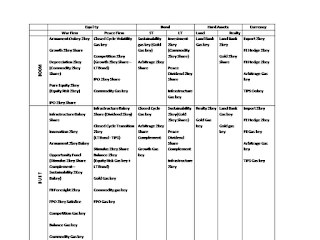
2key: Up to 95%; Share: 40-60%; Complement: 10-40%; Bakey: Residual, Gas key: 0-10% of ‘normal’ returns in asset class.
Now, the traders in the pit, the UPennFund managers on Wall Street,and Chicago Macro-economists pursuing their profession in the rarefied spaces of sky-high towers,alike,were in a tizzy as to how the system would adapt to the various stages of the macro-economic cycle. Once again, they approached the Messiah seeking his distilled essence. The Messiah obliged them, yet again. For each industry group, he used the pre-market session to obtain an estimate of the gross outstanding externality. He instructed the firms take sides – either ‘Peace’ or ‘War’ firms as appropriate to each. He then categorized investible funds in to ‘functional groups’: Growth, Risk Equity, Competition, Sustainable Development, Investment, Innovation, IPO, FPO– to name a few. Finally, lo and behold, the Messiah cranked up his ‘Mensa Economy'.
Boom time it was. Commodity prices spiralled up as the economy hummed and short-term interest rates firmed up. Equity prices, in particular those of ‘War’ and ‘Peace’ EO shares, gained traction. Shareholders in ‘War’ firms were beneficiaries of equity returns that were in consonance with the risk they had borne (Equity Risk 2Key). These firms also reaped rewards from a Commodity 2key Share - a return that supported Capital Retirement if in a Zero-sum with an Investment 2key in Long bonds.Peace firms, however, could only lay claim to a lesser return, a Growth 2key net of any inflation-induced bond impacts (a ‘paired fund’ return maximized by competition, hence Competition 2key). Both ‘War’ and ‘Peace’ firms shared in (own sector) IPO 2key in this phase of the economic cycle.
In the bond market, the Blue Optimism Fund exploited the low bond prices during the equity boom to buyback or exit SD-bonds while converting them to SB status by bidding away SD-tickets available at a discount from the equity market. The buyback enabled the Blue Optimism Fund to prematurely retire bonds, and facilitated the sponsoring of an IPO in the Equity market.
As the Economy peaked and entered the Bust cycle, shareholders in War firms enjoyed the Innovation 2key – a fund meant to support frontier, leading edge research. Both War and Peace firms enjoyed the Bakey returns of an Infrastructure investment fund whose primary gains went to LT Bonds. War firms were also favoured by an FII (Foresight) 2key, meant to pick winners for the early bird investor, andthe FPO 2key Satisfice, a strategic, thinly-disguised Monopoly fund, meant to expand market share by luring investors when most susceptible. These firms also benefited from a ‘paired Opportunity fund’ – a Stimulus 2key net of a Sustainability Bakey. Consistent with the Government’s view, the Opportunity fund ensured any gainaccruing to unsustainable War firms during the Bust period was ephemeral.
The story with ‘Peace Firms’ in Bust was quite different. Having accepted the vision of a sustainable industry, promoters and shareholders relied, on one hand,on the Infrastructure Bakey and a paired ‘Closed-cycle Transition 2key–TIPS’ fund, and on the other, on a paired ‘Balance2key’for equity gains. The Closed Cycle Transition ‘2key’ was essentially long bond returns net of inflation, a 2key maximized by a peaceful and cost-cutting, ‘Full Cost’ competitive economy. The Balance 2key, sourced from Equity Risk remnants (Gas key) and rising Long Bond returns, contributed to returns in this cycle, as did an Infrastructure Bakey camouflaged as Dividend 2key. In Bust, Long bonds attracted an Infrastructure 2key, a Sustainability 2key supported by excess Gold returns (Gold 2key), an Arbitrage 2key from equity and currency markets, and nominally, some Closed Cycle funds to enable aspiring firms to weather the ‘winter’. The Capital Protection Fund, CPF, (a Gold Gas key and a Commodity Gas key) preserved gains from Gold and Commodity markets among Peace firms while sowing the seed for a future 2key return. The Green Caution Fund exercised its option to bid up SD-tickets with the proceeds of its redemption from Long bonds from Peace firms even while investing in them on the equity side of the market.
In the ‘Hard Assets’ category – Land and Realty, the Messiahtrudged the simpler path.A Realty 2key supported Land prices during Bust period, while a Land Bank 2key and a Gold 2key Complement underwrote gains in Realty prices during Boom. A Land Bank gas key supported land assets in Boom, and realty assets in Bust. A Gold gas key added to Volatility in the Realty assets during Bust.
And as far as Currency markets were concerned, the Boom period was characterized by 2keys from Exports, Foreign Exchange Hedge, and FII Hedge pots. In the Bust cycle, currency markets moved with an Import 2key, and Foreign Exchange Hedge key, supplemented by FII gas key and Export gas key. A TIPS fund was distributed in 2key and gas key between the Boom and Bust cycles, albeit with a sting in the tail.
Having discussed threadbare the ideal operation of the stock market, the Messiah, sought to reinforce its utility by mentally simulating a policy goal to eliminate or minimize the Armament industry.He firmly believed that an industry as ‘bad’ and one as close to the government and its secrets as the Armament industry, would survive and proliferate, even if it meant the destruction of nations and their economies. The Messiah’s dilemma was how he would put an end to the scourge that robbed the global citizen of bread on his plate and returns in the market? How would he wind up an industry that had a long record of engendering technical innovations that bolstered the productivity and efficiency of industrially advanced nations, created business opportunities and sustained jobs – the very measures by which the Government and politicians were judged by the electorate? Could he not just give the industry the Christmas week and bull-doze the factories for bread lines come January 1? If the Messiah was no simpleton with child-like innocence camouflaging ignorance, thanks were in order to the Big Lord!
But seriously, the Messiah was aware, that behind the various wars and factional strife, was a coterie of advanced nations and industry barons heavily invested in mining and basic metal firms, in technology supporting those industries, as well as in commodity markets transacting the outputs of those industries. Fact of matter, the Messiah was so wise that he had a downright ‘unholy’suspicion: Could it be that the stakeholders and investors in those industries were forced to resort even to war to recover their investments that had been eroded by the umpteen stock market speculator-day traders? Perhaps Governments that had promised a 100% ‘Total return’ in the capital market to Hard Rock Mining and Basic Metal Industry, HRMBM firms, were obliged to consider novel ways - war and ‘peace-missions’ - to keep them, even if it meant the world was a last few steps away from a WW-III Armageddon?
Fearing the worst, the Messiah came up with a two-pronged ‘Carrot and Stick’ strategy. He decided he would, on one hand, offer the HRMBM industry a reasonable return for the risks they endured by sponsoring a ‘Stimulus 2key’ that stimulated economic demand and raised the standard of living of his followers, and on the other, simultaneously offer the armament industry an incentive to ‘downsize’, an opportunity to innovate in to a ‘non-military’ firm, and an opportunity to generate a ‘peace’ return on its investment while refraining from weapon production. To keep incentives straight, the Messiah exploited differences in intentions and outcomes between the two industries to promote a third party, Agriculture.
To facilitate the realization of the policy goal, the Messiah paired the Armament industry with the HRMBM industry, pitted them against ‘Peace Hawks’ (International Organizations) and Agriculture interests in the Bond market, and initiated equity trading in a ‘bifurcated’ stock market. In the boom-time economy, a Promoter of the Armament ‘War’ firm holding EO shares sought 2keys to realize capital gains, but was denied the same from lack of EI status. Unable to realize capital appreciation, his options were either to lobby and induce foreign policy mis-steps that enabled him to secure armament orders and exploit the Armament 2key, or fold in and submit his shares to the EO-EI conversion program. Sanity and good-will prevailed, and the Armament industry weighed its Externality Quotient in the pre-market session with intention to convert all EO shares to EI status, if eventually. As if walking a balance beam, the promoter sought to optimize, on one hand, the harvesting of 2key returns by releasing as many EO shares to the market as possible without compromising on share price, and on the other, minimize the loss of capital appreciation in the EI side of the Equity market from a delay in offering EO shares to the market. Avoiding the Armament 2key trap, he sold his EO shares to realize a ‘Depreciation2key’ with which to retire Armament production lines. The Buyer was an International Organization that monitored International military relations and managed a Peace Dividend fund. The transaction triggered an ‘SD Complement’ in the ‘Peace zone’ and an SD-ticket in the Bond market. An HRMBM ‘Peace’ firm pounced on the SD Complement and executed a similar trade to realize a ‘Competition 2key’.
Following the equity market transactions, the Bond market announced 2 SD tickets – one each from the Armament firm and the other from the HRMBM firm (both with a floor price supported by the UN/GEF/WWF). The SDs were bid up to different extents by bond market participants. The Armament SD, prized for the large risk to international peace that the industry had caused, was, again, bid away by the Peace Hawk whoapplied ‘Peace Dividend’ funds to buy in to the Bond market (which rose with infusion of the Peace Dividend 2key Share), thus ensuring a presence on both sides of the market. The HRMBM SD, comprised largely of damages to soil and ground water, was of particular interest to NABARD whose mission it was to support agriculture and which had issued agricultural bonds. It bid up the ‘exernality sin’ manifest in the SD tickets and won the right to retire the bonds prematurely when it had ‘redeemed’ sufficient number of SD tickets representing EO shares of value equal outstanding bonds in the market. The NABARD used the proceeds of the prematurely retired bonds to buy in to Land for agricultural use, thus offering a Land 2key to those invested in the asset.
In the Bust cycle, the Armament War firm had many takers for its EO shares. Shareholders had a choice between a Stimulus 2key, Innovation Funds, and Opportunity funds when offloading shares in the market. The Stimulus 2key supported Armament firms to the extent their output served non-military purposes. The Innovation 2key supported strategic research, albeit not necessarily peaceful or ‘Closed cycle’. Thus, the International Organization found it to its advantage to support the Armament firm with an Innovation 2key, and, simultaneously, buy out the SD ticket to consolidate in or exit the Bond Market. The Messiah also offered an Armament 2key, itself a Zero Sum with the Peace Dividend 2key, but only in Bakey, and only to holders of the Armament firm’s EI shares. The strategy restricted capital appreciation and ‘alpha’ to those Armament firms that had substantially converted their share base over to EI status and those that abjured the War route to profits.
The unconverted HRMBM Peace Firm EO shares, besides attracting Stimulus funds, found buyers in Closed Cycle proponents and Balance funds – the former seeking profits from lower cost consequent to enhancing the efficiency of material balances in the firm’s production process, and the latter seeking to profit from correcting the inefficient use of mining and refining capacity for production and stockpiling of arms.
In subsequent cycles, a dominant shareholder in the Armament industry, perhaps a Promoter, secured both the Armament 2key bakey for refraining from Armament production and stockpiling, and a Capital Depreciation/Retirement 2key for his ‘War EO’ shares (The Depreciation 2key was a Zero-Sum with an Investment 2key, both of which were sourced from returns generated in the Commodity market). The Capital Depreciation/Retirement2key was secured from a Peace Dividend Bond foreclosed by bidding away Armament SD-tickets in the bond market (which enabled the Promoter to claim EI status for his shares, a pre-requisite to de-commission an Armament production line or factory). The de-commissioning of Armament factory and/or the reduction in armament stockpile reduced the risk of war, which was an important factor in determining long bond prices. The consequent increase in bond prices was a reward to the Institution sponsoring the Peace Dividend Fund. The churning of the Armament EO to EI shares, induced a similar churn in the HRMBM shares, purchasing the SD-tickets from which enabled NABARD to retire its Agriculture bonds and channel them to purchase land for agricultural use – perhaps a harbinger of a nascent green revolution.
Armament factories outta business, sustained profits for metal and mining industry, a resurgent agriculture sector, an environmentally sustainable industry, and a financially-closed capital market? One would be excused for congratulating the Messiah for showing the path to sustainability, if not salvation. But the Messiah cared not to learn if his followers were ingrates. For, as he trudged his lonely path to the setting sun, he was wise to the nefarious, grand designs of those un-named bent on exploiting the opportunities and loopholes in his proposal and get the better of God in his own paradise (even if it meant a parallel, underground stock market and 8-figure signing bonuses for fresh Ivy League graduates !)
Ganga Prasad G. Rao
http://myprofile.cos.com/gangar
….And Alice woke up, all blurry-eyed, not remembering a word of what she had penned while in Wonderland. After staring and blinking a few seconds, she dozed off again in to another dream, this time just as exotic. Yes, something wasvery ‘grotesque’. The entire global financial system was in disarray. Panic ruled the markets.Buffeted between fears of currency crisis, global depression, and sovereign default, the entire financial community was looking for deliverance from their Messiah. But would the Messiah deliver on their pleas?
Call it the Big Lord’s design, Satan’s test of character, or cruel fate, but the Messiah was none other than a half-baked, unemployed albeit worldly-wise Economist, who, oblivious to the utter desperation in the financial community, fancied his hand at putting the world in order, and blog his resolution to the travails of the global markets. And, pray, what was his message? The Messiah accepted the fallacies of the past world, but stood resolute in his vision of the future - a world in which the sins, omissions and commissions of the industry were addressed in an overt, balanced, flexible and comprehensiveway. Rather than focus on any one externality to the exclusion of other significant externalities, the Messiah proposedclubbing them together in to an aggregate measure of firm-level externality. Firms as diverse as power plants burning brown coal, armaments industry overstocking mines, missiles and grenades to sustain employment, mining, refining and shipping, and the pesticide industries preferring environment-damaging inorganic pesticides to safer organic alternatives, could pay off their residual, un-mitigated externality, whether associated with inputs, outputs, transportation, consumption or disposal, in the capital market.
The Messiah’s disciple wondered what theory, principles, or tenets underlay the claim to measure aggregate non-pecuniary externality, and how he would go about extracting it. Perhaps it was telepathy, perhaps the Messiah was in the mood to sermonize; regardless, he chose to reveal his logic. Short of claiming the Garden of Eden as his vision of Sustainability, the Messiah advised that no matter how wrong the world was in the present, it should turn sustainable at some future point in time. And if the roots of the current unsustainability could be traced to the industry, the seeds of sustainability too lay in reforming the industry. Since the equity markets typically operated with limited foresight, the burden of sustainability fell upon the bond market. It was by issuing long bonds to correct wrongs of the past that the Government turned the future sustainable (and financed its budget in the present). Greater the wrong, the more long bonds issued to fund remedial action across years, even decades (Fukushima?, Why does it ring a bell?). Thus, the quantumof, and price variations in the long term bond market gave an indication of the extent of the ‘externality’ outstanding. The Messiah simply ensured a balance between theexternality damages by the industry and the value of outstanding long bonds. It was by perturbing the balance while simulating a firm as a monopoly that he comprehensively gauged the magnitude of its externalities. These externalities were distributed among shares and traded away in a ‘paired-complement’ strategy by creating two externality-differentiated share and bond classes.
Despite his misgivings of correcting externalities by monetary means in an inequitable world (which pre-supposed, among other things, an efficient capital market, in particular a comprehensive Sustainability Index feeding in to Long Bond pricing formula), the Messiah went about his mission methodically. He firstcreated some terminology: an economy was comprised of ‘War Firms’ and ‘Peace Firms’. Firms that truly believed in sustainable production and manufacturing, regardless of how polluting or non-polluting their process was, were assigned the ‘Peace’ label. Hawkish firms that would rather generate excess, short-term profits than go the extra mile for sustainability were deemed ‘War’ firms. To denote the extent of potential gains in various market sections, he coined ‘ungodly’ phrases: ‘2key’, signifying large and immediate, if not ‘excess returns’ (the all too familiar ‘alpha’) as appropriate to the asset class, and ‘gas key’, denoting nominal returns, if at all. In between these extremes, he recognized ‘Bakey’ (residual), ‘Complements’ and ‘Shares’ (and an ‘Ookey’ was short for ‘You should know better’!). These constituted the various fractions of every pot of money no matter which asset class – whether equity, commodity, bond, gold, or realty. The 2key portion rewarded firms for meeting objective measures of achievement; the ‘Gas key’ was essentially a ‘Capital Protection Fund’ that provided funds to alleviate ‘performance deficiencies’in stock market firms if by merely adding volatility to those market sections. (It protected the sponsors’ capital while leveraging the short-term gains of speculators to cause volatility in the equity market). Consistent with the theme of his mission, the Messiah distinguished between ‘Externality Outstanding’, EO equity shares and ‘Externality Internalized’, EI shares.
In the next step, he conceptualized an ‘Externality Quotient’, EQ, acomprehensive externality measure representing the discounted inter-temporal monetary negative,non-pecuniary externalities as normalized by the outstanding equity base of the firm or industry. A pre-market session was designed to elicit the EQ, first for the benchmark ‘EI Equal Frontrunner’ firm (a technological and environmental leader), and then for other firms in the industry/sub-aggregate. After noting the initial ‘equilibrium’ equity and bond prices, the ‘Frontrunner Benchmark’, the Messiah ordered the simulation of each firm by projecting it as a monopoly firm operating at competitive aggregate industry price and output against a designated bundle of long-term bonds of value equal the aggregate equity base of the sector to which the firm belonged. The simulation induced a change in Sustainability indices to the extent the firm’s externalities differed from the Frontrunner Benchmark.The change in the price of the long bond bundle, post simulation, from its benchmark value due changes in the underlying environmental and sustainability indices of the long-bond pricing formula were noted. The projected Gross EQ of the monopoly was simply the change in the value of bonds relative to the ‘Frontrunner Firm’ benchmark. To obtain the net firm EQ, the Gross EQ was re-computed and re-denominated to reflect the firm’s capacity/equity share in the aggregate. That externality estimate was distributed across the utility’s base of equity shares as ‘Sustainability Deficit’, SD. Each SD-tagged equity share now represented a share in the assets and profit stream of the firm, as well as a share in the uncompensated, non-pecuniary externality liability it generated across space and time.
To ensure changes in price of long ‘SD’ bonds indeed measured an externality impact in the pre-open session, the Messiah insisted that a ‘Sustainability Index’, a Divisia index of underlying indicators, factor into LT Bond prices the impact of firm operation on EHS measures in the short, medium and long run. The indicators were chosen to represent various potential and significant damage classes. The sustainability indicators included factors as diverse as air, water and land pollution measures, as well as population, health and social indicators such as maternal and infant mortality, longevity, even violence and terrorism. These measures and indicators were themselves the outputs of underlying scientific, socio-economic and statistical models – measures that had real societal values attached to them but were not priced in to the products and equity shares. The Divisia module, equivalent to a reduced form of an externality costing model, indicated the change in long bond prices for various values of underlying determinants.
The SD-tagged ‘Externality-Outstanding’ (EO) equity share‘entitled’ the firm to generate a certain amount of externality in the course of its business. Every EO-EI share transaction in the equity market released an SD to the bond market where it was bid up or down and priced in to a longbond transaction, again of the same value as the equity transaction. Only upon the cancellation of the Equity SD-ticket in the bond market was an EO equity share converted to ‘Externality-Internalised’ EI share. The Messiah requiredevery ‘EO-EI-SD-ticket’ transaction in the ‘War Zone’ be matched by a ‘Sustainability Complement’ transaction involving a ‘Peace firm’. Thus, 2 SD-tickets were generated simultaneously from the equity market and transferred to the bond market for price-discovery and to sanctify the conversion of Long SD Bonds to SB status.
Anticipating the impracticability of every firm negotiating the bidding of its SD-ticket in the bond market, a recognized haven of the Greens, the Messiah willed a ‘Blue Optimism’ fund and ‘Green Caution fund’. The two funds took opposing positions in the Bond market and competed with other interests in the race to garner as many SD-tickets as possible. The winner - the side which converted all its outstanding SD bonds to SB and prematurely retired the bonds - qualified for a Closed-Cycle IPO 2key; the loser sponsored a ‘De-listing Bakey’. Between them, the bond funds brought about a slow replacement of ‘low dividend yield’ funds with new Closed-cycle ‘growth’ funds that enlivened the market with Growth 2key.
To hasten the transition to an ‘Externality-Internalized’ industry, the Messiah suggested a ‘virtual bifurcation’ of the stock market between the two share classes- EO and EI, the intent being to restrict certain funds and money pots to appropriate share classes.Lest there be a stampede overnight, only the ‘strictly 2key’ money pots – Growth, Opportunity, and Foresight 2keys - were restricted to the EI-section of the market, while the EO section was satisficed with Bakey, Shares, Complements and Gas keys. The Messiah’s ‘bifurcation’ induced promoters and shareholders to churn their shares from EO to EI earlier than they would otherwise, and brought about an early and comprehensive internalization of externalities. This churning of EO shares in to EI shares continued until the entire equity share base turned ‘EI’, and all bonds ‘SB’. At this point, the Messiah deemed the stock market to have ‘soft-landed’ and hailed the birth of an operating, albeit rudimentary, financially closed-cycle economy.

2key: Up to 95%; Share: 40-60%; Complement: 10-40%; Bakey: Residual, Gas key: 0-10% of ‘normal’ returns in asset class.
Now, the traders in the pit, the UPennFund managers on Wall Street,and Chicago Macro-economists pursuing their profession in the rarefied spaces of sky-high towers,alike,were in a tizzy as to how the system would adapt to the various stages of the macro-economic cycle. Once again, they approached the Messiah seeking his distilled essence. The Messiah obliged them, yet again. For each industry group, he used the pre-market session to obtain an estimate of the gross outstanding externality. He instructed the firms take sides – either ‘Peace’ or ‘War’ firms as appropriate to each. He then categorized investible funds in to ‘functional groups’: Growth, Risk Equity, Competition, Sustainable Development, Investment, Innovation, IPO, FPO– to name a few. Finally, lo and behold, the Messiah cranked up his ‘Mensa Economy'.
Boom time it was. Commodity prices spiralled up as the economy hummed and short-term interest rates firmed up. Equity prices, in particular those of ‘War’ and ‘Peace’ EO shares, gained traction. Shareholders in ‘War’ firms were beneficiaries of equity returns that were in consonance with the risk they had borne (Equity Risk 2Key). These firms also reaped rewards from a Commodity 2key Share - a return that supported Capital Retirement if in a Zero-sum with an Investment 2key in Long bonds.Peace firms, however, could only lay claim to a lesser return, a Growth 2key net of any inflation-induced bond impacts (a ‘paired fund’ return maximized by competition, hence Competition 2key). Both ‘War’ and ‘Peace’ firms shared in (own sector) IPO 2key in this phase of the economic cycle.
In the bond market, the Blue Optimism Fund exploited the low bond prices during the equity boom to buyback or exit SD-bonds while converting them to SB status by bidding away SD-tickets available at a discount from the equity market. The buyback enabled the Blue Optimism Fund to prematurely retire bonds, and facilitated the sponsoring of an IPO in the Equity market.
As the Economy peaked and entered the Bust cycle, shareholders in War firms enjoyed the Innovation 2key – a fund meant to support frontier, leading edge research. Both War and Peace firms enjoyed the Bakey returns of an Infrastructure investment fund whose primary gains went to LT Bonds. War firms were also favoured by an FII (Foresight) 2key, meant to pick winners for the early bird investor, andthe FPO 2key Satisfice, a strategic, thinly-disguised Monopoly fund, meant to expand market share by luring investors when most susceptible. These firms also benefited from a ‘paired Opportunity fund’ – a Stimulus 2key net of a Sustainability Bakey. Consistent with the Government’s view, the Opportunity fund ensured any gainaccruing to unsustainable War firms during the Bust period was ephemeral.
The story with ‘Peace Firms’ in Bust was quite different. Having accepted the vision of a sustainable industry, promoters and shareholders relied, on one hand,on the Infrastructure Bakey and a paired ‘Closed-cycle Transition 2key–TIPS’ fund, and on the other, on a paired ‘Balance2key’for equity gains. The Closed Cycle Transition ‘2key’ was essentially long bond returns net of inflation, a 2key maximized by a peaceful and cost-cutting, ‘Full Cost’ competitive economy. The Balance 2key, sourced from Equity Risk remnants (Gas key) and rising Long Bond returns, contributed to returns in this cycle, as did an Infrastructure Bakey camouflaged as Dividend 2key. In Bust, Long bonds attracted an Infrastructure 2key, a Sustainability 2key supported by excess Gold returns (Gold 2key), an Arbitrage 2key from equity and currency markets, and nominally, some Closed Cycle funds to enable aspiring firms to weather the ‘winter’. The Capital Protection Fund, CPF, (a Gold Gas key and a Commodity Gas key) preserved gains from Gold and Commodity markets among Peace firms while sowing the seed for a future 2key return. The Green Caution Fund exercised its option to bid up SD-tickets with the proceeds of its redemption from Long bonds from Peace firms even while investing in them on the equity side of the market.
In the ‘Hard Assets’ category – Land and Realty, the Messiahtrudged the simpler path.A Realty 2key supported Land prices during Bust period, while a Land Bank 2key and a Gold 2key Complement underwrote gains in Realty prices during Boom. A Land Bank gas key supported land assets in Boom, and realty assets in Bust. A Gold gas key added to Volatility in the Realty assets during Bust.
And as far as Currency markets were concerned, the Boom period was characterized by 2keys from Exports, Foreign Exchange Hedge, and FII Hedge pots. In the Bust cycle, currency markets moved with an Import 2key, and Foreign Exchange Hedge key, supplemented by FII gas key and Export gas key. A TIPS fund was distributed in 2key and gas key between the Boom and Bust cycles, albeit with a sting in the tail.
Having discussed threadbare the ideal operation of the stock market, the Messiah, sought to reinforce its utility by mentally simulating a policy goal to eliminate or minimize the Armament industry.He firmly believed that an industry as ‘bad’ and one as close to the government and its secrets as the Armament industry, would survive and proliferate, even if it meant the destruction of nations and their economies. The Messiah’s dilemma was how he would put an end to the scourge that robbed the global citizen of bread on his plate and returns in the market? How would he wind up an industry that had a long record of engendering technical innovations that bolstered the productivity and efficiency of industrially advanced nations, created business opportunities and sustained jobs – the very measures by which the Government and politicians were judged by the electorate? Could he not just give the industry the Christmas week and bull-doze the factories for bread lines come January 1? If the Messiah was no simpleton with child-like innocence camouflaging ignorance, thanks were in order to the Big Lord!
But seriously, the Messiah was aware, that behind the various wars and factional strife, was a coterie of advanced nations and industry barons heavily invested in mining and basic metal firms, in technology supporting those industries, as well as in commodity markets transacting the outputs of those industries. Fact of matter, the Messiah was so wise that he had a downright ‘unholy’suspicion: Could it be that the stakeholders and investors in those industries were forced to resort even to war to recover their investments that had been eroded by the umpteen stock market speculator-day traders? Perhaps Governments that had promised a 100% ‘Total return’ in the capital market to Hard Rock Mining and Basic Metal Industry, HRMBM firms, were obliged to consider novel ways - war and ‘peace-missions’ - to keep them, even if it meant the world was a last few steps away from a WW-III Armageddon?
Fearing the worst, the Messiah came up with a two-pronged ‘Carrot and Stick’ strategy. He decided he would, on one hand, offer the HRMBM industry a reasonable return for the risks they endured by sponsoring a ‘Stimulus 2key’ that stimulated economic demand and raised the standard of living of his followers, and on the other, simultaneously offer the armament industry an incentive to ‘downsize’, an opportunity to innovate in to a ‘non-military’ firm, and an opportunity to generate a ‘peace’ return on its investment while refraining from weapon production. To keep incentives straight, the Messiah exploited differences in intentions and outcomes between the two industries to promote a third party, Agriculture.
To facilitate the realization of the policy goal, the Messiah paired the Armament industry with the HRMBM industry, pitted them against ‘Peace Hawks’ (International Organizations) and Agriculture interests in the Bond market, and initiated equity trading in a ‘bifurcated’ stock market. In the boom-time economy, a Promoter of the Armament ‘War’ firm holding EO shares sought 2keys to realize capital gains, but was denied the same from lack of EI status. Unable to realize capital appreciation, his options were either to lobby and induce foreign policy mis-steps that enabled him to secure armament orders and exploit the Armament 2key, or fold in and submit his shares to the EO-EI conversion program. Sanity and good-will prevailed, and the Armament industry weighed its Externality Quotient in the pre-market session with intention to convert all EO shares to EI status, if eventually. As if walking a balance beam, the promoter sought to optimize, on one hand, the harvesting of 2key returns by releasing as many EO shares to the market as possible without compromising on share price, and on the other, minimize the loss of capital appreciation in the EI side of the Equity market from a delay in offering EO shares to the market. Avoiding the Armament 2key trap, he sold his EO shares to realize a ‘Depreciation2key’ with which to retire Armament production lines. The Buyer was an International Organization that monitored International military relations and managed a Peace Dividend fund. The transaction triggered an ‘SD Complement’ in the ‘Peace zone’ and an SD-ticket in the Bond market. An HRMBM ‘Peace’ firm pounced on the SD Complement and executed a similar trade to realize a ‘Competition 2key’.
Following the equity market transactions, the Bond market announced 2 SD tickets – one each from the Armament firm and the other from the HRMBM firm (both with a floor price supported by the UN/GEF/WWF). The SDs were bid up to different extents by bond market participants. The Armament SD, prized for the large risk to international peace that the industry had caused, was, again, bid away by the Peace Hawk whoapplied ‘Peace Dividend’ funds to buy in to the Bond market (which rose with infusion of the Peace Dividend 2key Share), thus ensuring a presence on both sides of the market. The HRMBM SD, comprised largely of damages to soil and ground water, was of particular interest to NABARD whose mission it was to support agriculture and which had issued agricultural bonds. It bid up the ‘exernality sin’ manifest in the SD tickets and won the right to retire the bonds prematurely when it had ‘redeemed’ sufficient number of SD tickets representing EO shares of value equal outstanding bonds in the market. The NABARD used the proceeds of the prematurely retired bonds to buy in to Land for agricultural use, thus offering a Land 2key to those invested in the asset.
In the Bust cycle, the Armament War firm had many takers for its EO shares. Shareholders had a choice between a Stimulus 2key, Innovation Funds, and Opportunity funds when offloading shares in the market. The Stimulus 2key supported Armament firms to the extent their output served non-military purposes. The Innovation 2key supported strategic research, albeit not necessarily peaceful or ‘Closed cycle’. Thus, the International Organization found it to its advantage to support the Armament firm with an Innovation 2key, and, simultaneously, buy out the SD ticket to consolidate in or exit the Bond Market. The Messiah also offered an Armament 2key, itself a Zero Sum with the Peace Dividend 2key, but only in Bakey, and only to holders of the Armament firm’s EI shares. The strategy restricted capital appreciation and ‘alpha’ to those Armament firms that had substantially converted their share base over to EI status and those that abjured the War route to profits.
The unconverted HRMBM Peace Firm EO shares, besides attracting Stimulus funds, found buyers in Closed Cycle proponents and Balance funds – the former seeking profits from lower cost consequent to enhancing the efficiency of material balances in the firm’s production process, and the latter seeking to profit from correcting the inefficient use of mining and refining capacity for production and stockpiling of arms.
In subsequent cycles, a dominant shareholder in the Armament industry, perhaps a Promoter, secured both the Armament 2key bakey for refraining from Armament production and stockpiling, and a Capital Depreciation/Retirement 2key for his ‘War EO’ shares (The Depreciation 2key was a Zero-Sum with an Investment 2key, both of which were sourced from returns generated in the Commodity market). The Capital Depreciation/Retirement2key was secured from a Peace Dividend Bond foreclosed by bidding away Armament SD-tickets in the bond market (which enabled the Promoter to claim EI status for his shares, a pre-requisite to de-commission an Armament production line or factory). The de-commissioning of Armament factory and/or the reduction in armament stockpile reduced the risk of war, which was an important factor in determining long bond prices. The consequent increase in bond prices was a reward to the Institution sponsoring the Peace Dividend Fund. The churning of the Armament EO to EI shares, induced a similar churn in the HRMBM shares, purchasing the SD-tickets from which enabled NABARD to retire its Agriculture bonds and channel them to purchase land for agricultural use – perhaps a harbinger of a nascent green revolution.
Armament factories outta business, sustained profits for metal and mining industry, a resurgent agriculture sector, an environmentally sustainable industry, and a financially-closed capital market? One would be excused for congratulating the Messiah for showing the path to sustainability, if not salvation. But the Messiah cared not to learn if his followers were ingrates. For, as he trudged his lonely path to the setting sun, he was wise to the nefarious, grand designs of those un-named bent on exploiting the opportunities and loopholes in his proposal and get the better of God in his own paradise (even if it meant a parallel, underground stock market and 8-figure signing bonuses for fresh Ivy League graduates !)
Subscribe to:
Posts (Atom)
